

SOLD – Antique Best No. 1 Wenham Binocular Microscope John Benjamin Dancer c1875, Cased
Sold
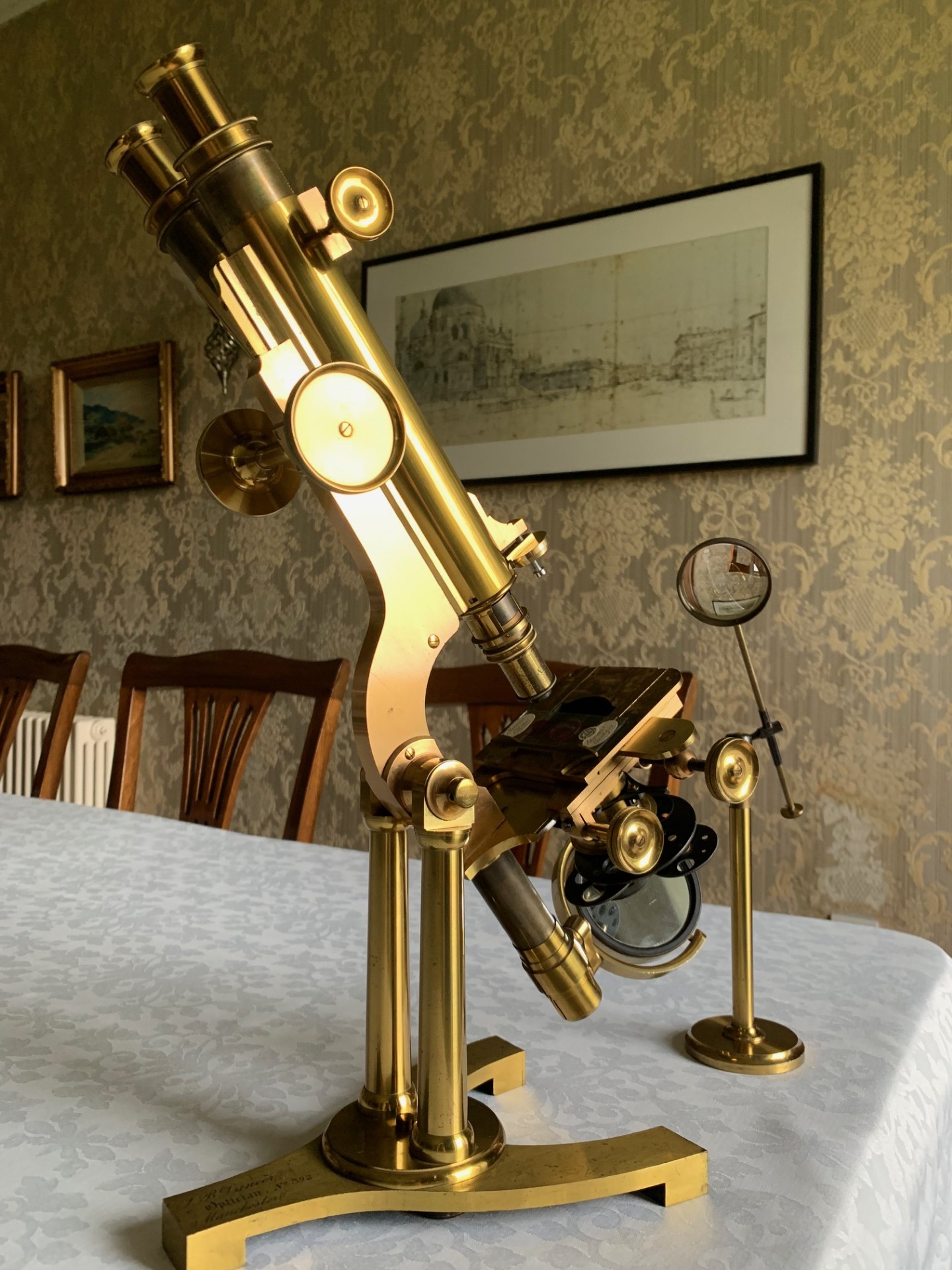
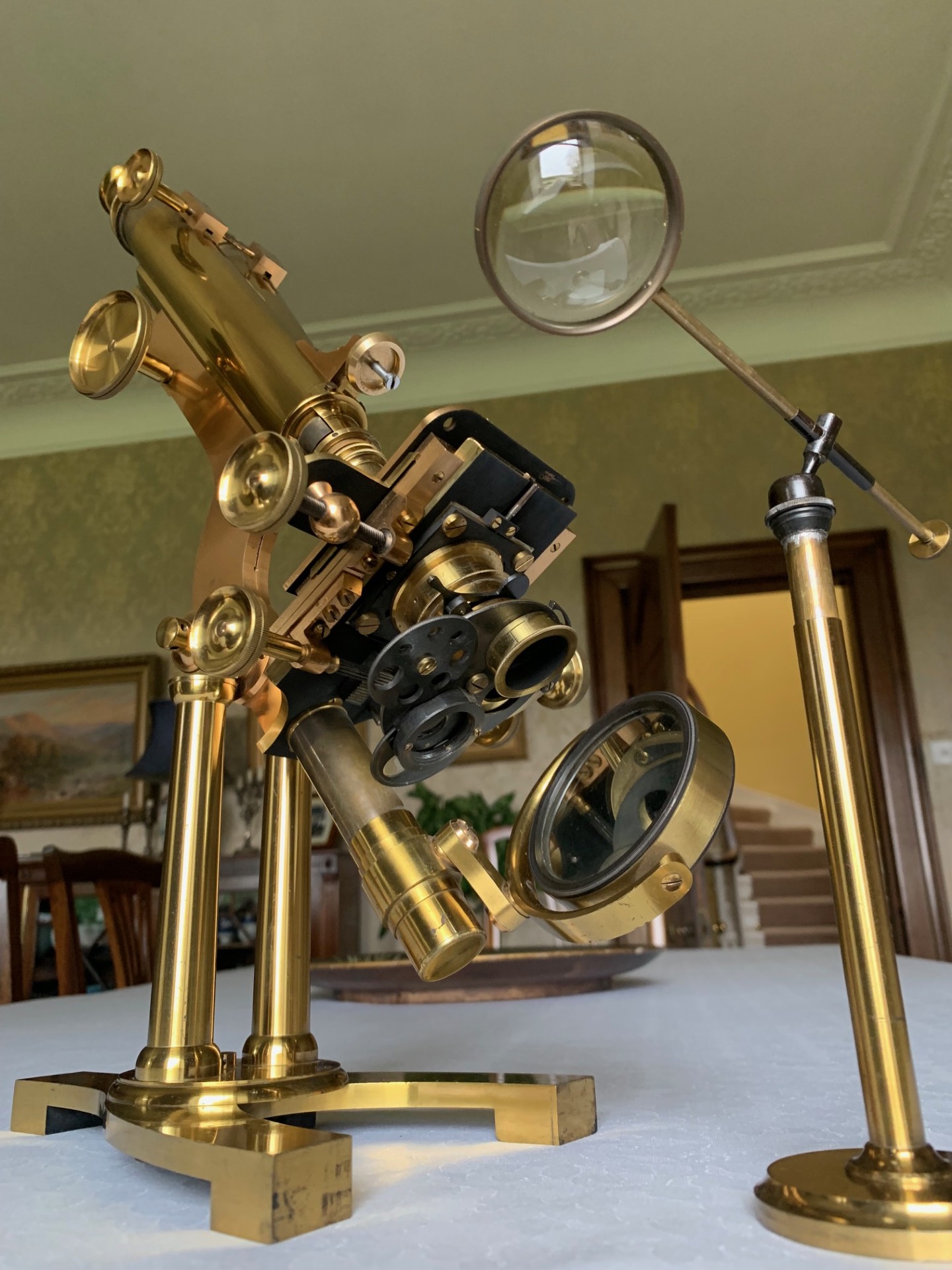
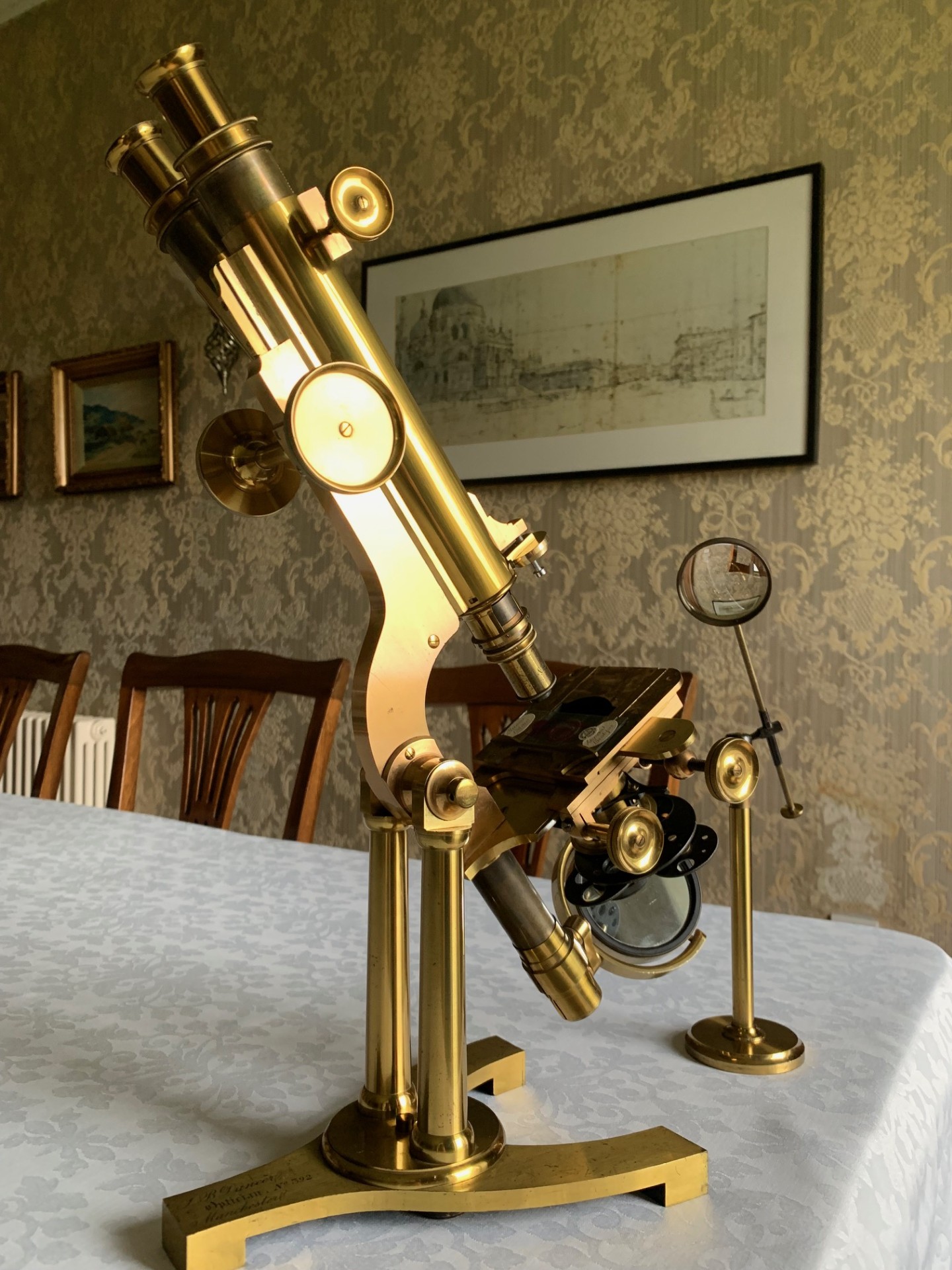
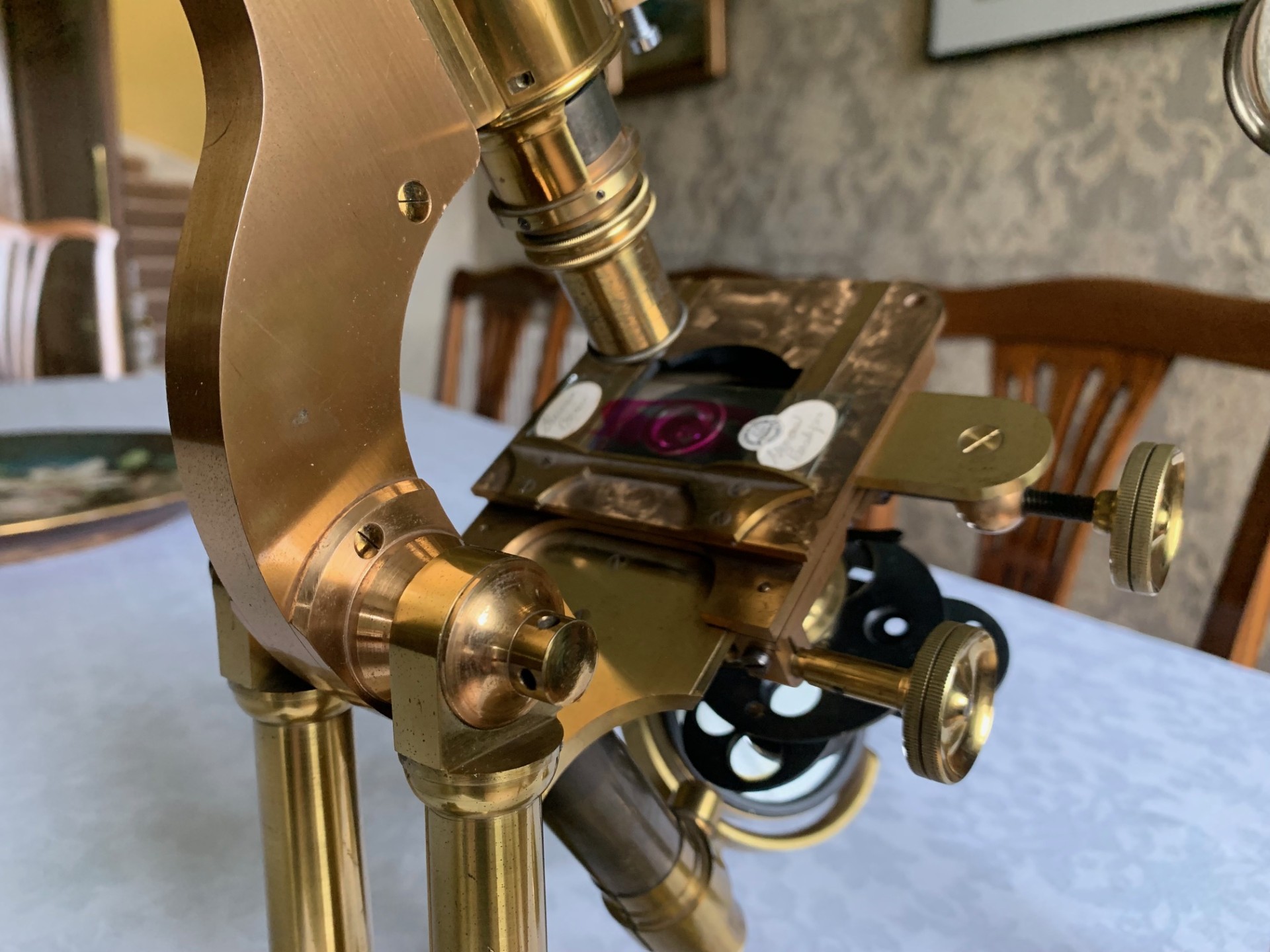
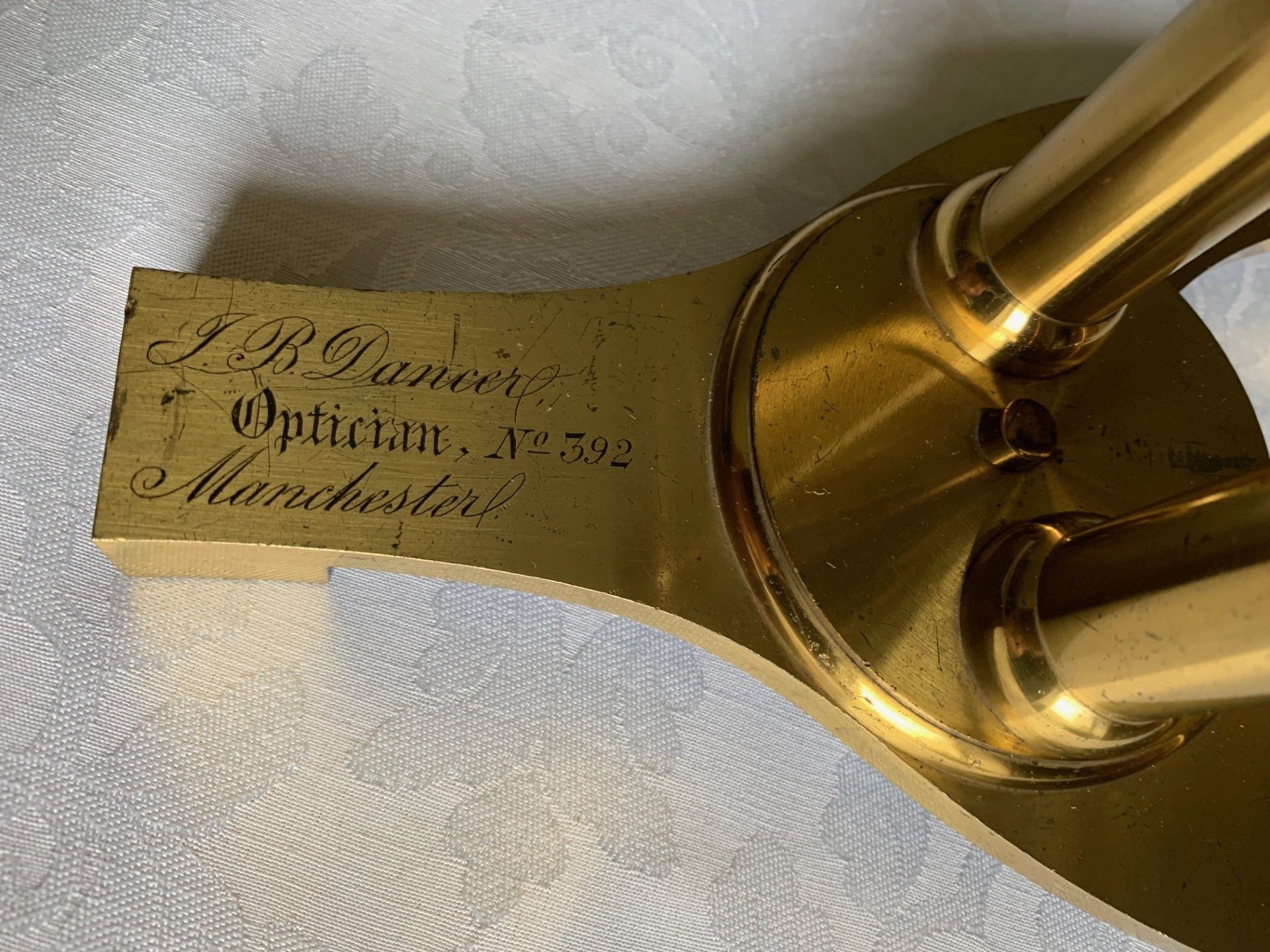
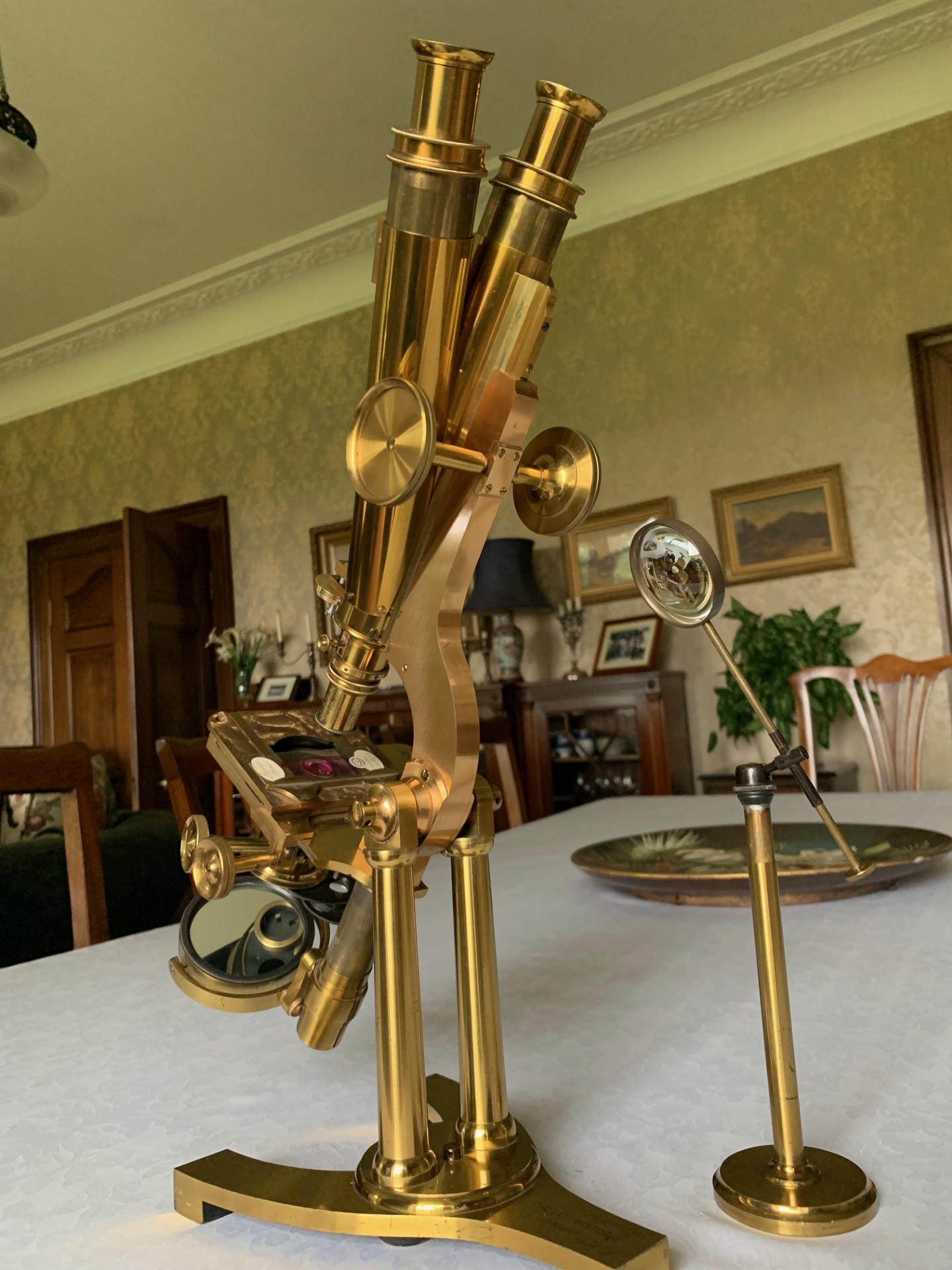
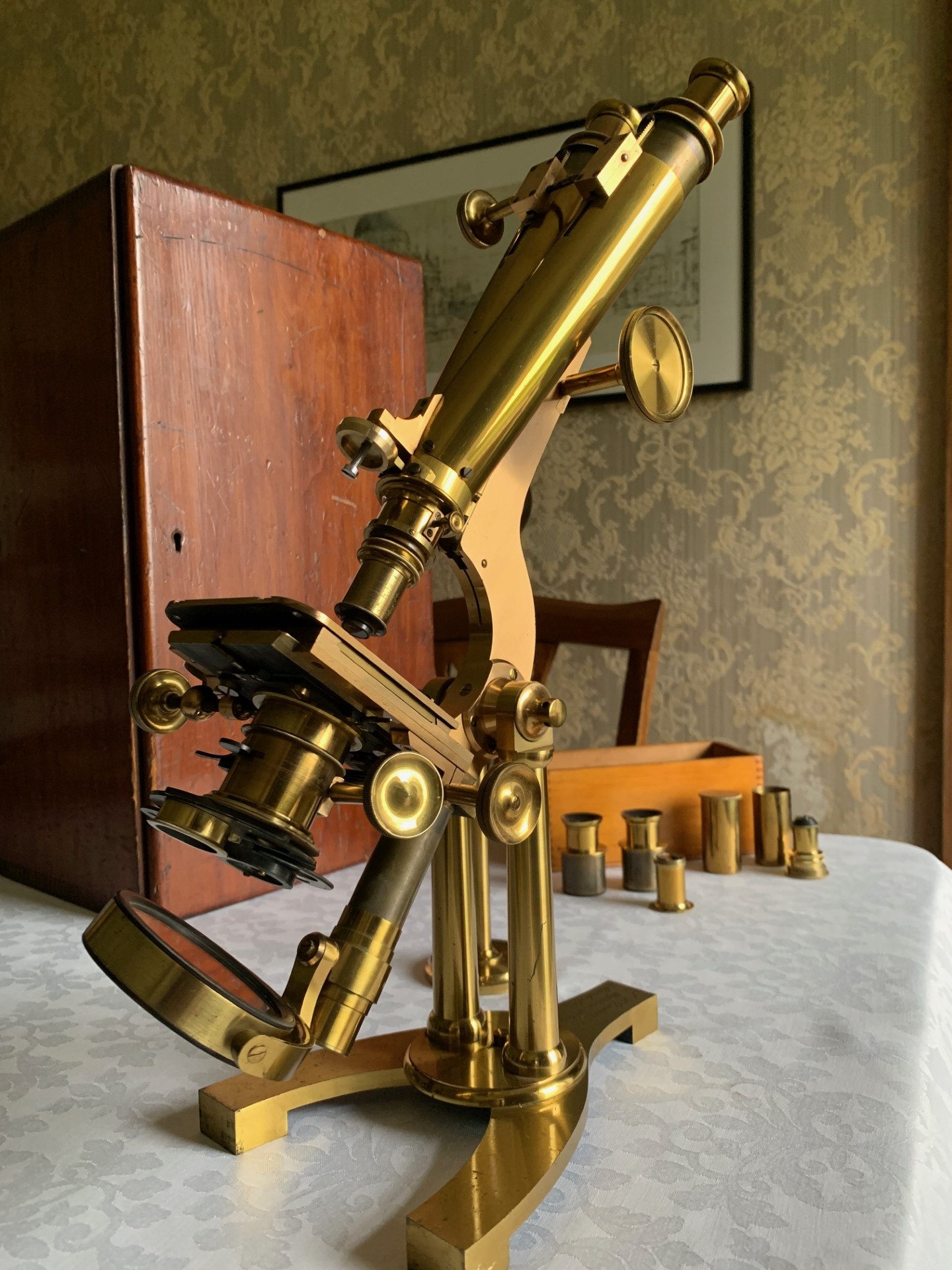
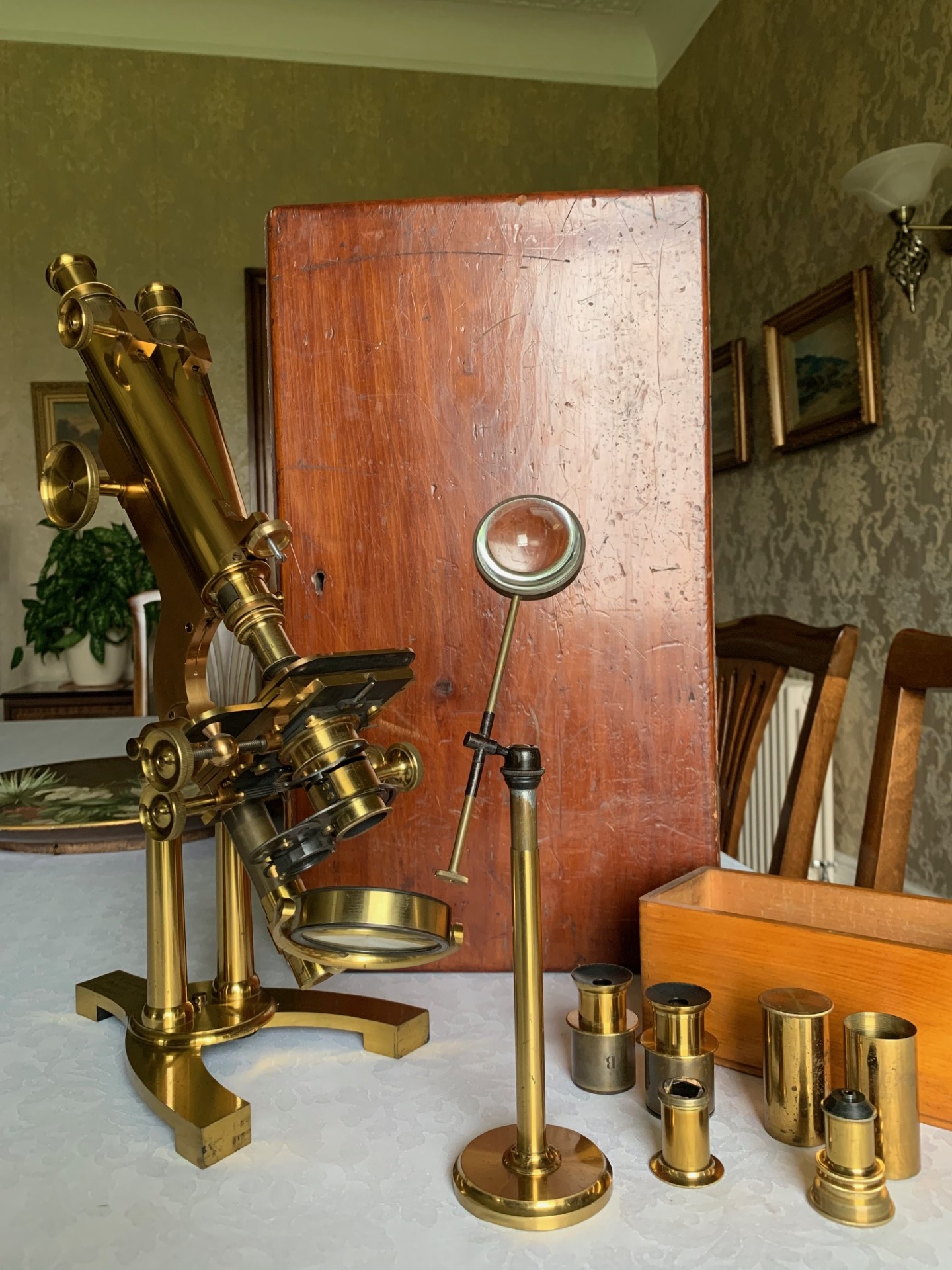
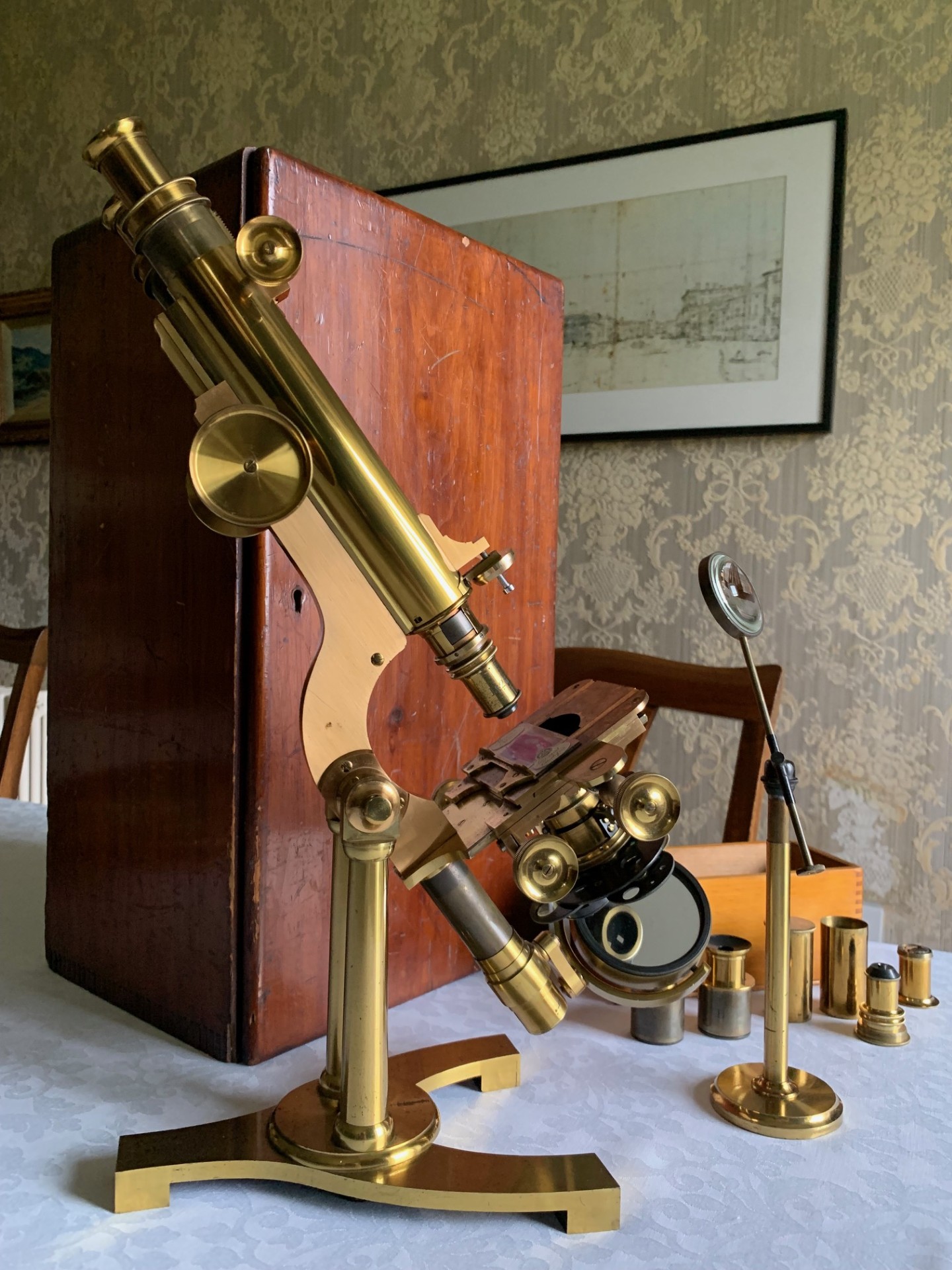
Antique and generally extremely good cosmetic condition Wenham binocular instrument manufactured by scientific instrument makers J. B. Dancer of Manchester and dating to around 1875 with production serial number 392.
Circa
1875
Maker
John Benjamin Dancer, Manchester
Country of manufacture
UK and Ireland
Description
Background to J. B. Dancer (source – Microscope Museum website):
John Benjamin Dancer was a well-known Manchester optician and instrument maker, born in London in 1812, the son of Josiah Dancer, also an optician and manufacturer of optical, philosophical and nautical instruments. Josiah and his family moved from London to Liverpool in 1817. JB Dancer took over his father’s business in 1835 and continued in business in Liverpool until 1841, when he entered into partnership with A. Abraham, a scientific instrument maker of Lord Street, Liverpool. He moved to Manchester to establish a branch of the business as Abraham & Dancer at 13 Cross Street. The partnership ceased in 1845. Dancer continued in business under his own name until 1878, when part of the business was transferred to his daughters Elizabeth Eleanor and Anna Maria (he had to give up his business activities because of ill health and poor vision). The business continued trading under the name of EE Dancer & Co. until 1900, when the entire stock and the process of producing quality microphotographs were sold to the London microscope dealer Richard Suter. Dancer became well known for the quality of his microscopes and received several honours, including a prize medal at the International Exhibition in London. He was appointed Optician in Manchester to the Prince of Wales. Dancer is perhaps best known for his photographic work, in particular on microphotography and the stereoscopic camera. He took the earliest known photograph of Manchester, showing a cutler’s shop at Market Street in 1842.
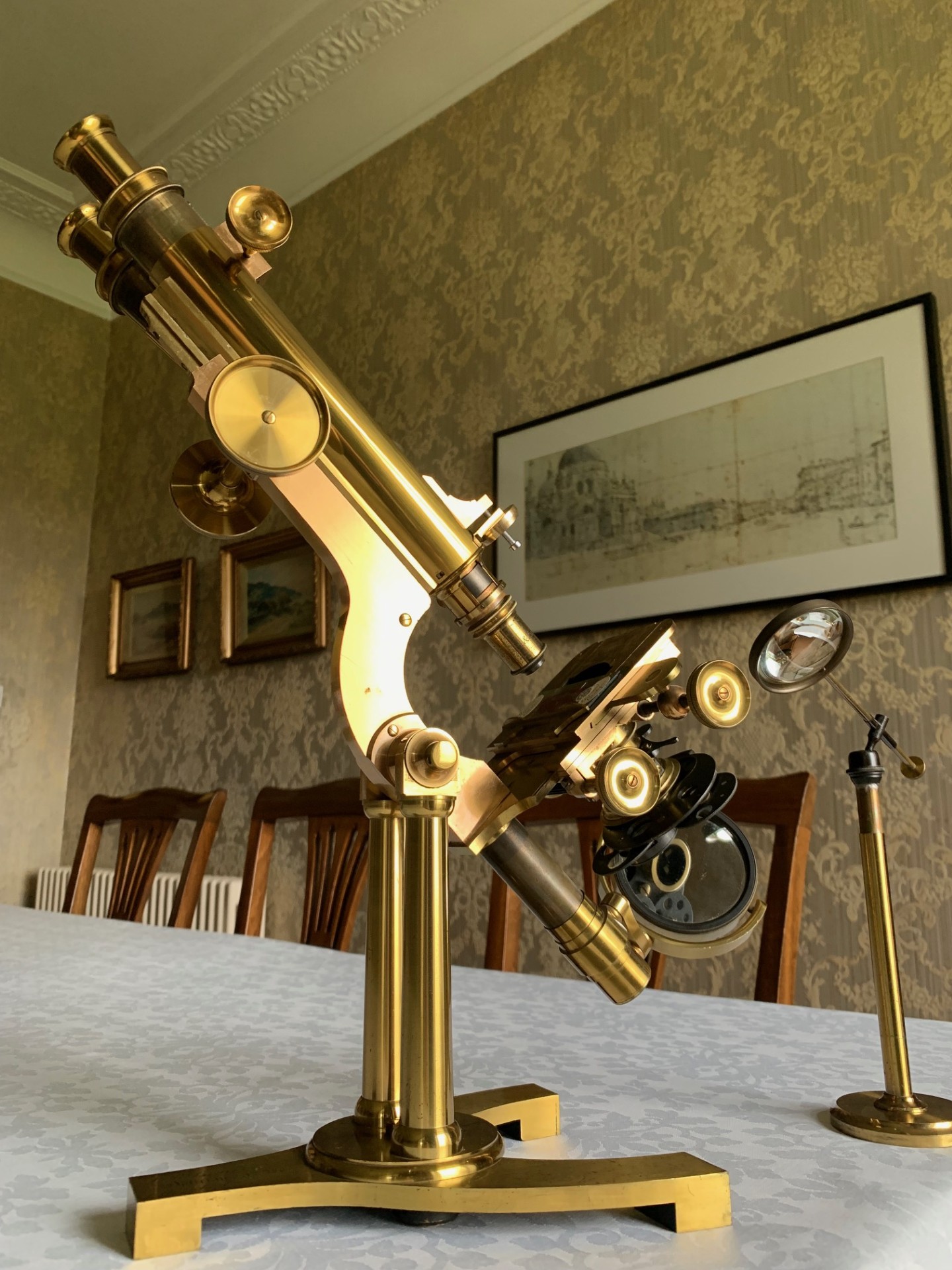
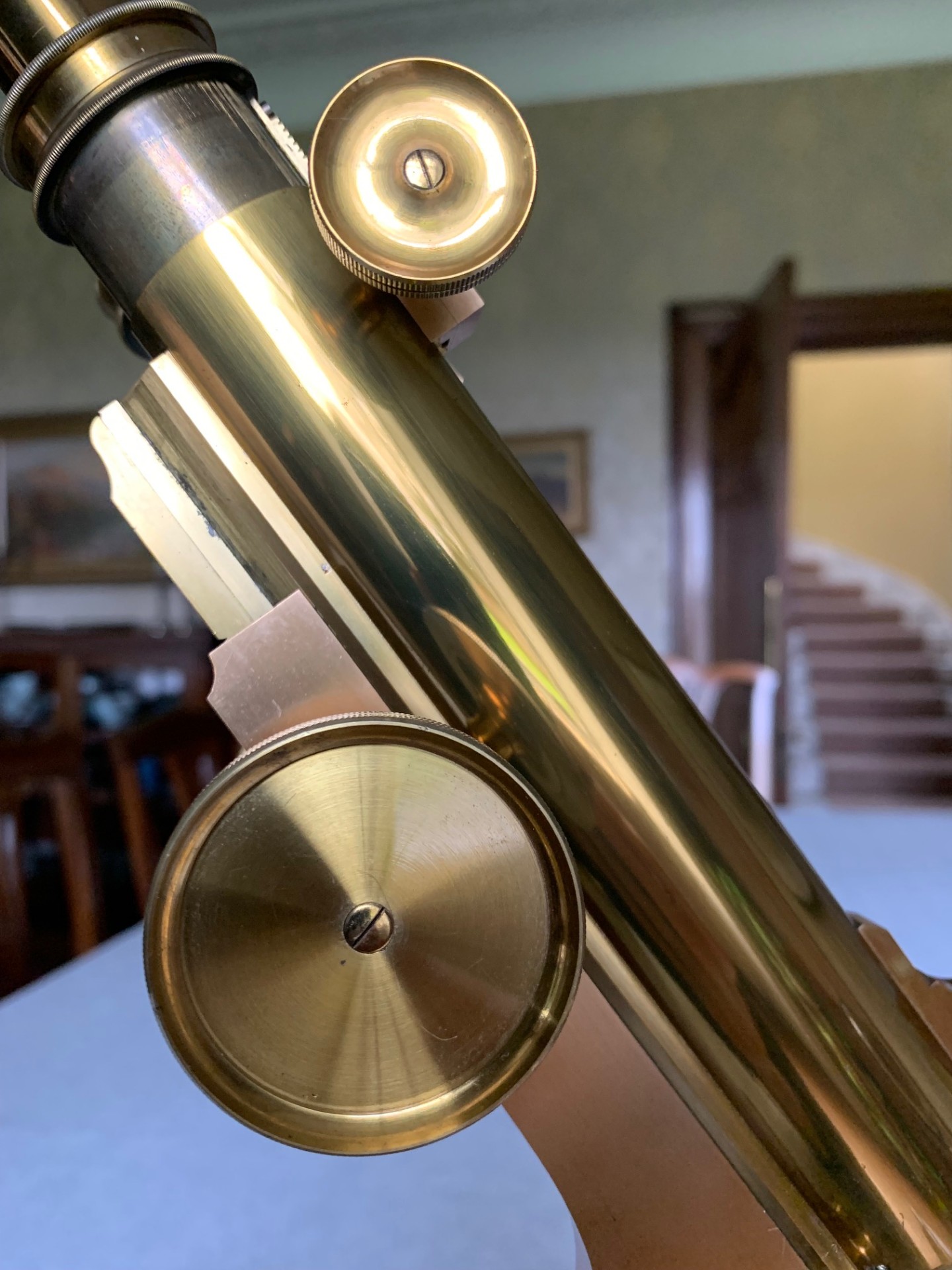
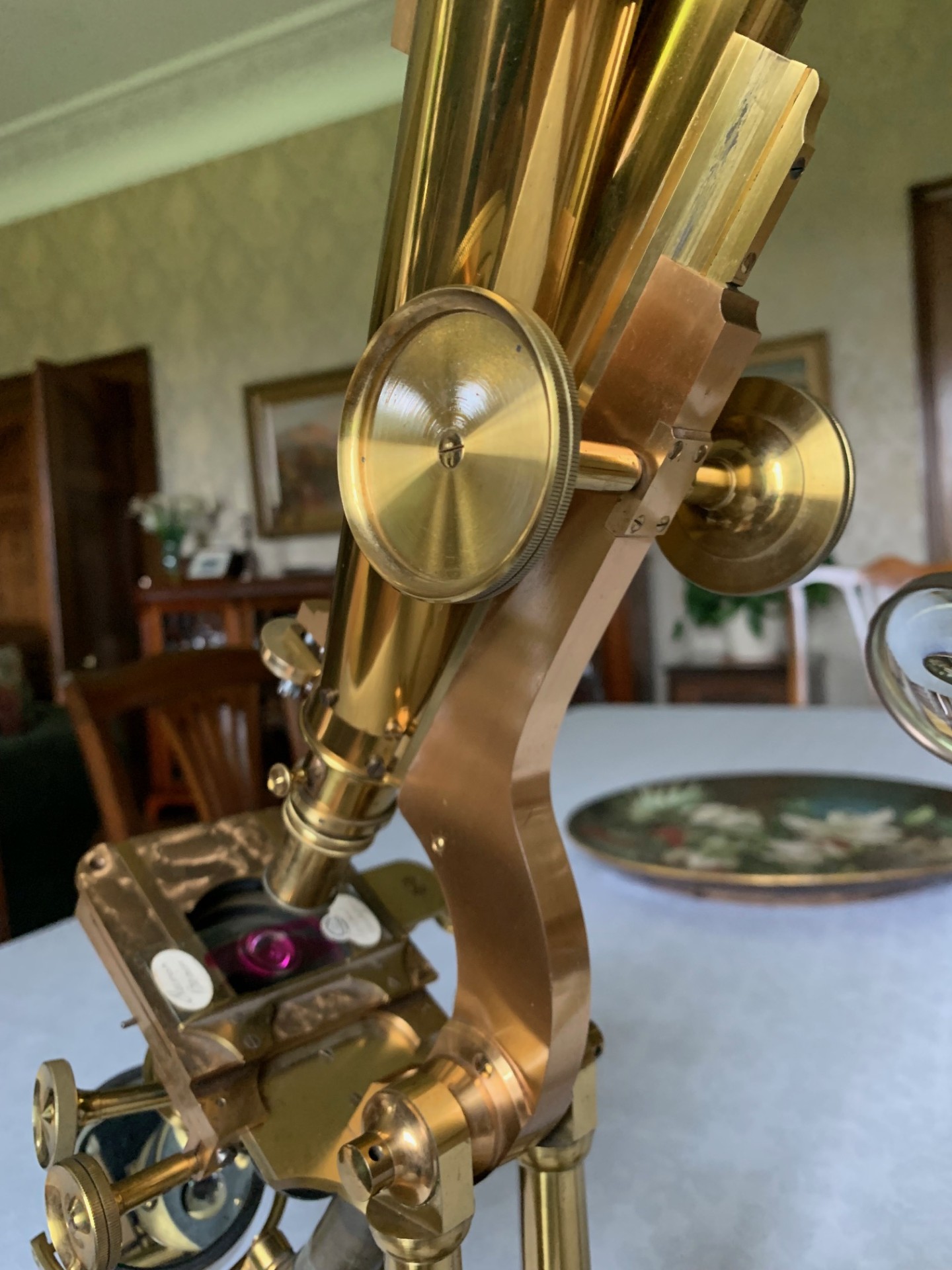
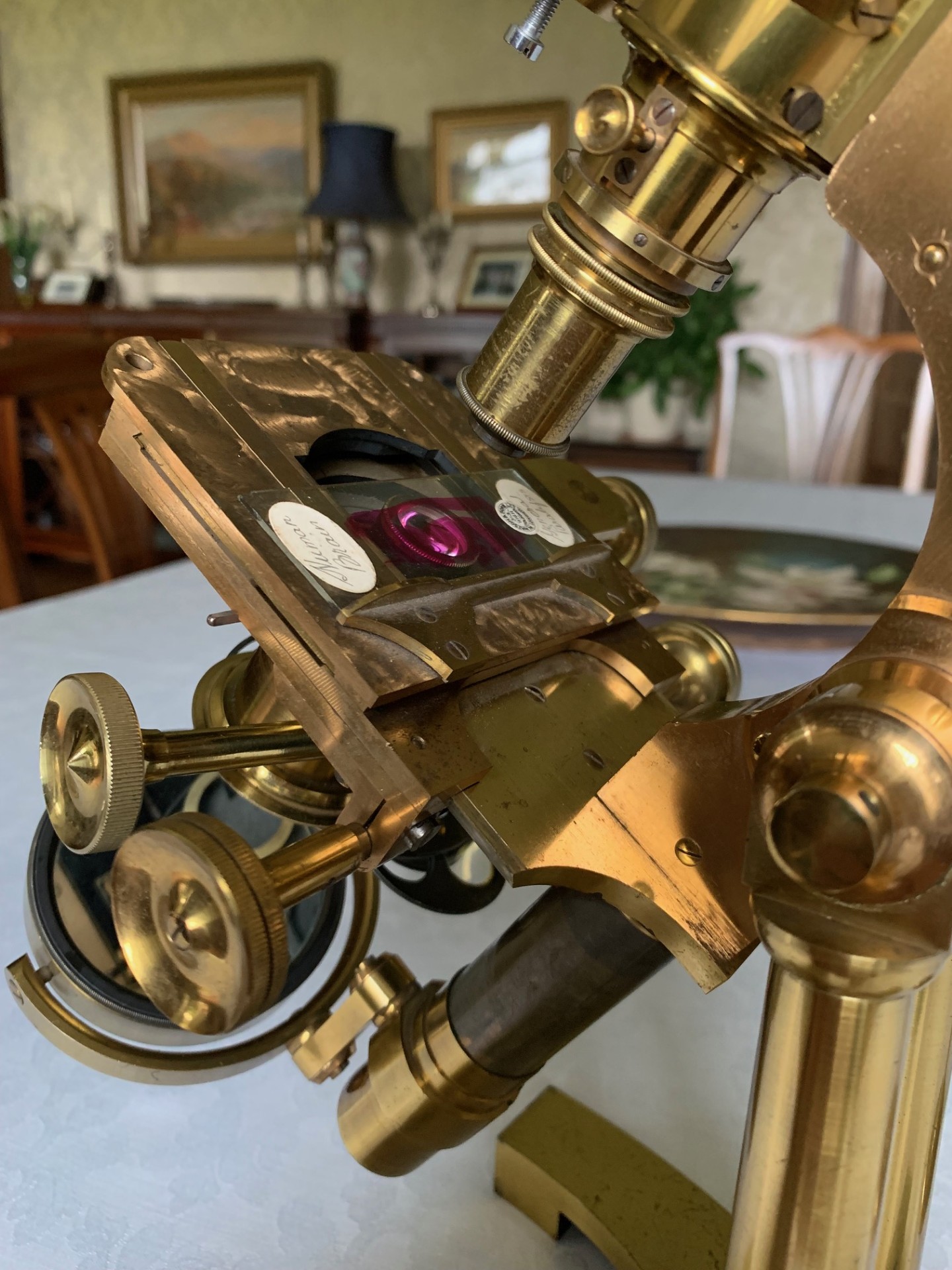
In terms of the technical details, the instrument stands on a heavy brass Y-shaped foot giving good stability, with twin uprights leading to the main pivot joint, which can be adjusted for tension if required. There’s a lister-type upper limb giving a good range of coarse focus travel, which should allow low power objectives of up to 4 inches to be used. The instrument tilts for inclined viewing and holds in position throughout the usable range of inclination. Coarse focus is via the older-style straight-cut rack and pinion, with smooth action and good rack with no missing teeth and the main binocular tubes holding in position as they should on adjustment throughout their working range. Fine focus is controlled via a separate brass thumb-wheel at the front of the optical tube, acting one the nose-piece only and was seized solid when I first obtained the instrument. It’s operational now with some replacement components and would ideally benefit from further sympathetic restoration.
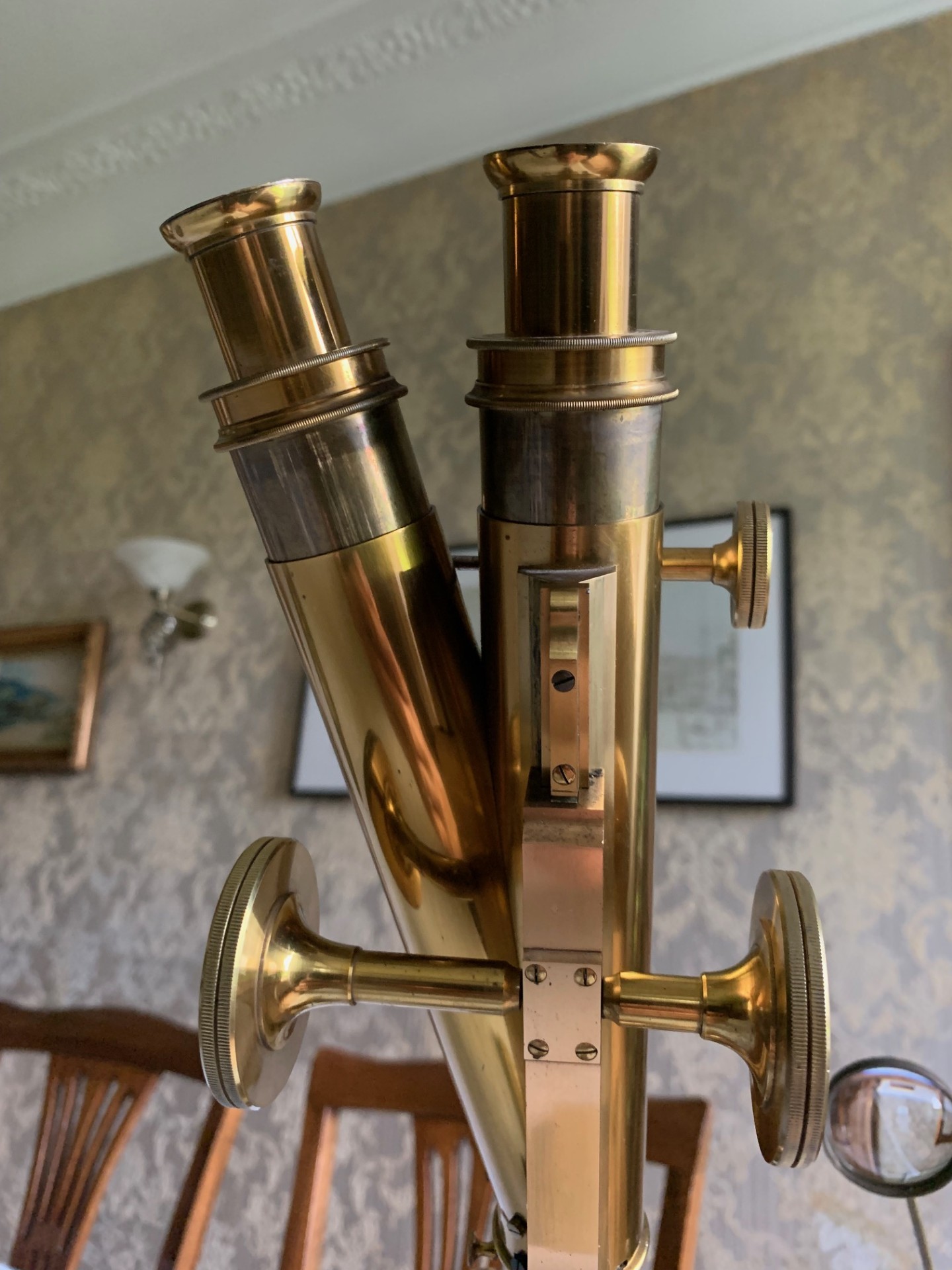
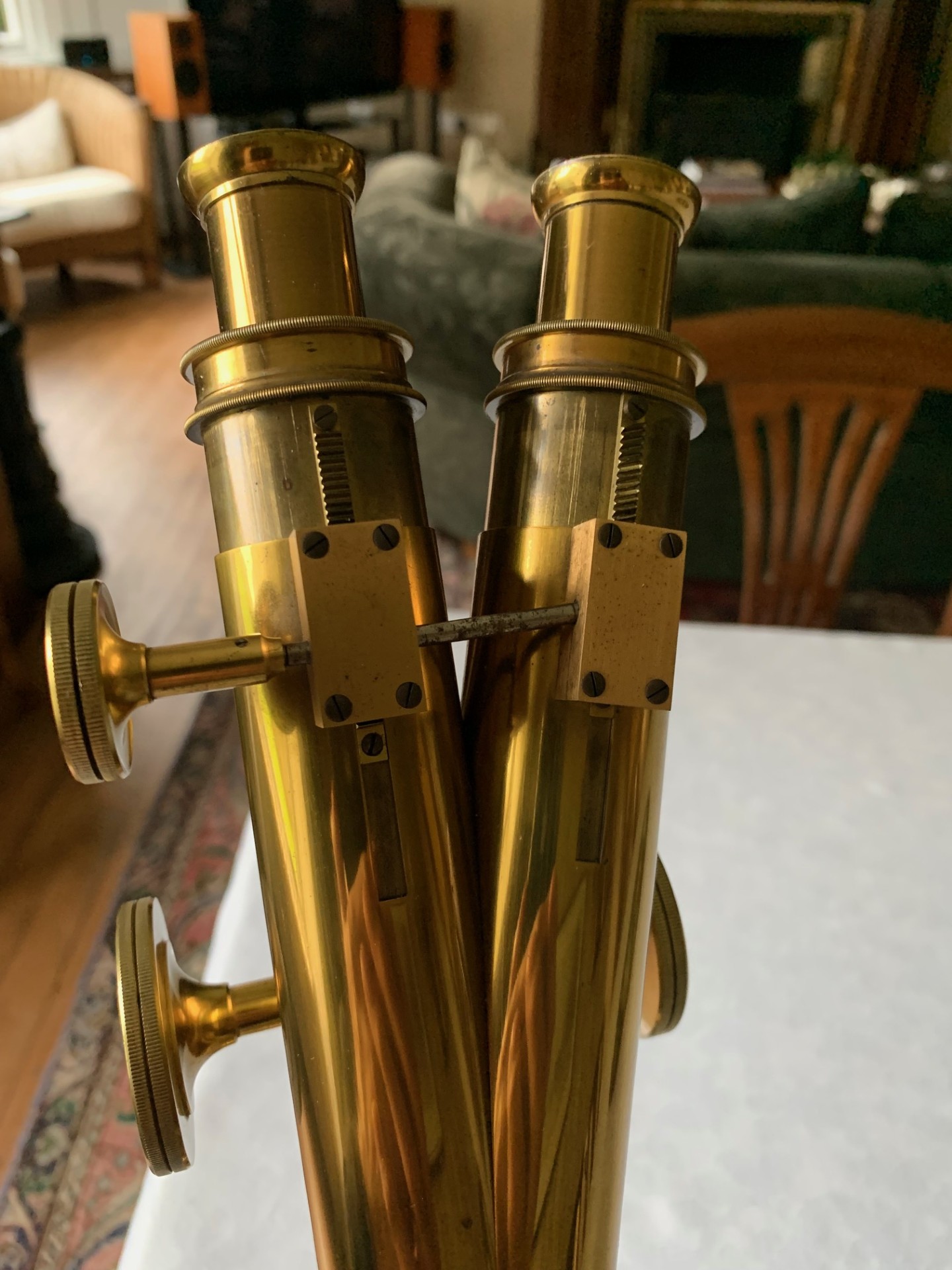
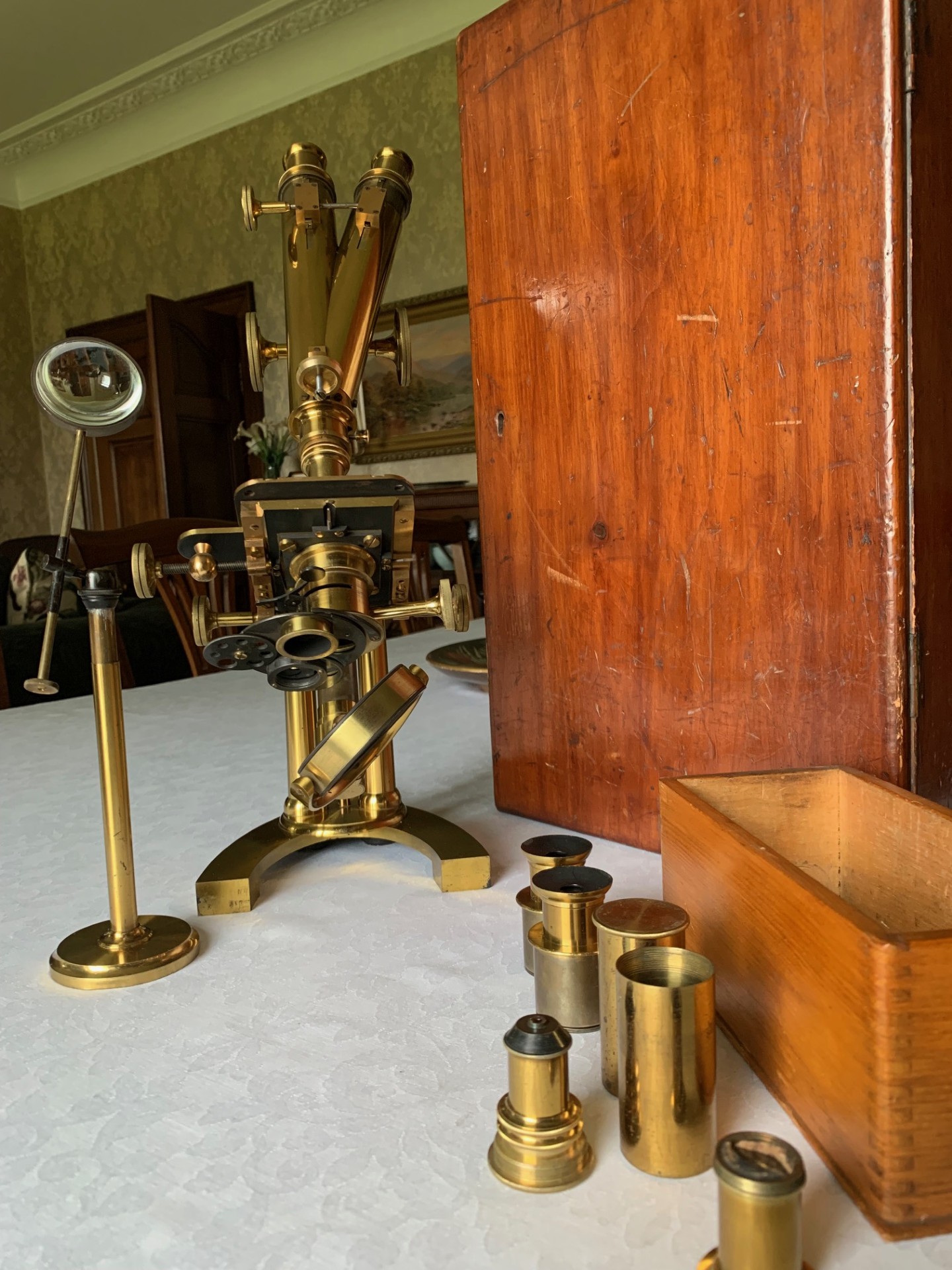
With its optics, this instrument is in binocular configuration with a Wenham-style prism in a carrier just above nose-piece, which is on an in/out slider and when set to “in” splits the light beam thereby illuminating both optical tubes, although collimation isn’t perfect and ideally requires careful adjustment. There’s mechanically extendable eyepiece draw-tubes operated by a rack and pinion system which works with care and only occasional slippage. Extending the draw-tubes will increase magnification – you also have to re-focus. The optical Wenham prism operated via a slider allows use in both binocular and monocular configuration, with just the right-hand tube/eyepiece used for monocular observations (this tends to be the preferred method for higher magnification applications).
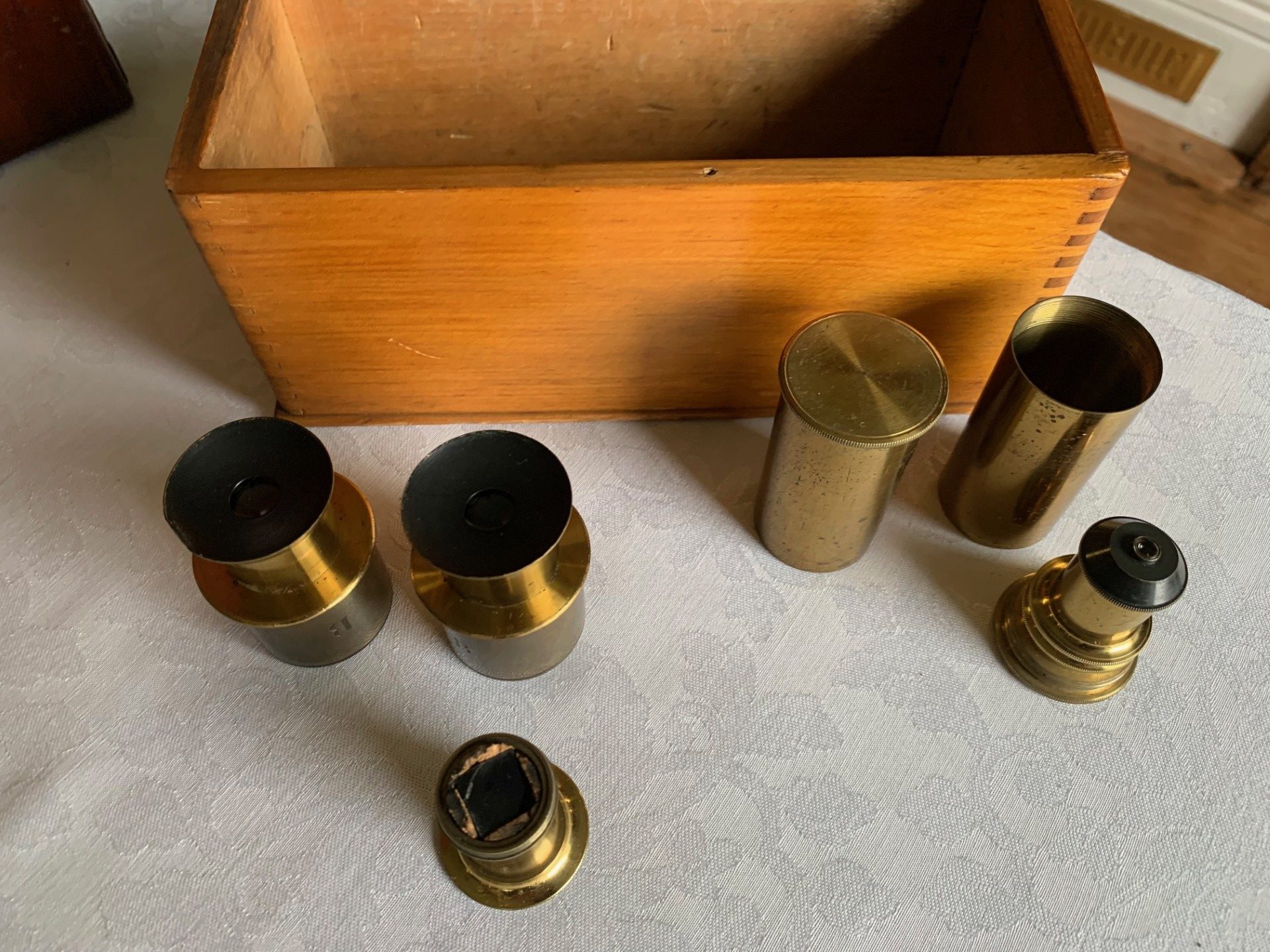
There’s two pairs of top-hat eyepieces by Dancer for binocular use:
– Set A – 5x magnification
– Set B – 6x magnification
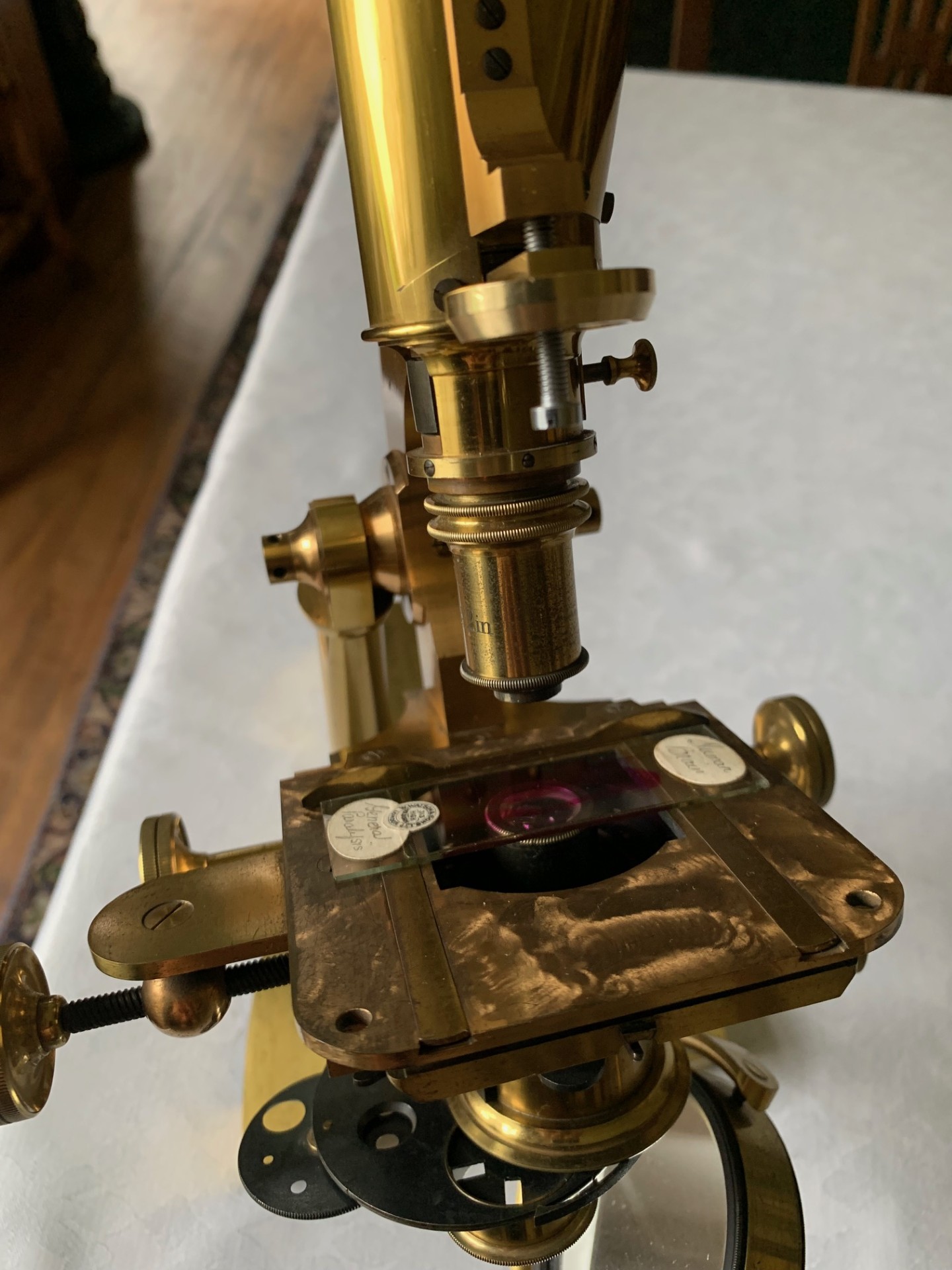
There’s also a good pair of Dancer objective lenses in brass, as under – note the instrument is RMS in terms of objective thread diameter, so plenty of other objectives should also fit:
– 1&2 inch – 6x magnification
– 1/4 inch – approx 25x magnification
(the objectives have period brass canisters)
The magnification range available is therefore around 25x to 150x with the current set of optics.
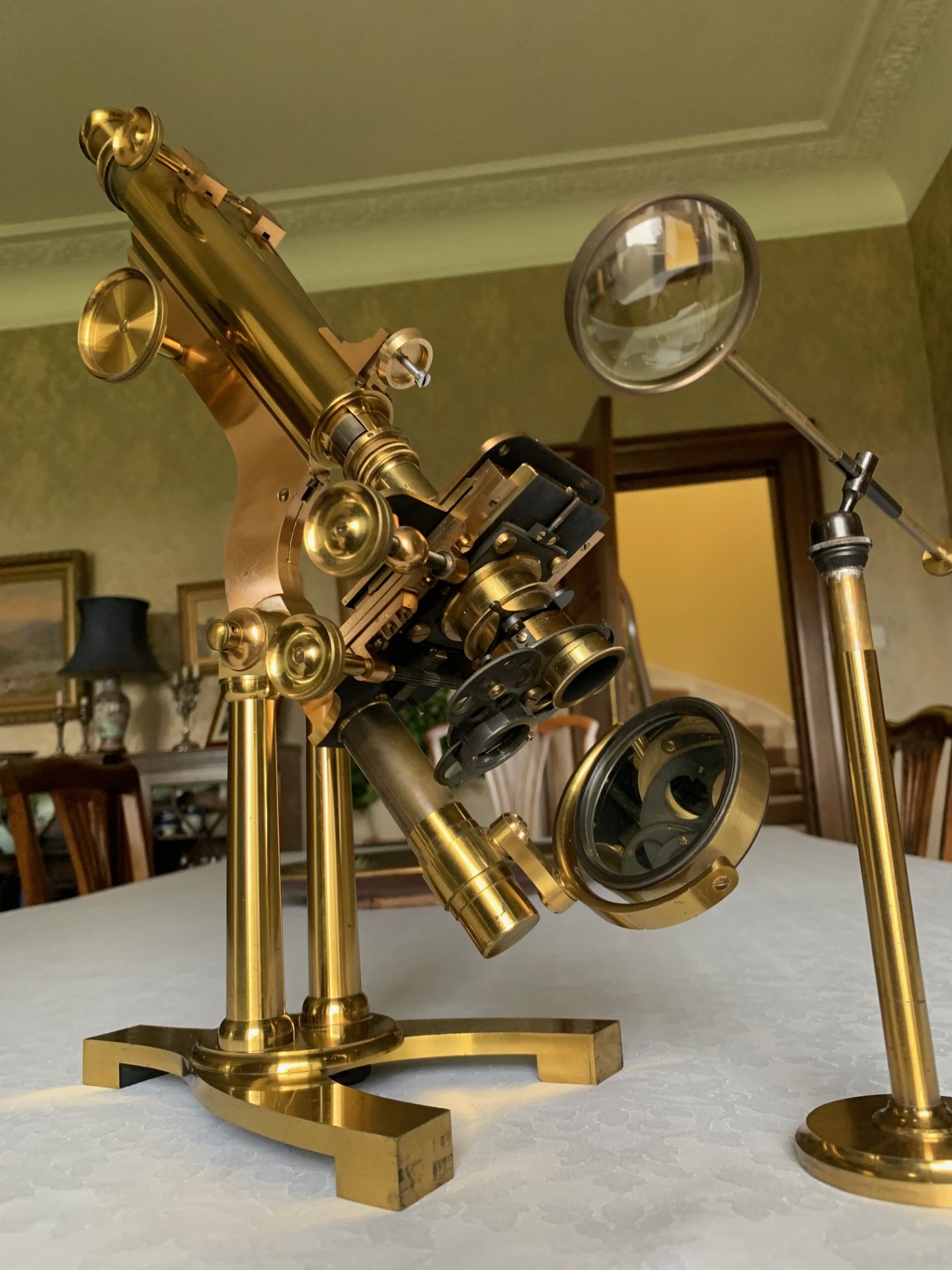
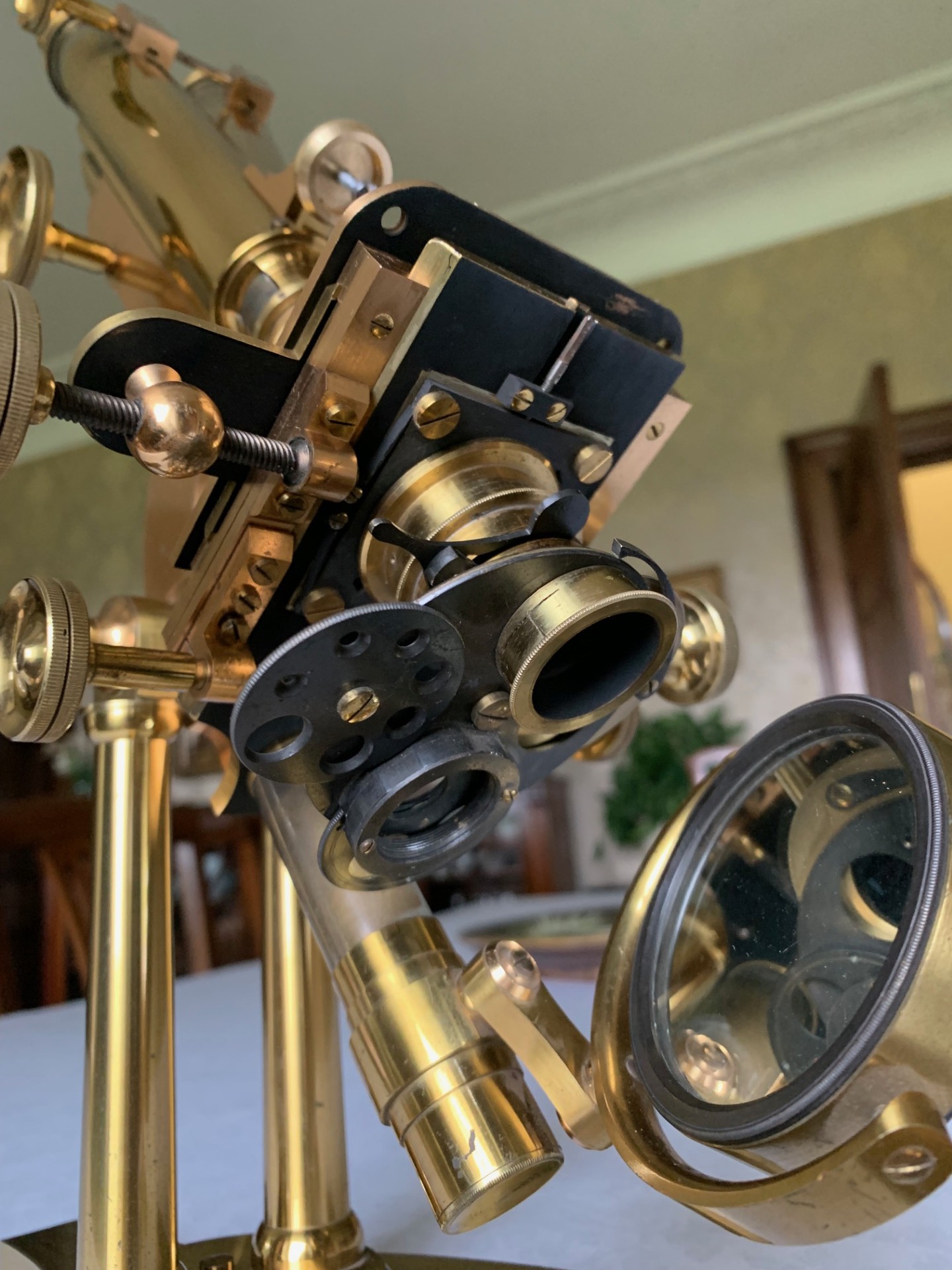
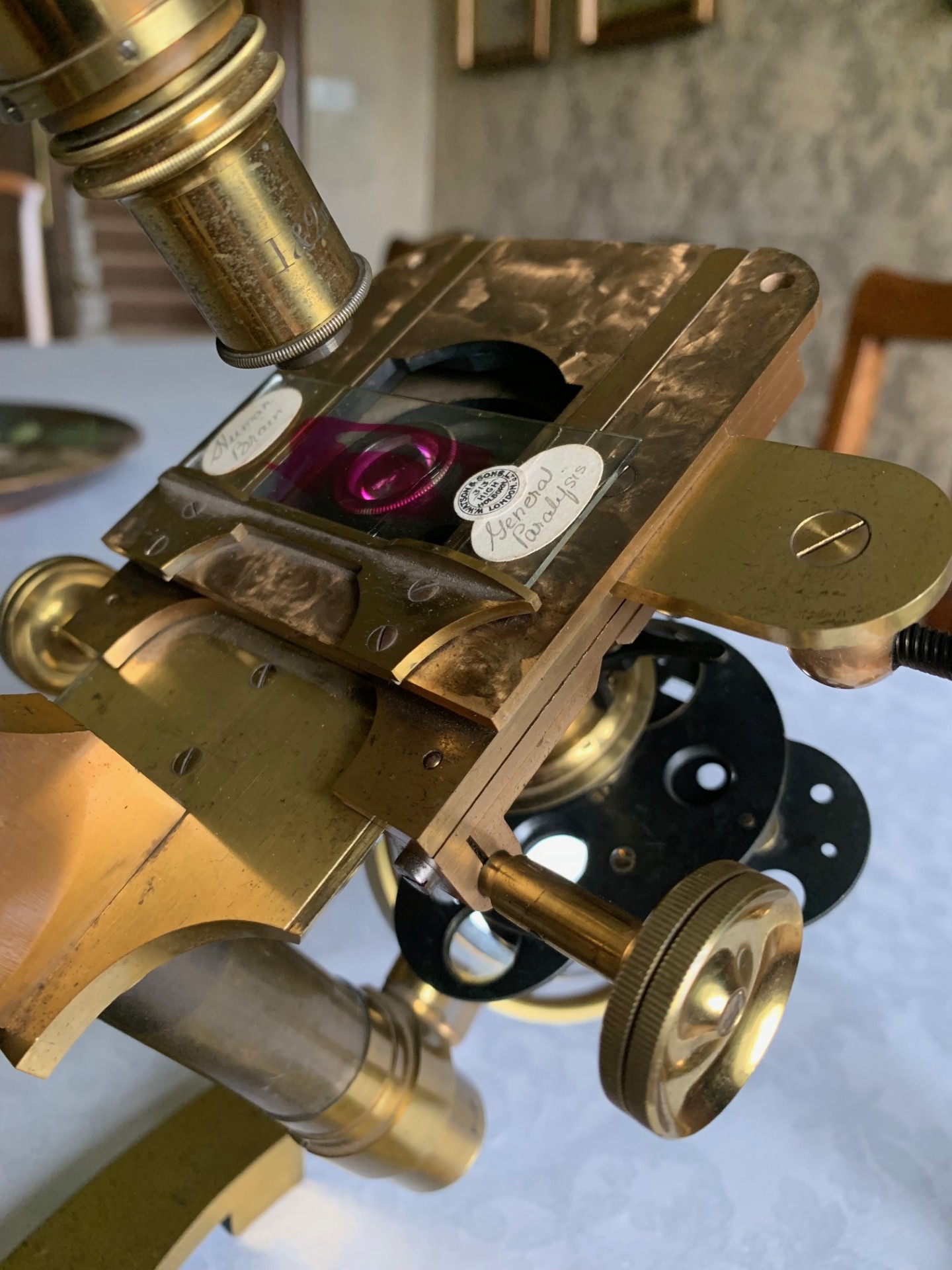
The fully mechanical rectangular brass stage is attached to the limb tail-piece just below the pivot point and is a well engineered feature that’s a delight to use, with nice smooth action to its moving parts. It’s got thumb-wheel x/y adjusters for both axes with smooth operation. The top-plate also has an integral specimen holder/ledge for holding slides during inclined viewing and when the axes are being moved around which works well. The x/y controls have a nice solid stable feel about them, offering good accurate control of specimen positioning, which is a real advantage for detailed and higher magnification work. The top-plate also has recesses for inter alia sage forceps and the like.
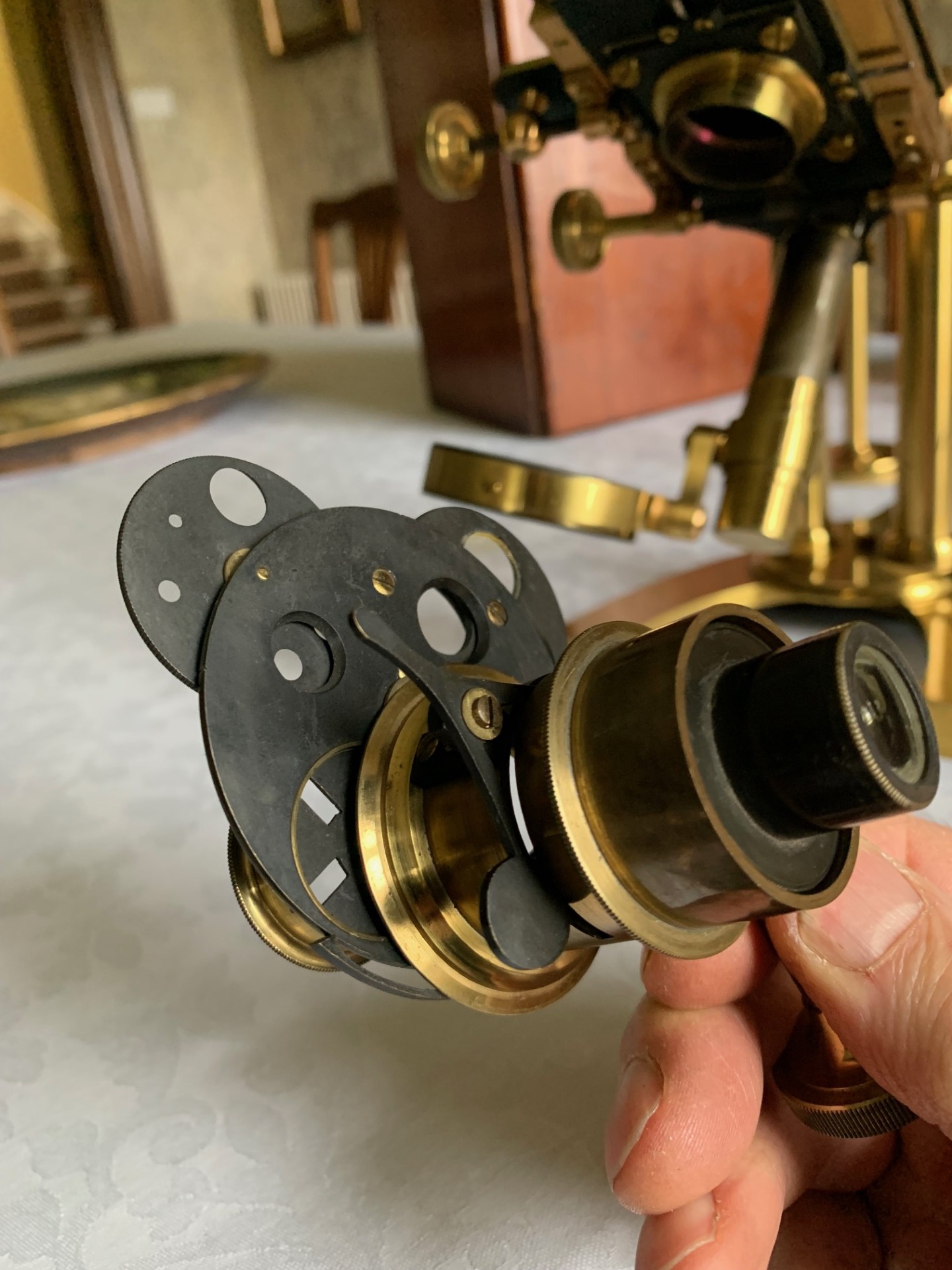
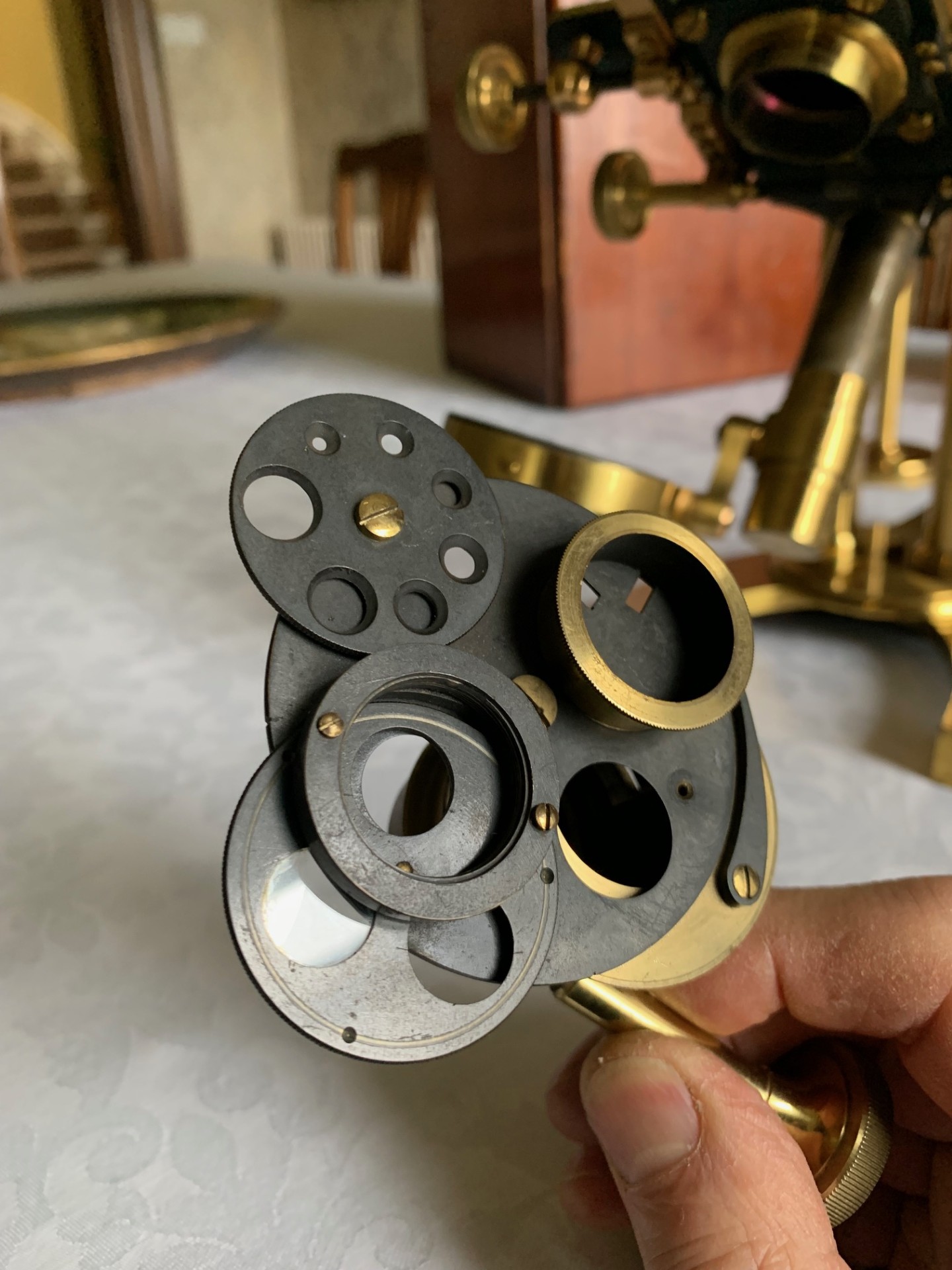
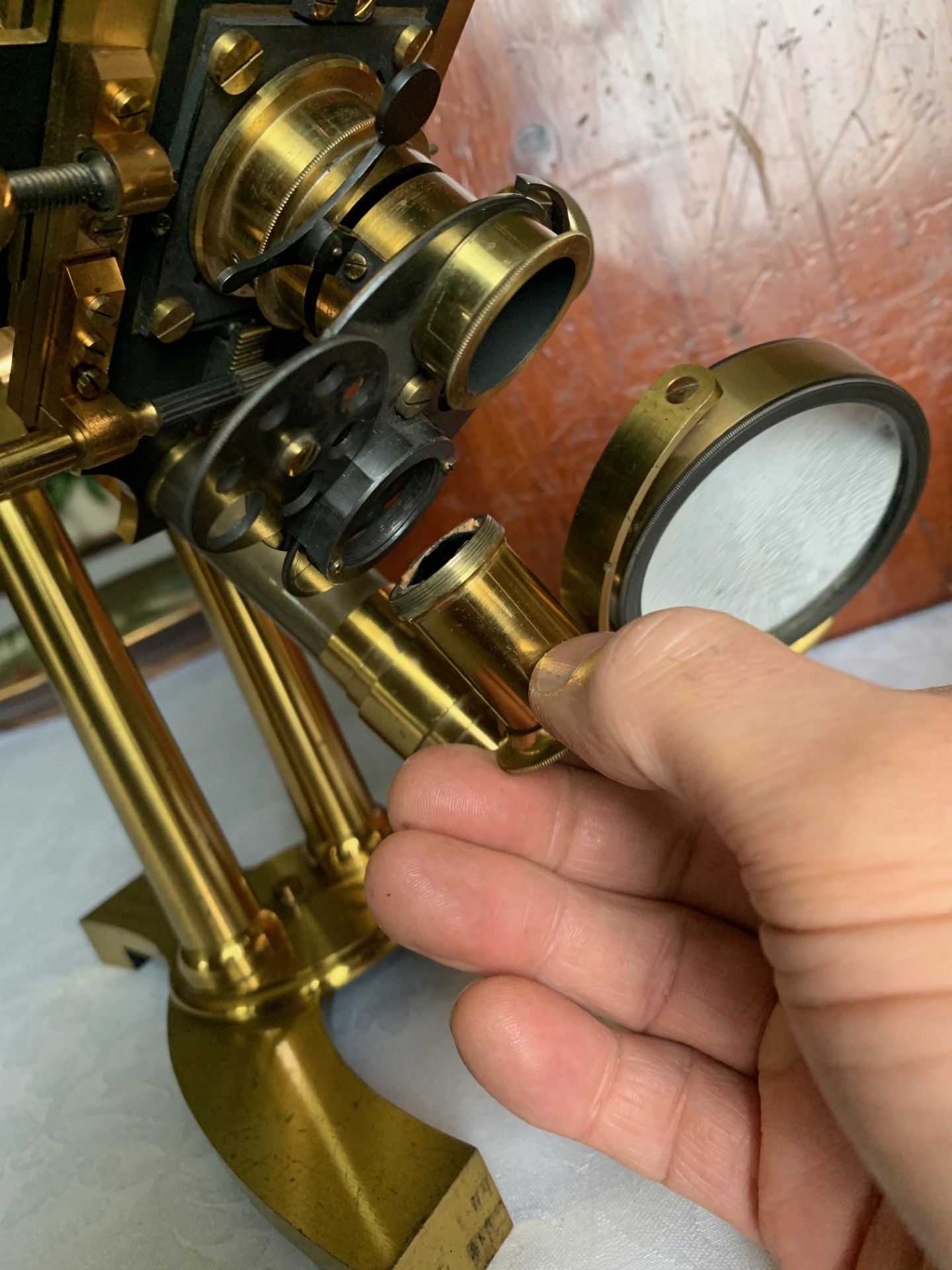
Turning to the sub-stage, we have a brass ring-mount to which will friction-fit accessories such as the supplied plug-in complex condenser that’s shown fitted in the listing photos – explained later in the listing.
Lighting is via a plano-concave mirror in a brass carrier on a height/rotation adjustable brass support arm and gimbal fitted to the limb tailpiece, with period silvering that’s in excellent condition to both sides.
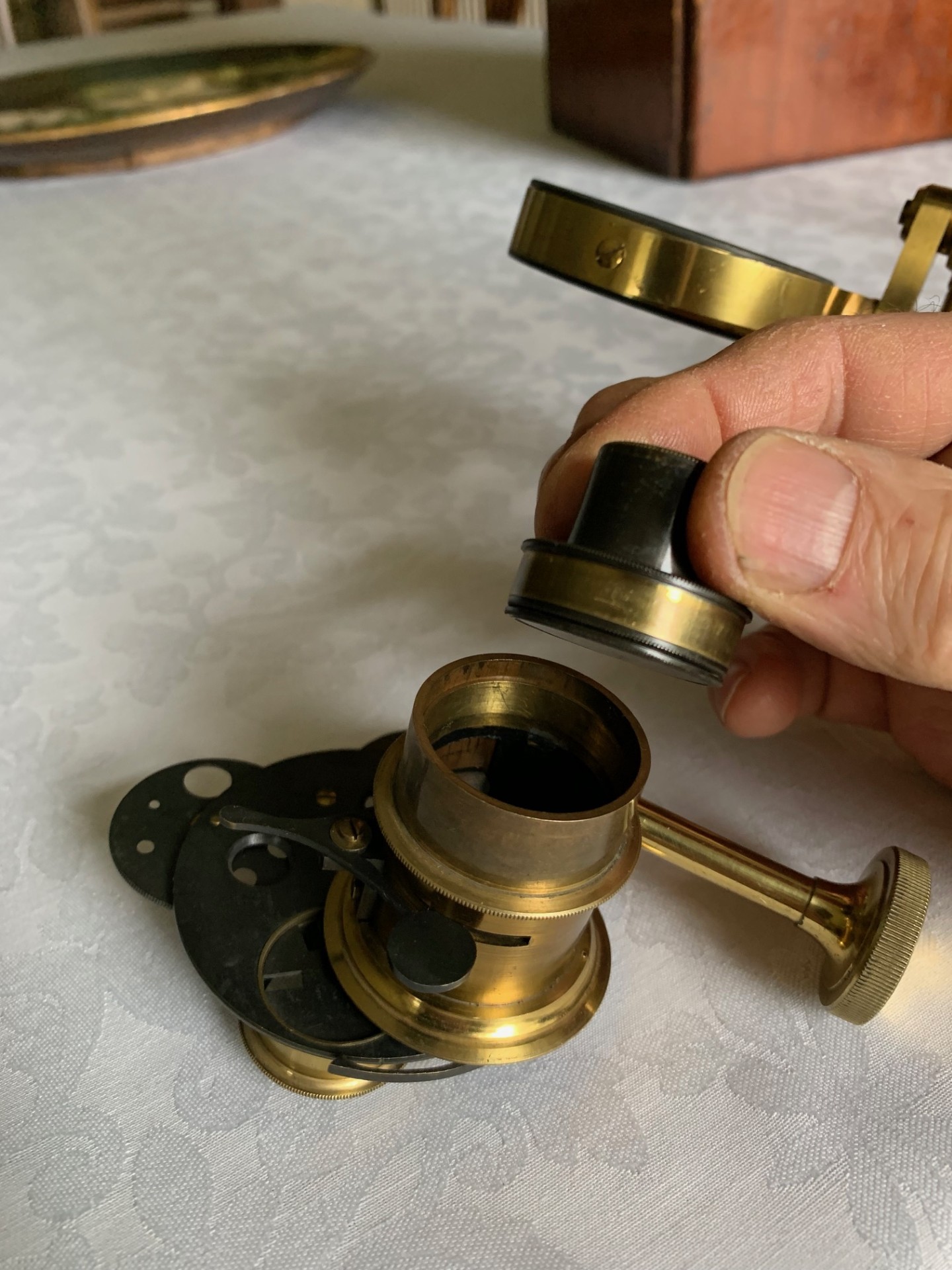
Functions of complex condenser:
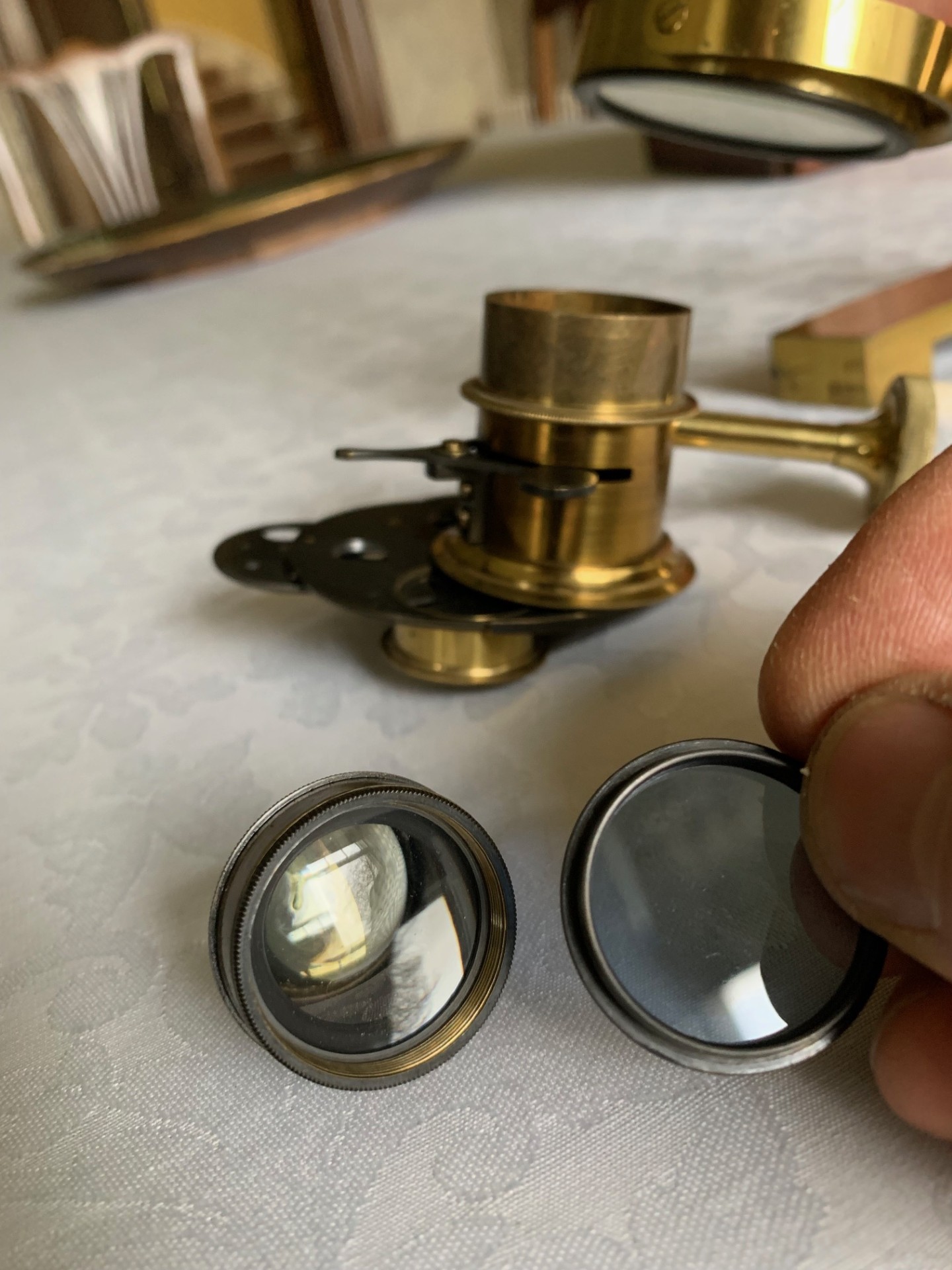
– top-mounted removable condenser lens with height adjustment via rack & pinion system and screw-in blue filter
– flip in/out darkfield stops with two sizes of stop available – works really well
– wheel of stops with 4 main positions, one open and three with additional functionality, with click stop when aligned
– subsidiary aperture rotor with 7 positions
– subsidiary rotor with screw-in filter and 3 positions one with glass insert fitted (possibly selenite)
– plug-in brass carrier fitted with removable oblique stop
– nicol prism polariser that screw-fits into plug-in brass carrier
Additional accessory:
– multi-adjustable bull’s-eye condenser on brass stand
There’s a substantial period hardwood case for the instrument, with reasonable exterior finish and an internal drawer that can accommodate the accessories. There’s a good solid brass carry-handle to the case and unfortunately the lock is missing, so there’s a cupboard latch fitted to help keep the door closed.
The instrument and its controls have been very gently dusted, lightly lubricated and operate smoothly with age-appropriate signs of wear and condition points as described, very much as one would expect for an instrument of this quality and age. With its bright lacquered finishes and the signature double optical tubes, it’ll make a great display piece in the right setting and is also a usable instrument – note various points on use-related condition mentioned in this listing. It presents really well and I’m certain it will look the part in a library or home office, especially when set up with an appropriate antique slide.
Owing to the weight and delicacy of this antique microscope, it will be partially dismantled, carefully wrapped for shipping and dispatched by insured courier upon receipt of cleared funds.
Thanks for looking and just message seller if additional photos or details are required.
Ask the Dealer
Dealer information
 Arcboutant Scientific
Arcboutant Scientific based in Glasgow Scotland, with an interest in scientific collectables dating back to 1988. Now making available carefully curated fine examples, principally of antique microscopes and associated scientific equipment by quality English and Continental makers, to collectors world-wide.