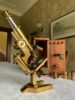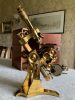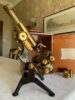


SOLD – Antique Monocular Histology-type Brass Microscope by F. Koristka of Milan – c1903, Cased
Sold
Nice usable example of a compact monocular Histology-type brass microscope with wooden storage case by Italian makers F. Koristka - serial no. 2291 which dates this example to around 1903.
Circa
1903
Maker
F. Koristka of Milan, Italy
Country of manufacture
Other
Description
Offered for sale we have a nice example of an antique upright monocular brass microscope with the instrument dating to around the 1903 period. The condition is generally pretty good, with only a few minor age and use appropriate signs of wear to the finish on the instrument and just the right time worn look to its lacquered finish and brass-work. Being a compact upright instrument, it’s also a good proposition for display, say on a desk-top when set up with a suitable antique slide. It’s also perfectly usable producing some nice bright images at medium magnification with its current set of optics.
This instrument is a compact model with friction tube coarse focus designed for bacteriological use, presumably either out in the field or in a desk-top setting. I’ve located a copy of the F. Koristka catalogue for 1903 and on page 32 this exact model of microscope is shown in fig. 15 – see images in listing photo stream.
The specific details of this model as presented are as follows:
1) Rectangular iron foot construction with single column upright in lacquered brass finish, to which attach both stage and Continental-style upper limb. This compact microscope is non-inclinable.
2) A monocular eyepiece tube with standard 23mm diameter No. 3 eyepiece giving 8x magnification.
3) The instrument’s coarse focus is controlled via push-pull of the optical tube which friction-fits into a brass outer tube and in turn that screw fits into a brass ring-mount. Travel and focus are both very good with positive feel and the optical tube holding in position as it should throughout its working range. There’s also an un-graduated eyepiece draw-tube which when extended increases magnification quite noticeably – you also have to re-focus after adjusting it.
Fine focus is via a single brass thumb-screw atop the Continental column, which also works very well.
4) There’s two brass objective lenses with canisters, which are marked 1 inch but it’s more like a 1/2 inch objective, so may be in the wrong canister, giving around 15x magnification and 1/4 inch which will be about 25x magnification. This provides 120x and 200x magnification options.
Note: the thread for the objectives is RMS.
5) The stage is of a plain square design in brass with black paint finish and some minor signs of surface patination. It’s fitted with two stage clips which work well at retaining slides and also the stage is marked “F. KORISTKA MILANO”.
The stage is fitted with a wheel-of-stops for control of lighting levels, with the rotor accessed from the front of the stage and there are a total of 6 different aperture sizes available, with nice positive feel/click as each aperture aligns correctly to the optical axis.
6) Lighting is provided by single-sided convex mirror on a gimbal mount, with swing adjustment, silvering slightly foxed but still usable with reflectivity that’s perfectly adequate for this application.
7) There’s a hardwood storage case with some interior fittings and cupboard latches to keep it closed. The case does have a cosmetic shrinkage crack to its top surface and dimensions as shown.
Background to F Koristka (Milan, Italy) – source Microscope Museum
Francesco Koristka, Italian of Polish descent, was a maker of microscopes, cameras and other medical and scientific instruments that traded at Via S. Vittore 47 (1880 – 1895), Via Guiseppe Revere 2 (1896 – c1920), Corso Vittorio Emanuele 30 (1930s), and Via Ampere (1970s), Milan, Italy. The firm was founded in the early 1880s and the full name was Fratelli Koristka SA. Thanks to his relationships with Ernst Abbe, Koristka had the opportunity to build microscopes and photographic objectives using the Zeiss’s patents but he also built lenses of original design. Soon, the firm became one of the most important Italian makers of microscopes and one of the few Italian precision industries of the period. In 1928, two sons of Francesco Koristka, Gianfranco and Italo, continued the activity of their father with the company ‘Compagnia Generale d’ottica F.lli Gian Franco & Italo Koristka’, with headquarters in Corso Vittorio Emanuele, 30 Milano. In 1929, the firm was acquired by the Officine Galileo of Florence but continued to produce instruments under its own brand until the late 1960s.
In summary, this is a nice clean example of a compact antique monocular microscope from quality Italian manufacturer F. Koristka of Milan, that’s in good working and decent cosmetic condition for its age. Being compact it’s also a perfect desk-top accessory, especially when set up with an appropriate antique slide – it’s working height is about 10 inches as shown in the listing photos.
For shipping, the instrument and case will be very well packed and dispatched by insured courier upon receipt of cleared funds. Overseas buyers please use eBay Global Shipping if it’s available in your territory or contact seller for alternative shipping options/costs.
Thanks for looking.
Ask the Dealer
Dealer information
 Arcboutant Scientific
Arcboutant Scientific based in Glasgow Scotland, with an interest in scientific collectables dating back to 1988. Now making available carefully curated fine examples, principally of antique microscopes and associated scientific equipment by quality English and Continental makers, to collectors world-wide.