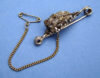



IRON BULLET EXTRACTOR, 16th /17th century
Stock Number: 10003
$8750
Circa
1600
Description
EARLY IRONWORK BULLET EXTRACTOR, probably German, c. 16th or early 17th century. Measuring 13-1/2” (34 cm) long, this remarkable device is made of iron, with an outer main tube which tapers down. This tube has a finely shaped handle, with two slightly springy grips, and cut openwork shaping. A central shaft is threaded within this structure, and has twin turning arms with symbolic acorn tips, a possible maker’s mark, and a threaded end to screw into the ball for extraction. In use one can conveniently grasp the handles and rotate the arms all with one hand, while guiding and holding the tube with the other hand. Condition is good, the iron cleaned but not over-cleaned, now showing just patches of oxidation.
A few examples of this form are known, mostly in institutional collections. Five of these are illustrated by Bennion, and we note one in Tesseract Catalogue 69 (Item 42). In period literature we find this general form in Gerssdorff\’s Feldtbuch der Wundtartzney of 1517, and find a good likeness in Scultetus\’ Armamentarium Chirurgicum of 1655. An elegantly shaped surgical tool, from the earliest days of gunpowder use in Western Europe.
Ask the Dealer
Dealer information
 TESSERACT
David and Yola Coffeen both have enjoyed academic careers, as planetary astronomer and as linguist/educator. But since 1982 (yes, 1982!) they have been full-time dealers in early scientific and medical instruments, under the name Tesseract. Selling primarily by catalogue (over 100 issued so far) they also have a web presence at www.etesseract.com, and can be contacted at mail@etesseract.com.