

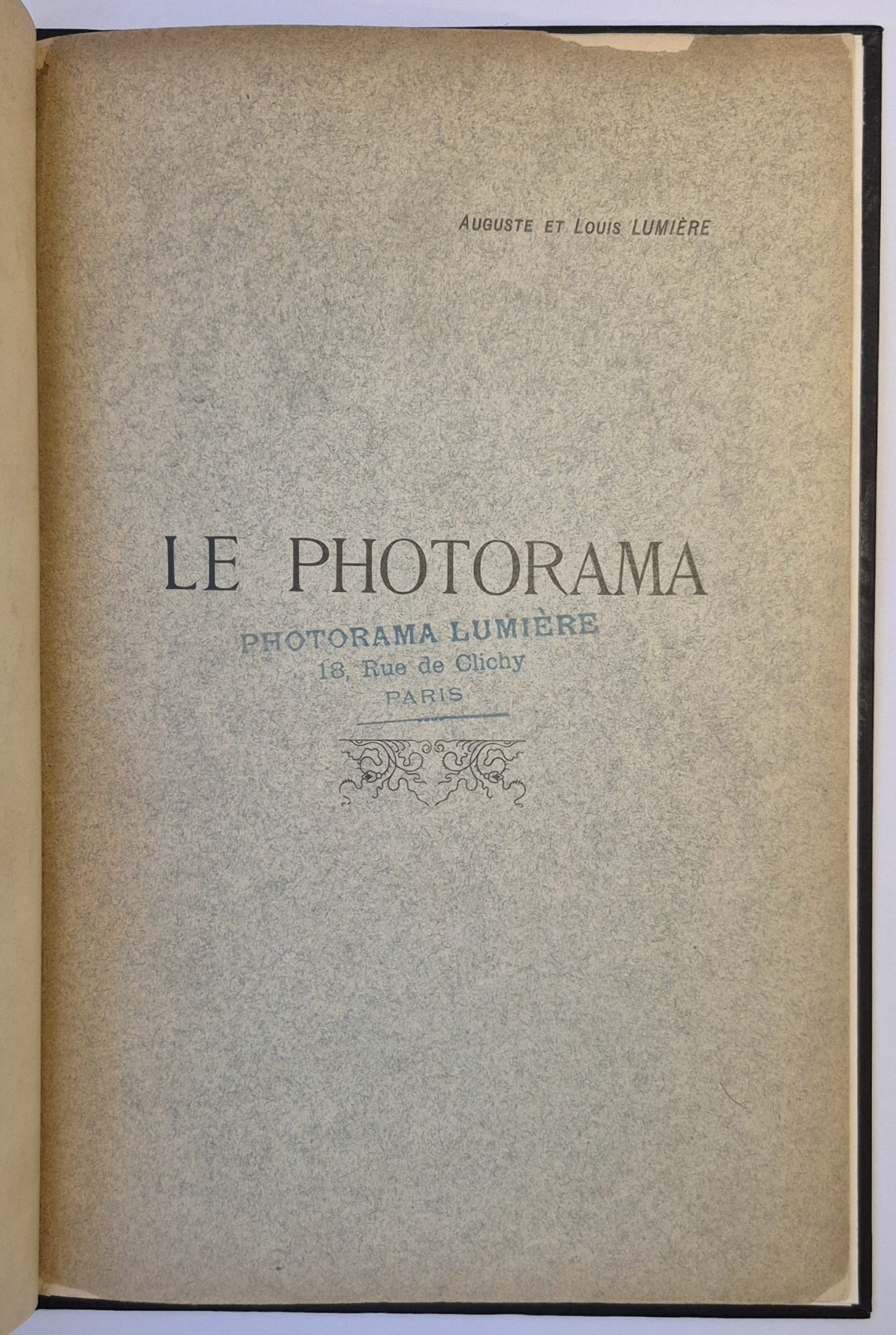
Rare first description of Lumière bothers’s 360-degree photographic panorama apparatus, the photorama
Sold
Circa
1900
Country of manufacture
France
Description
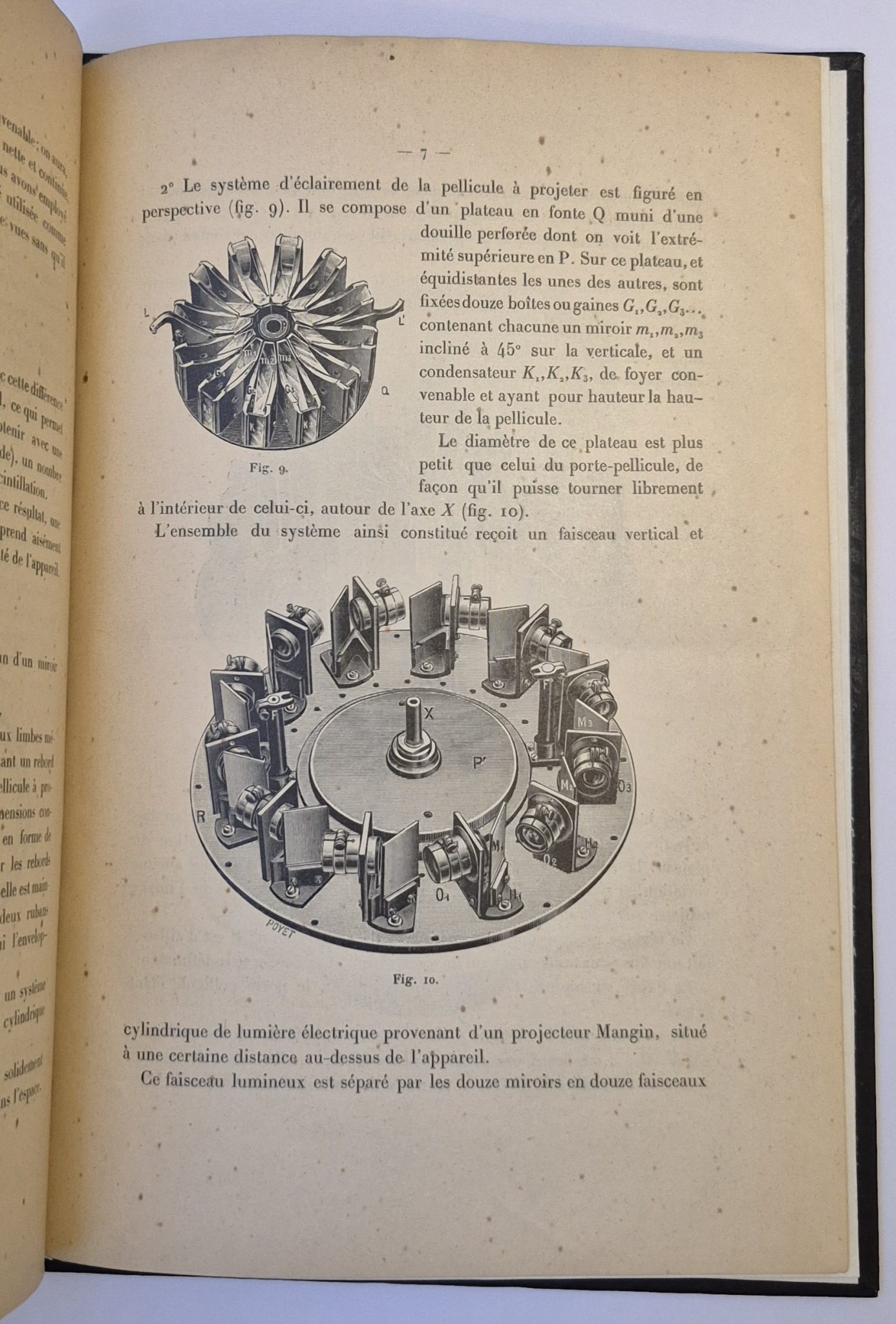
Very rare copy of the first illustrated description of the Lumière Brothers’ photorama.
LUMIERE (Auguste & Louis), Le Photorama, Lyon, Imp. A. Storck et Cie, s. d. [ca. 1900].
Octavo (2), 10 pages; modern binding with a green morocco title label and gilt fillets pasted onto the front cover, plain spine, original printed blue wrappers preserved (a few minor losses to the edges of the original wrappers; some foxing).
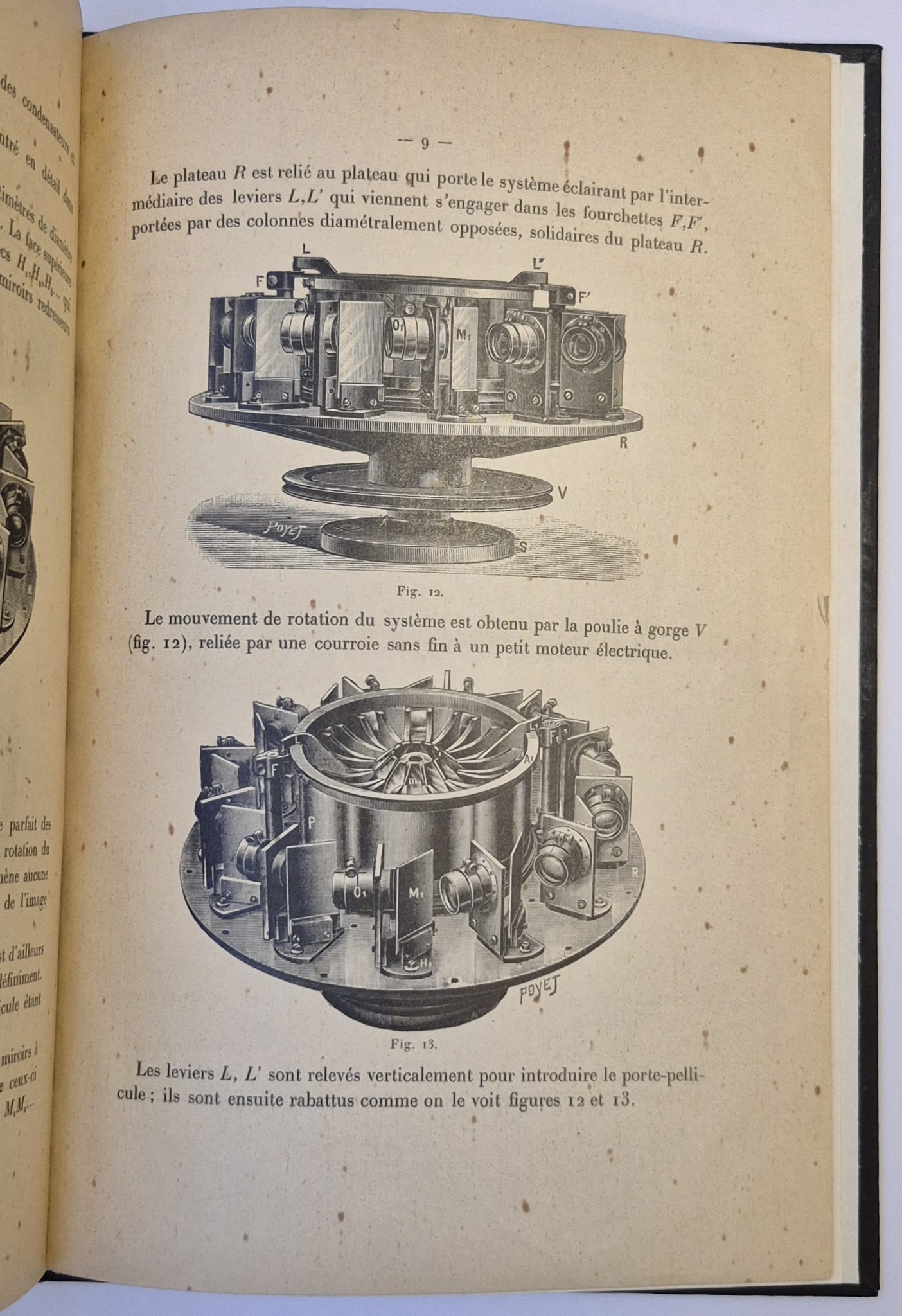
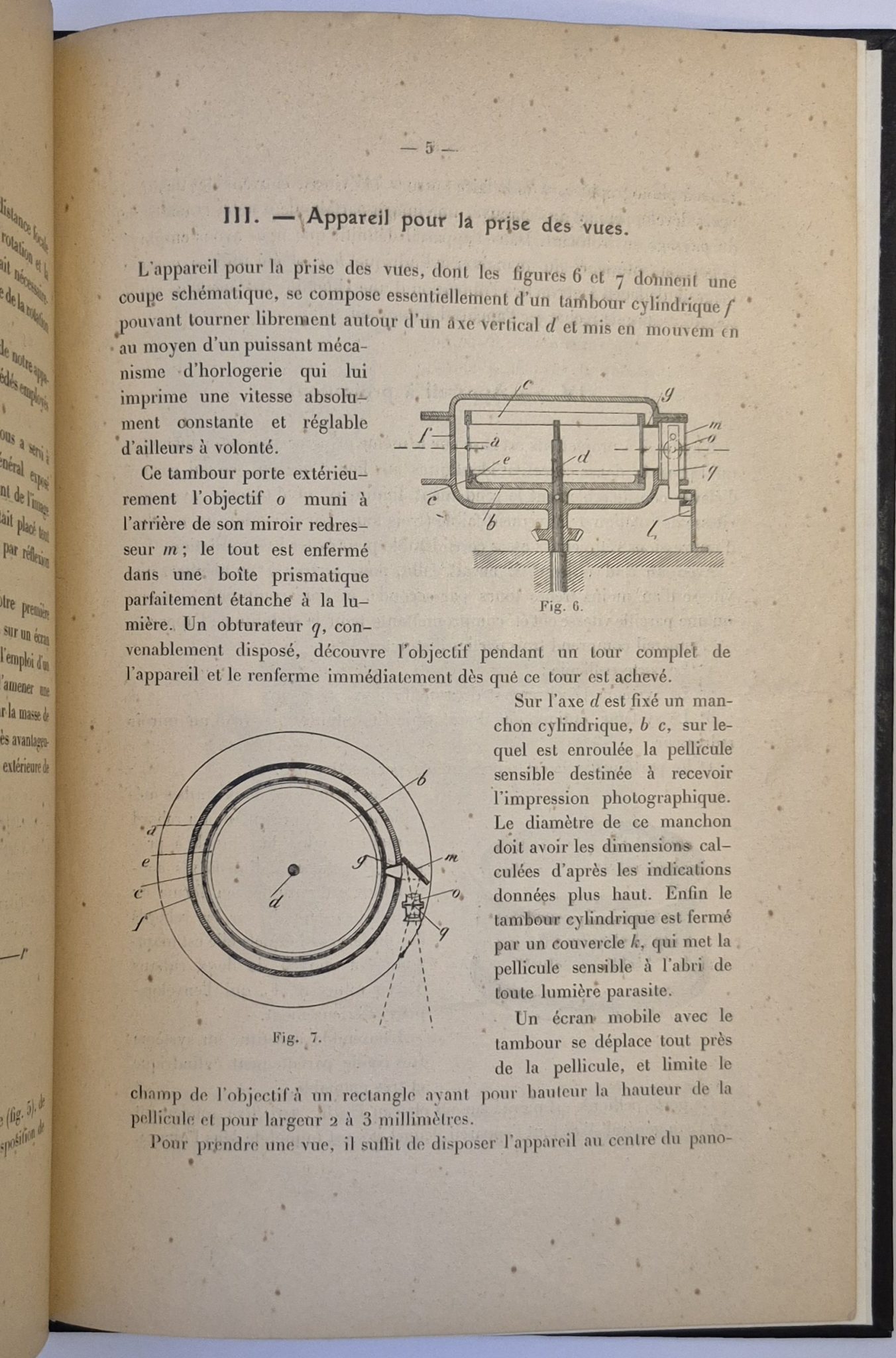
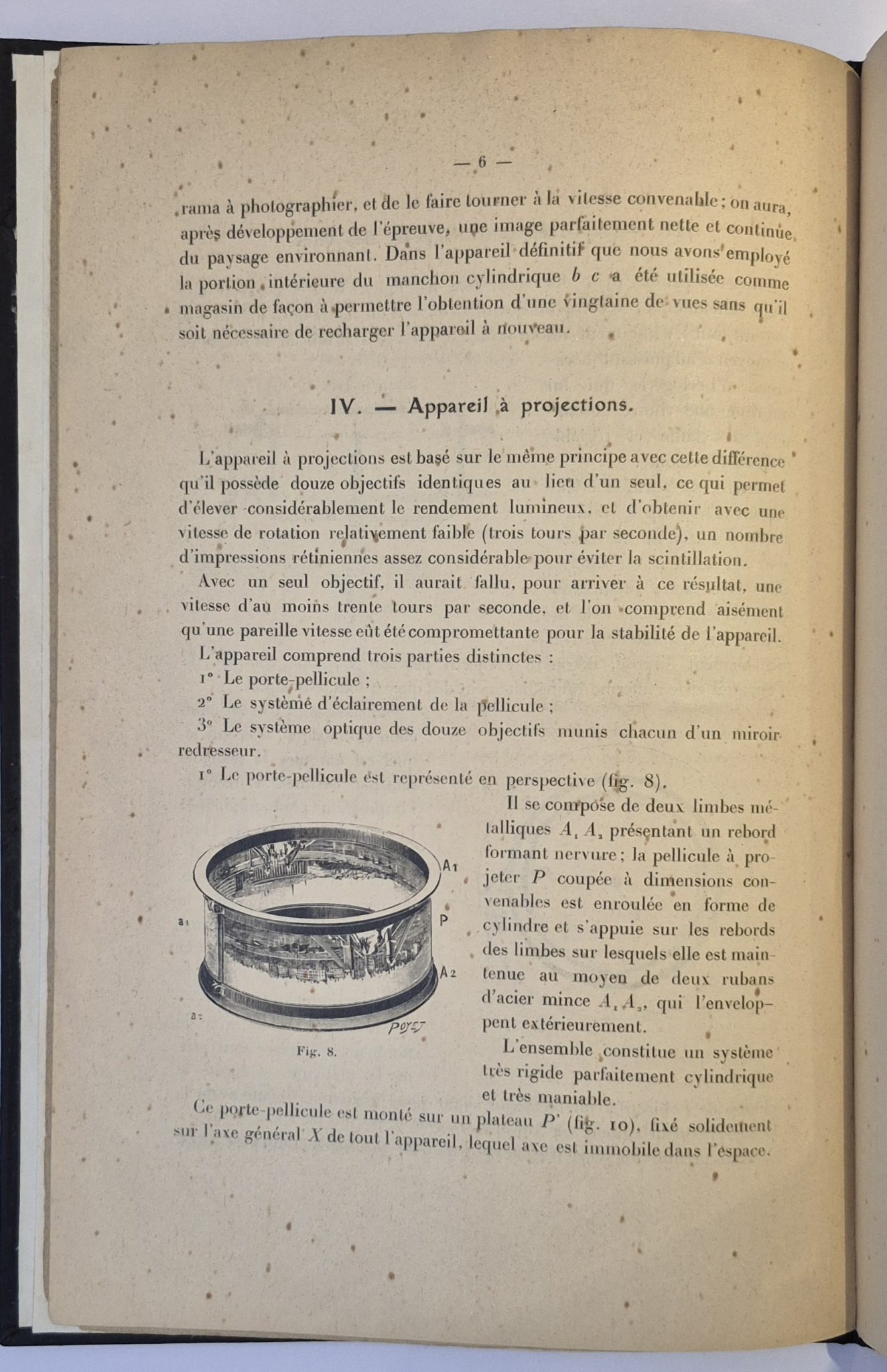
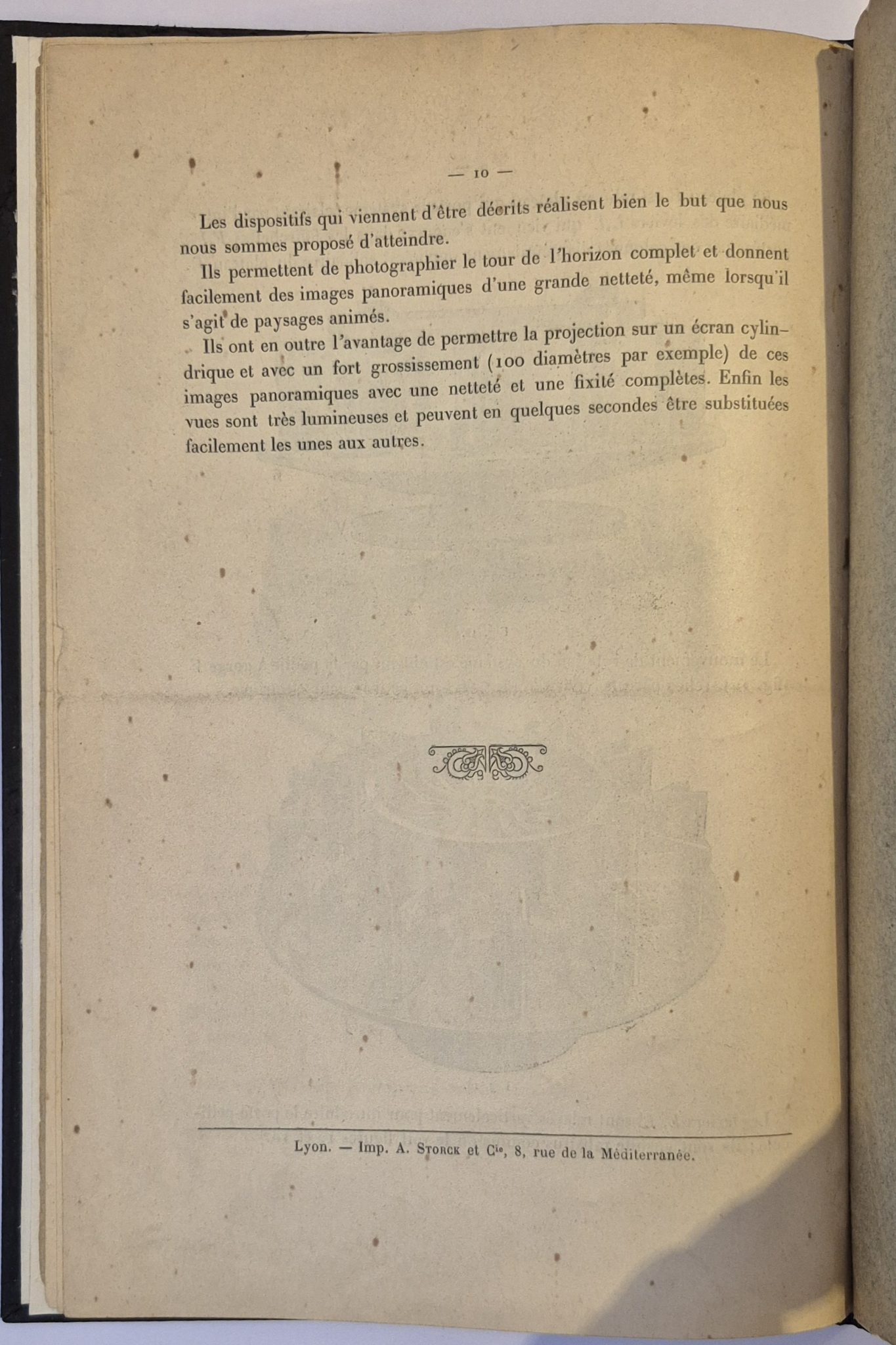
Brochure detailing the operation of the Photorama, “Reversible Panoramic Photographic Apparatus,” a new invention by the Lumière Brothers. The process is described and explained in four parts – Principle of the apparatus; Image reversal; Apparatus for taking photographs; Projection apparatus – and is illustrated with 13 figures in the text.
“On December 29, 1900, Louis Lumière filed the patent for the Photorama.” This was a panoramic photography process that allowed for the complete reproduction of the horizon, a full 360°, in a single image, and, most importantly, the complete projection of this image onto a cylindrical screen.
The Lumière Photorama aimed to be the photographic culmination of the panorama, a creation of the Irish painter Robert Barker (1739-1806). In 1787, Barker patented a device he called “Nature at a Glance”: spectators were placed on a platform and found themselves at the heart of a landscape or battlefield, painted in trompe-l’œil on a canvas stretched around the entire perimeter of the rotunda. […] The Lumière system was the first to allow both the shooting and the perfect, aberration-free projection of a panoramic view, and on a gigantic scale, as the projected image measured over 6 meters in height. […] The success of the projection lies in the fact that Louis Lumière applied certain principles of the Cinematograph shutter to his apparatus. Instead of the fixed systems experimented with until then, he used a moving mechanism: the uniform projection of the entire photograph, rolled into a cylinder, was achieved by the continuous rotation at 180 rpm (3 revolutions per second) of a platform supporting 12 lenses, which ensured the enlargement. These lenses were positioned around the periphery of the film, which remained stationary.
Through this “scanning” of the entire circumference of the film, each portion of the image was considered a “virtual frame,” and the enlargement of this portion of the image was repeated ad infinitum each time a lens passed in front of it. The “persistence of vision” then merged all these projected image portions onto the circular screen into a single continuous image. Thus, there were no longer any aberrations due to the use of fixed lenses, each enlarging an identical portion of the film, which on the screen produced the same result as if several juxtaposed and clumsily joined images were projected individually. […] »
Ask the Dealer
Dealer information
 Le Zograscope
Established by Alexandre Piffault in 2014 and based in Paris at 5 rue de Condé, 75006, very close to Odéon, Le Zograscope specializes in antique and rare books in Science, Medicine and Technology, and rare antique instruments in the same fields. We have especially a strong interest in early and continental microscopy, early and special mathematical/drawing instruments, medical and surgical instrument, and rare technology.
Personnal website : https://www.lezograscope.com/