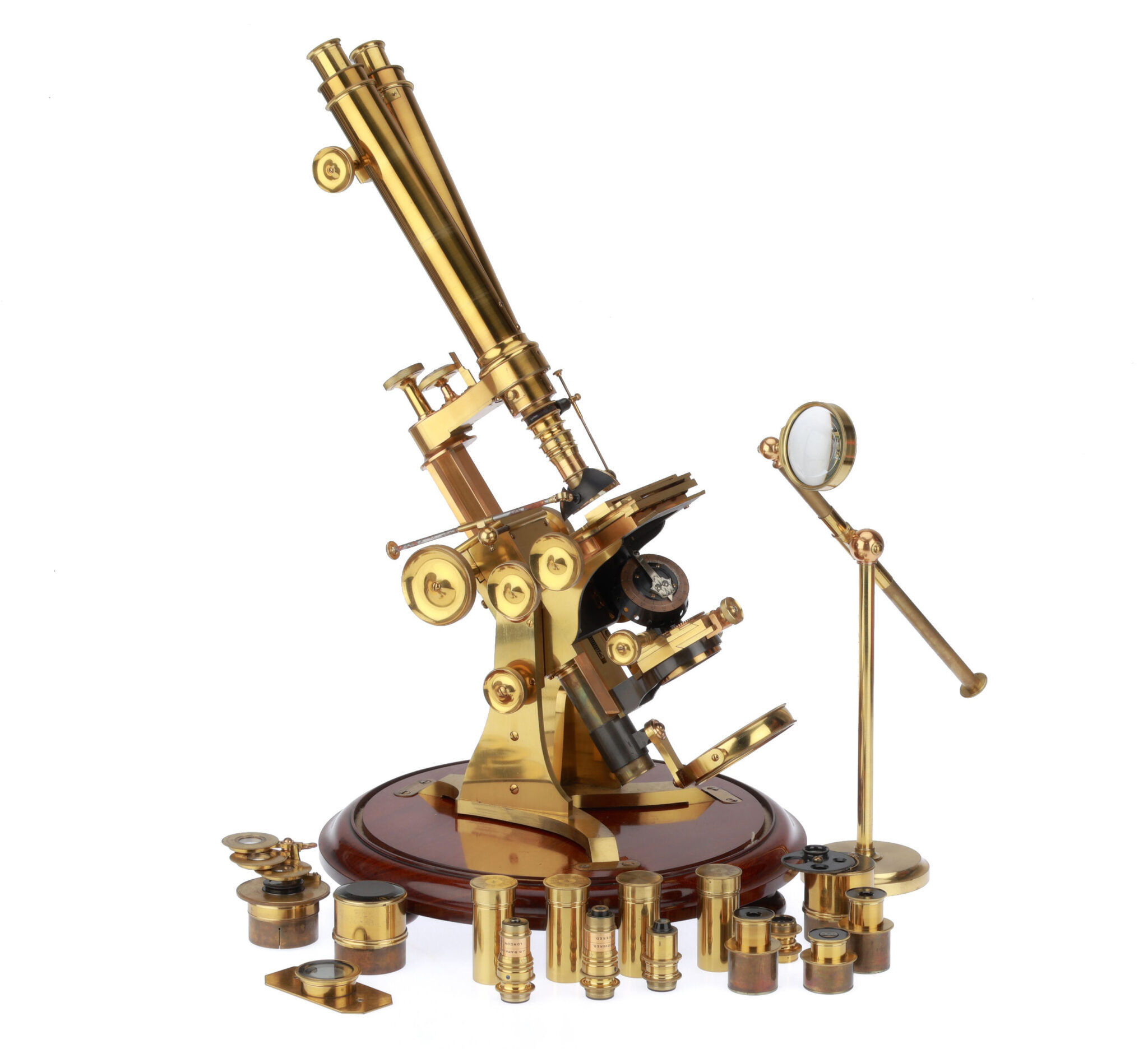
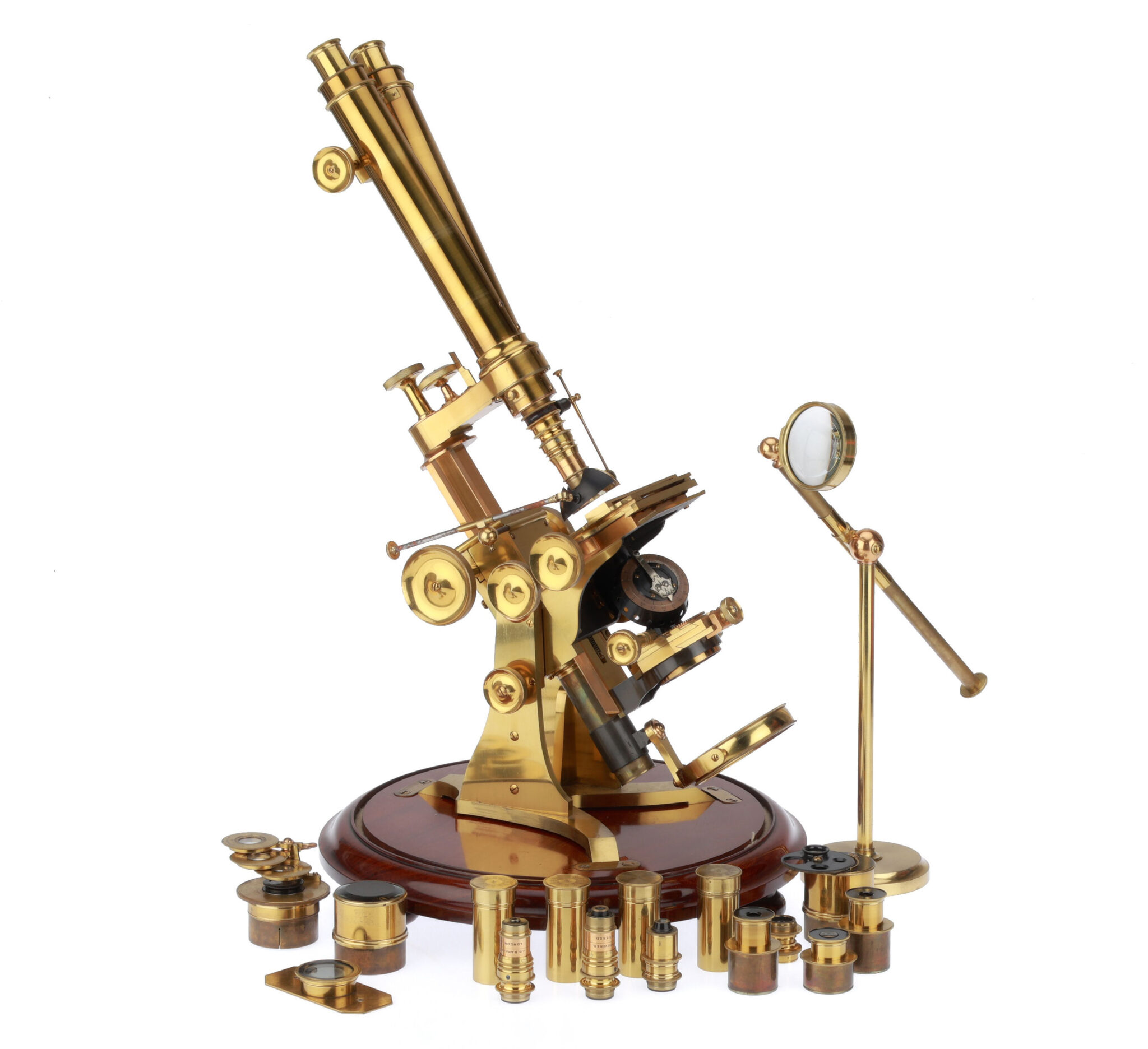
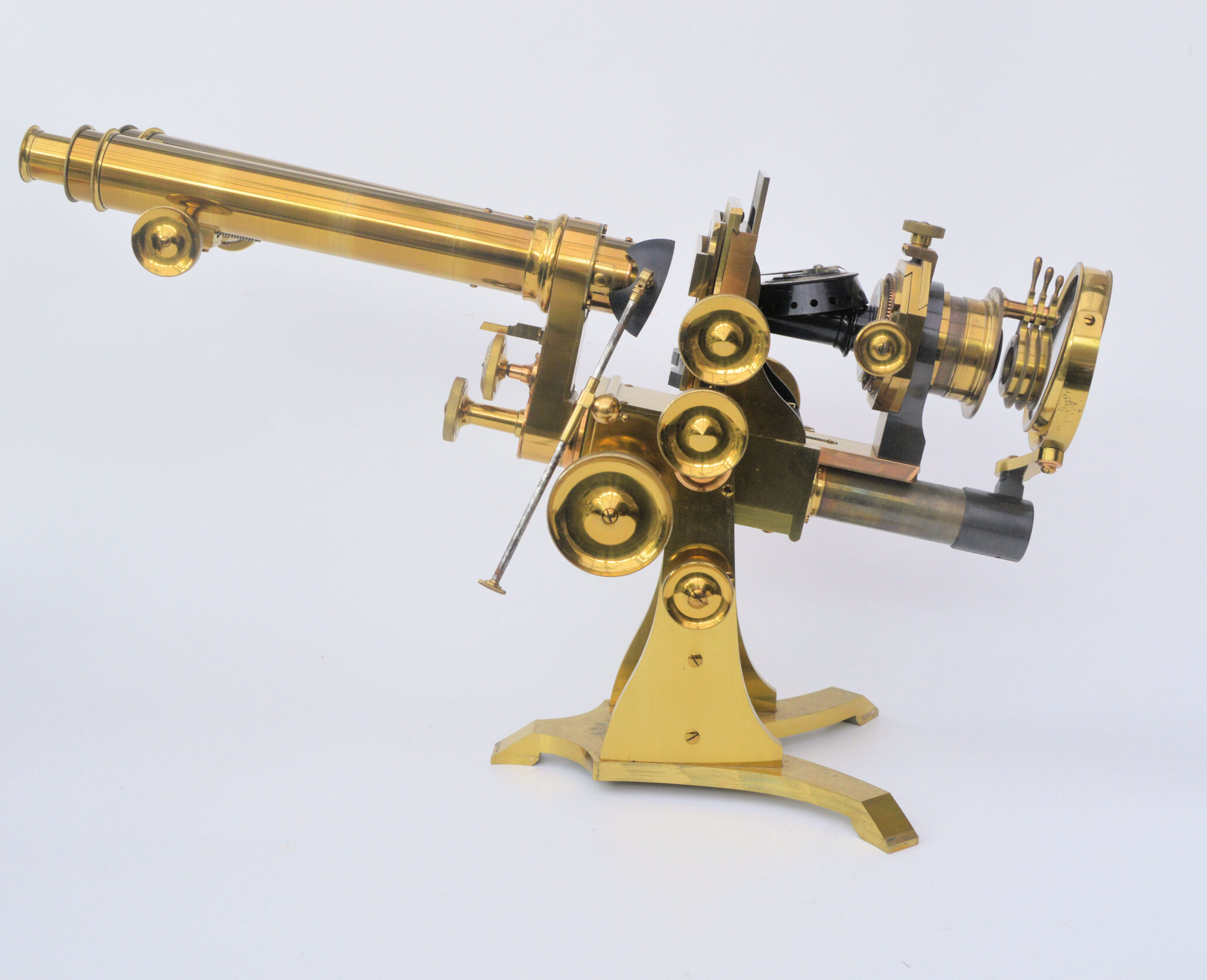

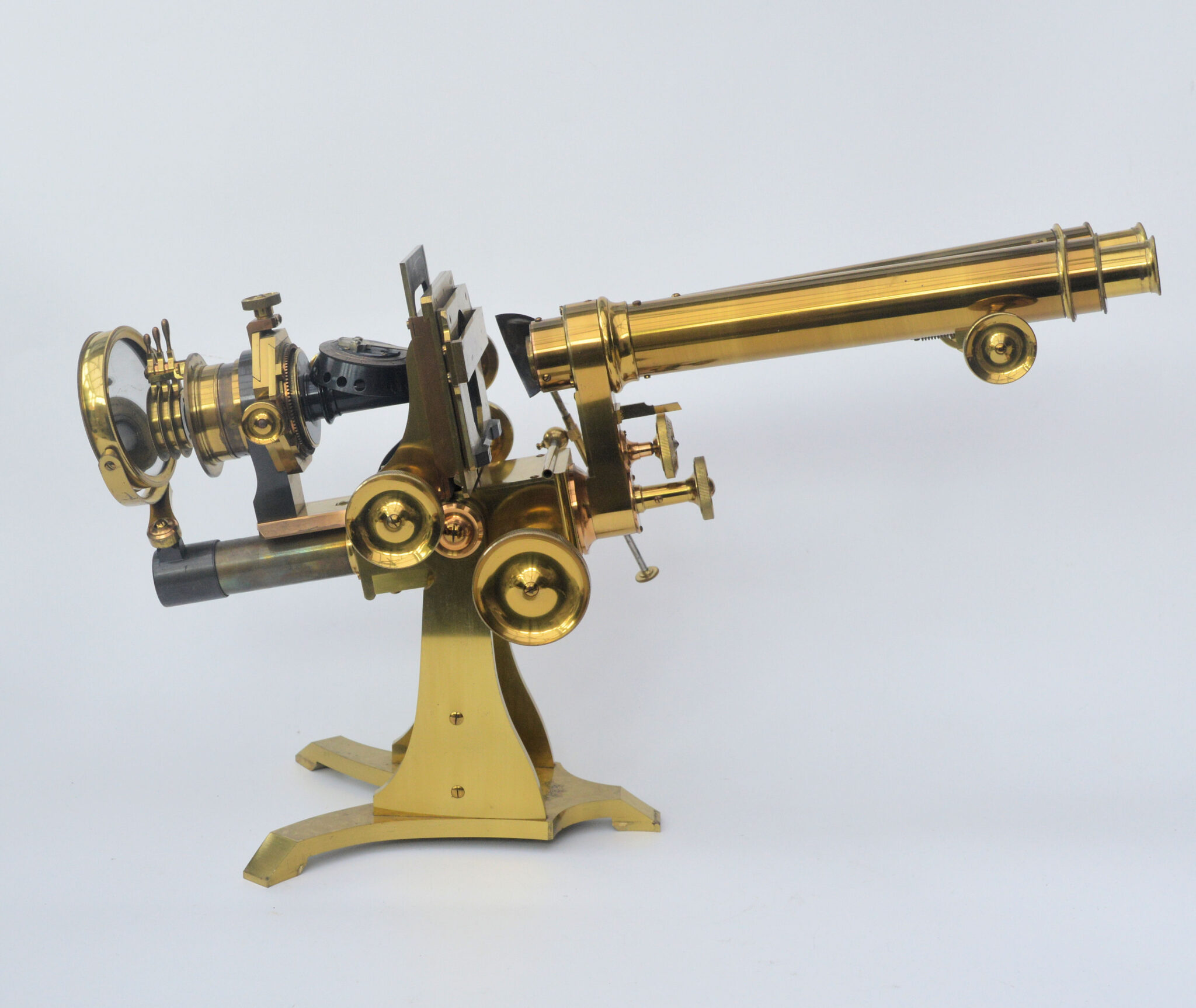
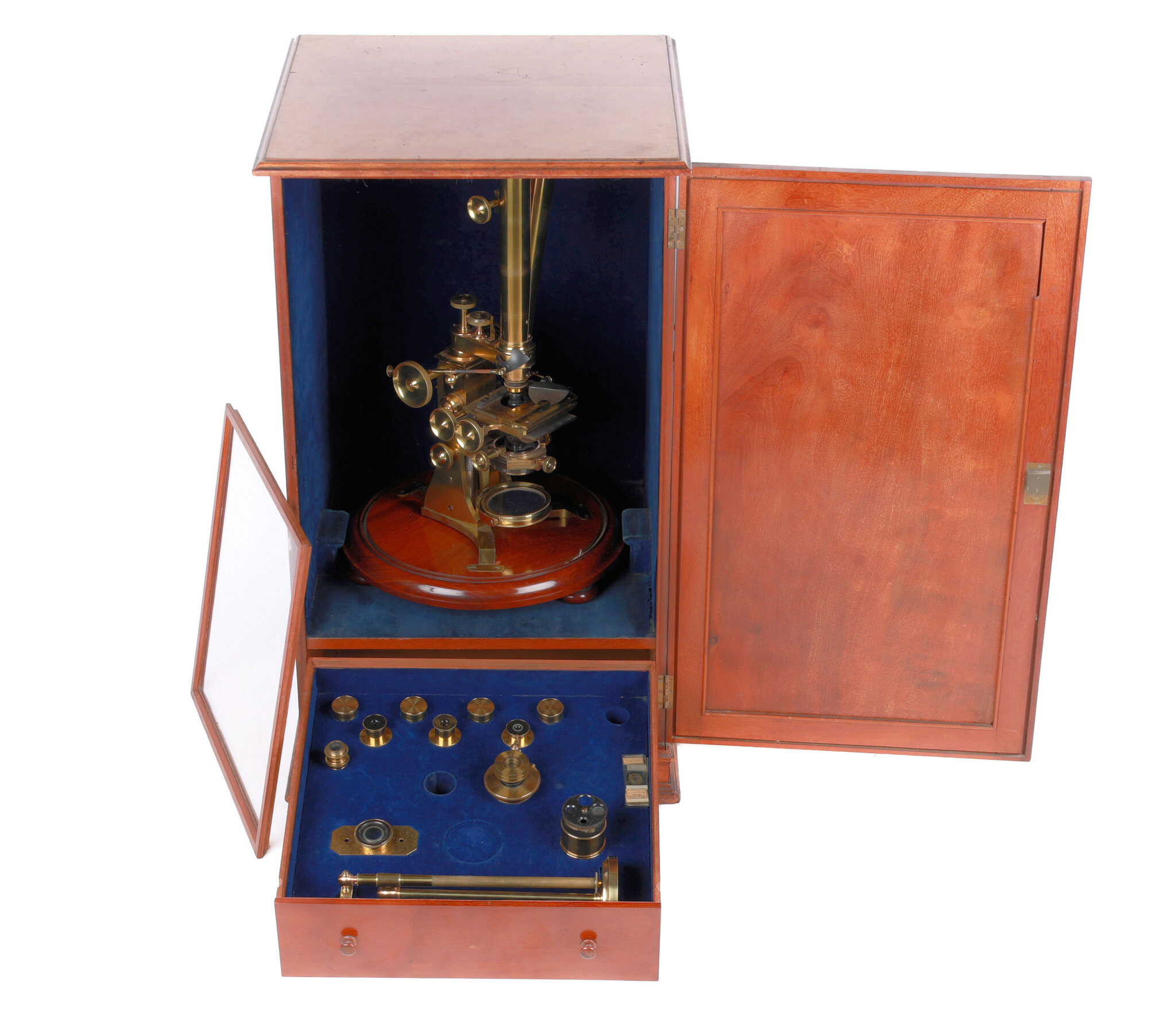
Very large binocular microscope in case with accessories.
£4,850
Possibly previously owned by Joseph Bancroft Reade, founder and president of the Microscopical Society.
Circa
1865
Country of manufacture
UK and Ireland
Description
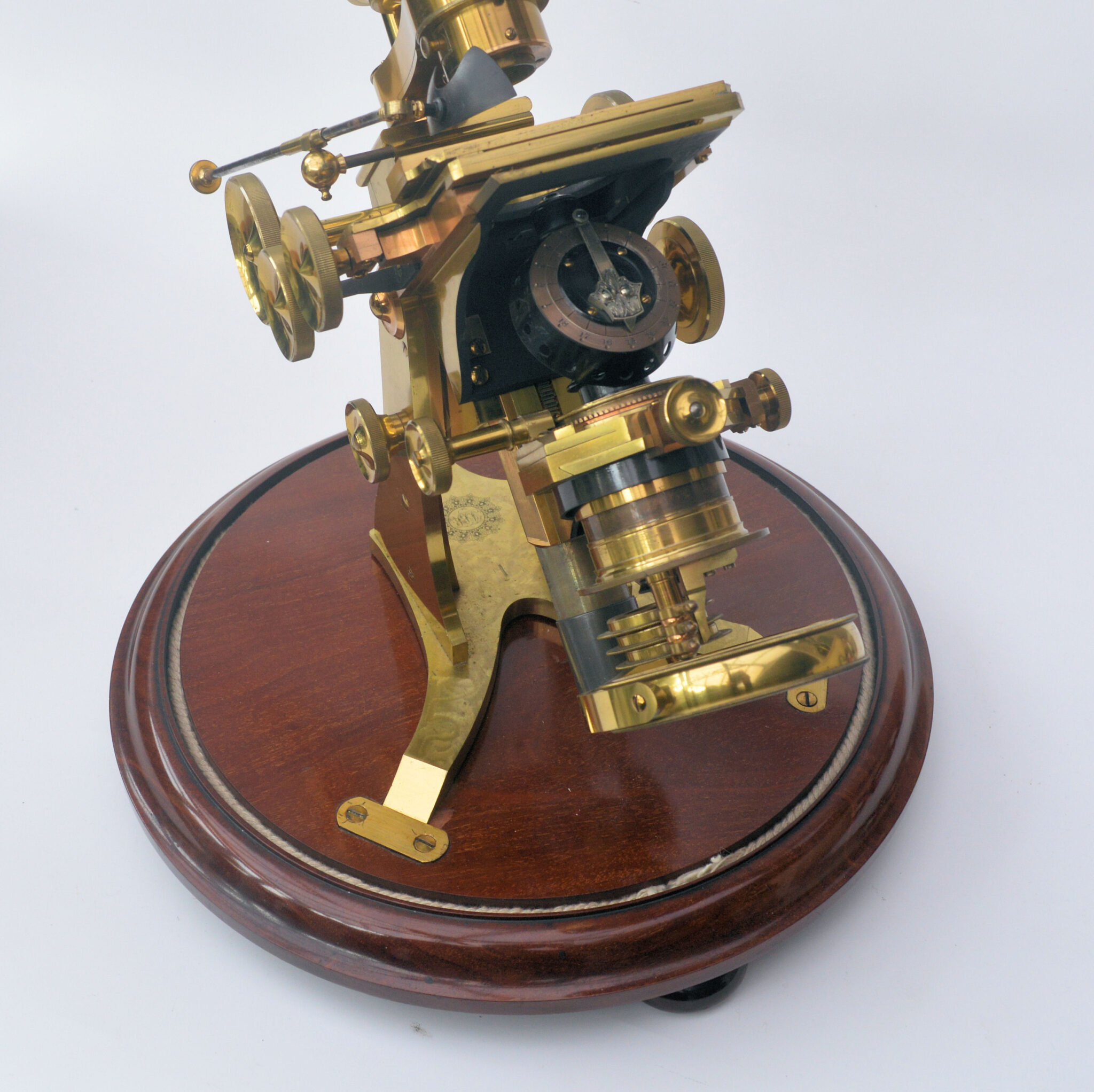
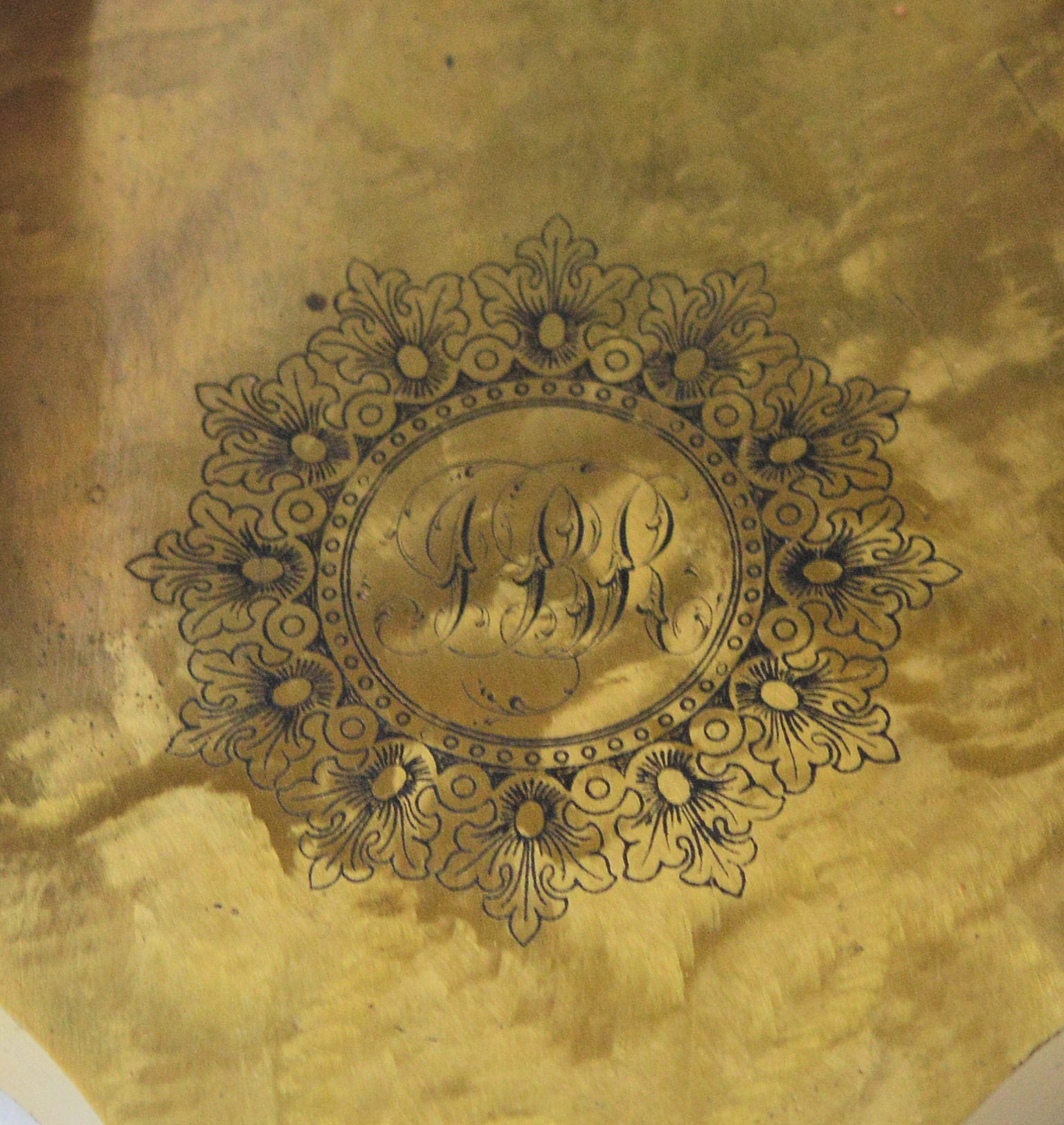
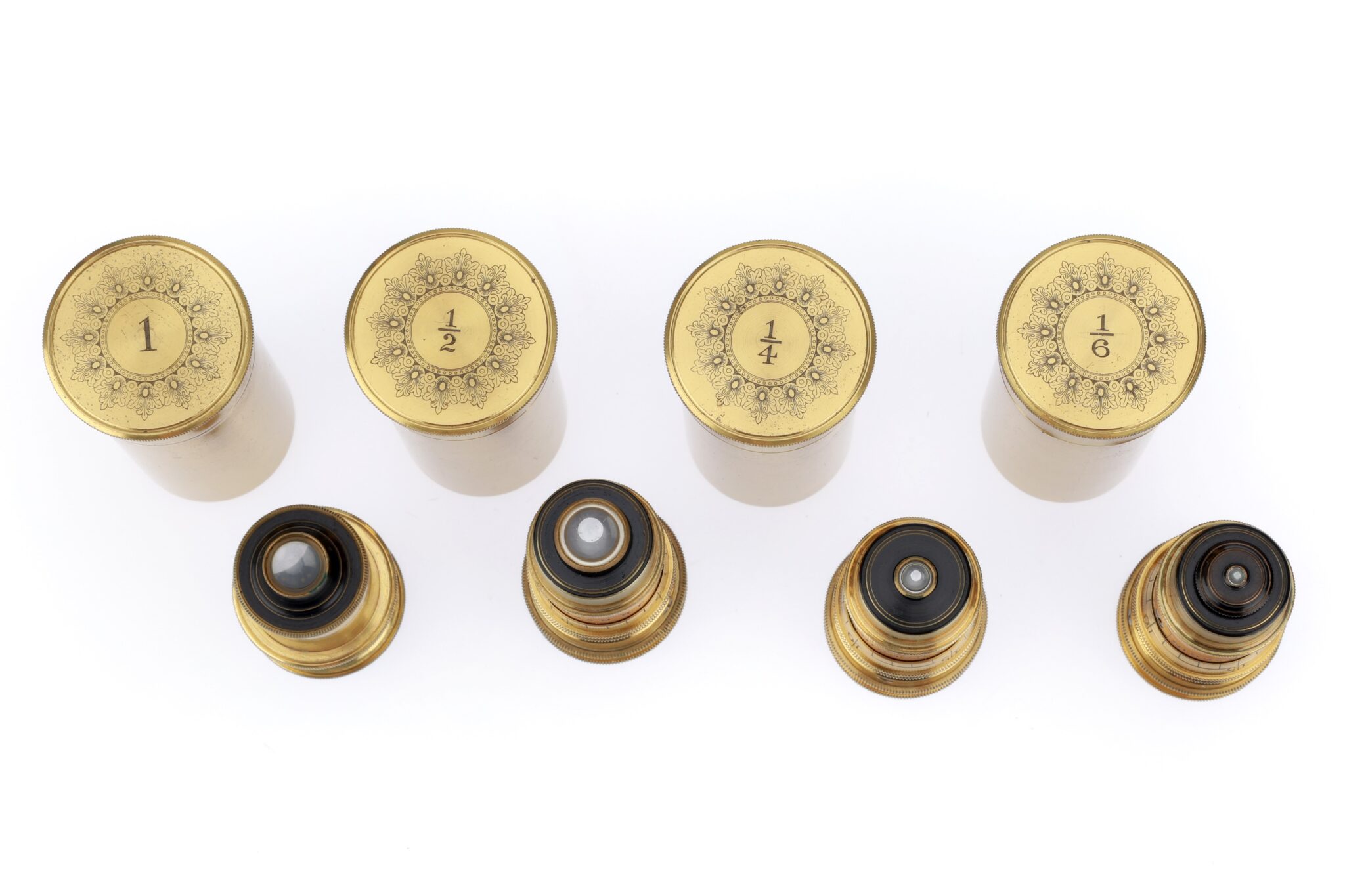
A substantial lacquered brass microscope, unsigned but almost certainly by Ross, the microscope foot finely engraved with the previous owners initials in a circular cartouche ‘J.B.R’, the cartouche design replicated on the objective canister lids.
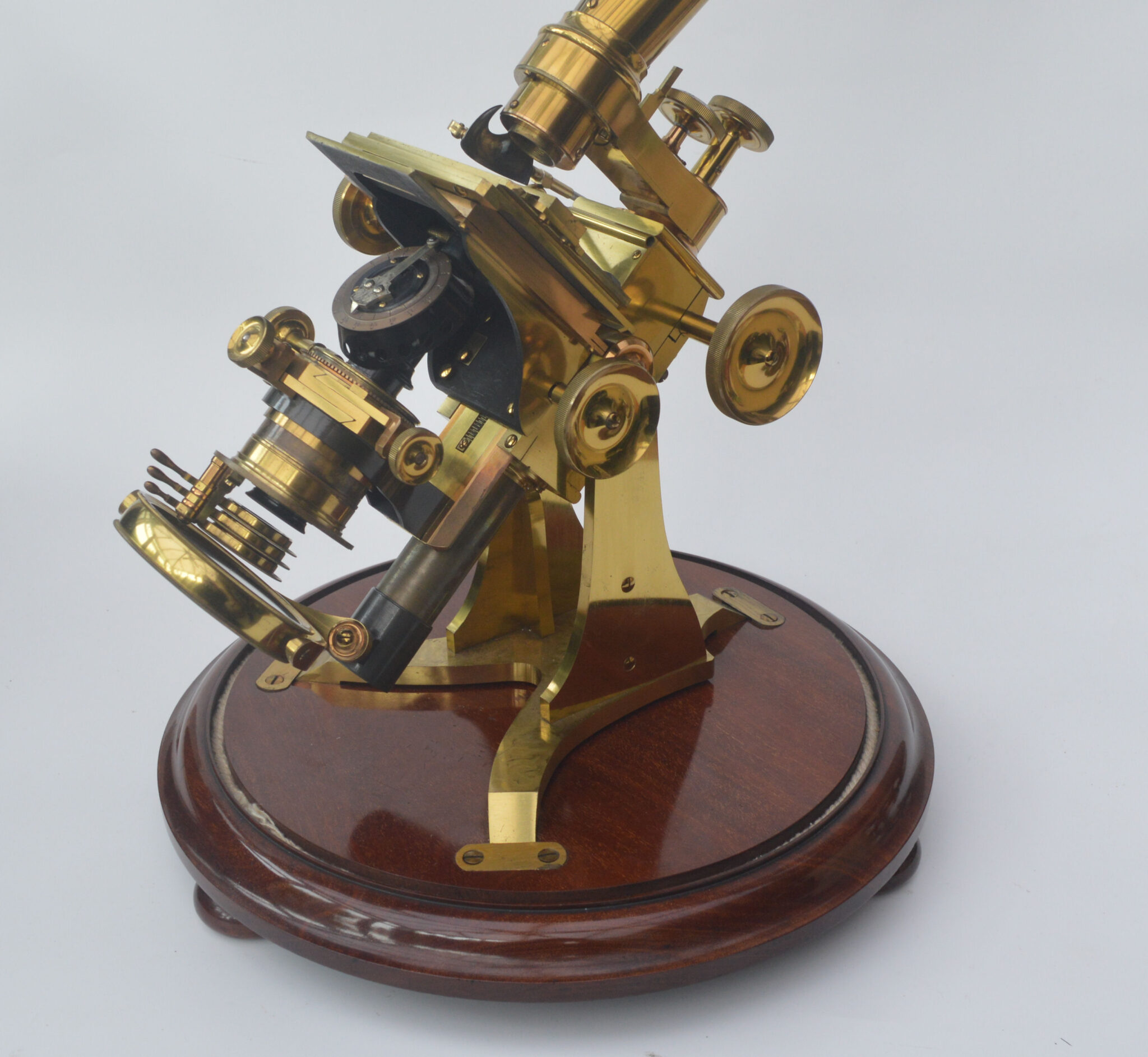
The microscope stand is a large ‘Y’ shaped base with a ‘machine finish’ below the golden lacquer, with 2 large uprights supporting the main microscope body on large trunnions, large (84mm diameter) articulated plano-concave mirror on sliding collar, octagonal substage collar mount with X-Y screw control, with crown and pinion gearing for rotation, with rack and pinion focusing, with Ross-Type Gillette’s condenser with engraved German silver spring to front, stage with X-Y control via rack and screw, with rotating slide holder finished in filigree work below the golden lacquer, large wheels to focus the course rack and pinion acting on trapezoidal cross-sectioned bar, Wenham prism in slide in/out drawer, binocular tubes with inter-ocular adjustment via rack and pinion at top. The microscope comes with the following accessories:
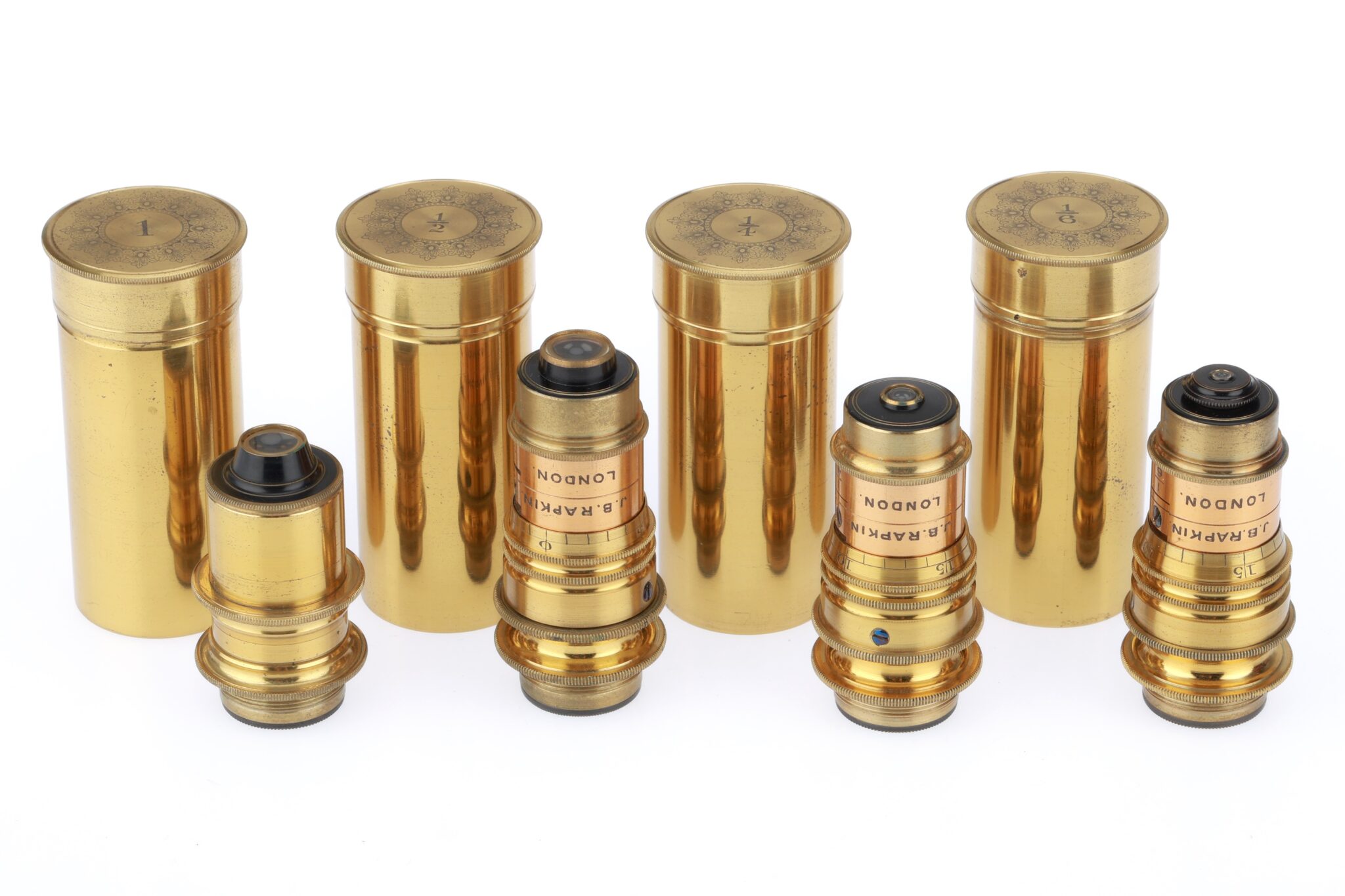
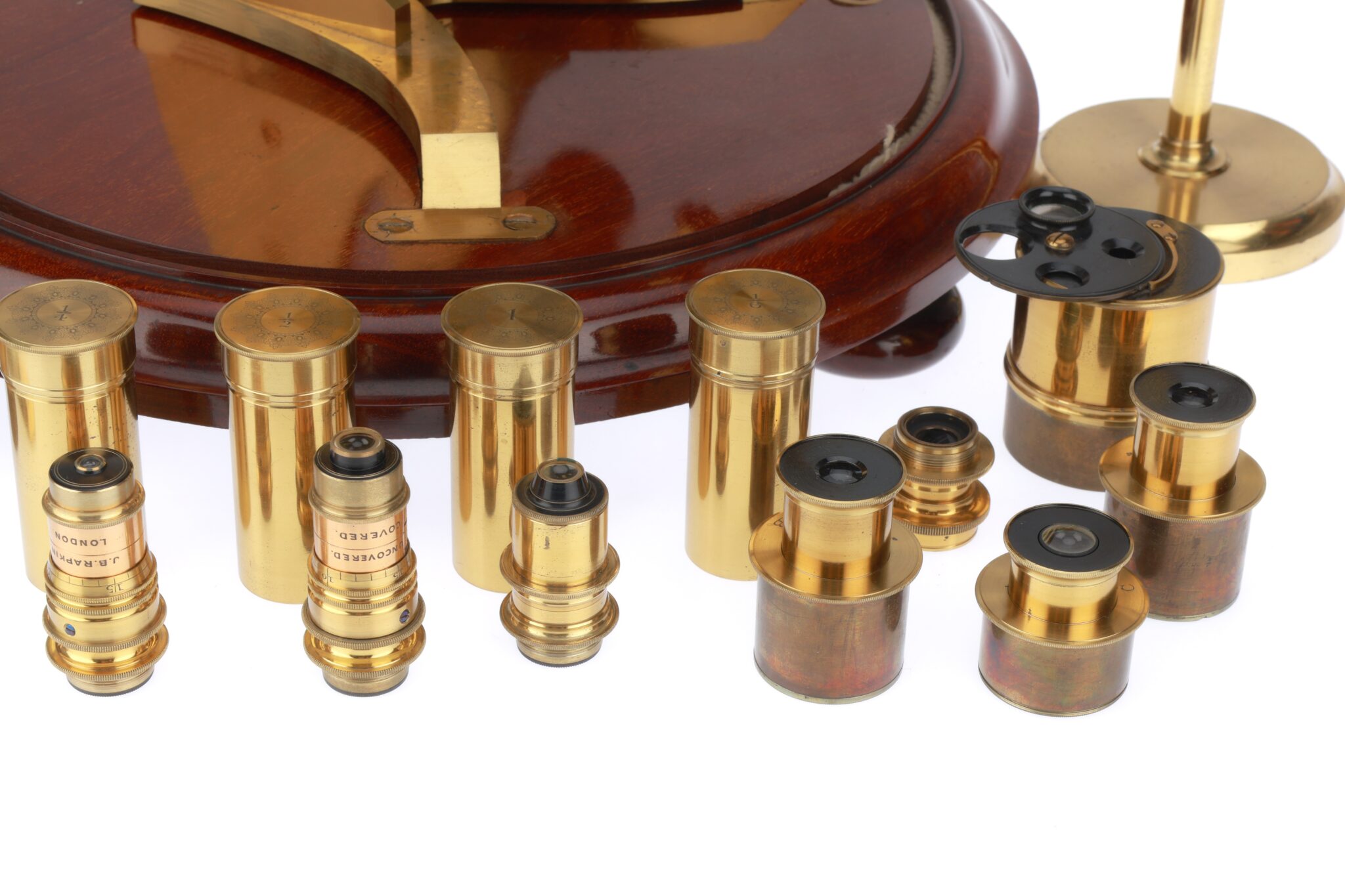
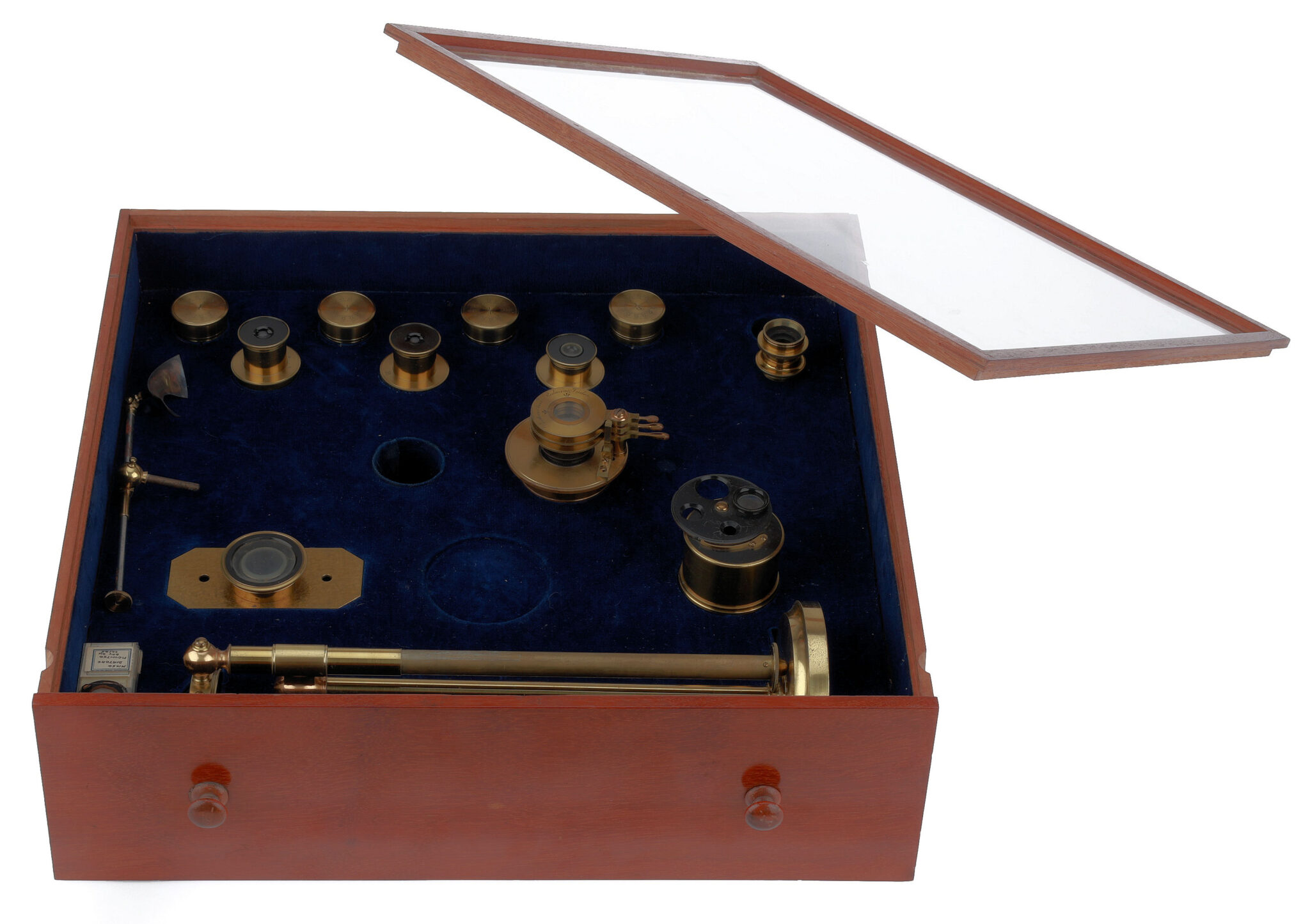
1 inch objective & can.
½ inch objective engraved J. B. RAPKIN LONDON & can.
¼ inch objective engraved J. B. RAPKIN LONDON & can.
1/6 inch objective engraved J. B. RAPKIN LONDON & can.
Objective collar side reflector.
Pair of low power binocular eyepieces.
Pair of medium power binocular eyepieces.
High power eyepiece.
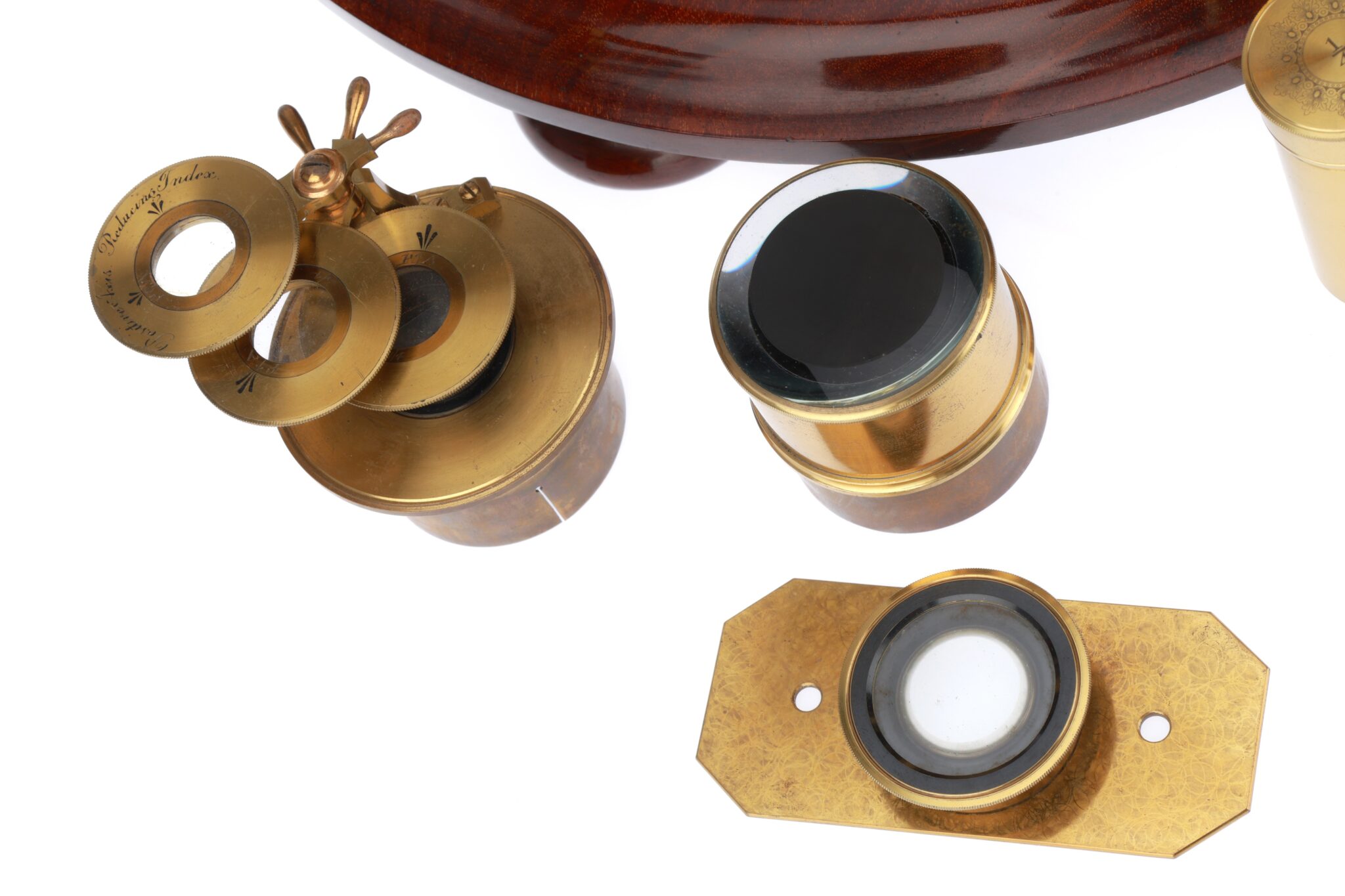
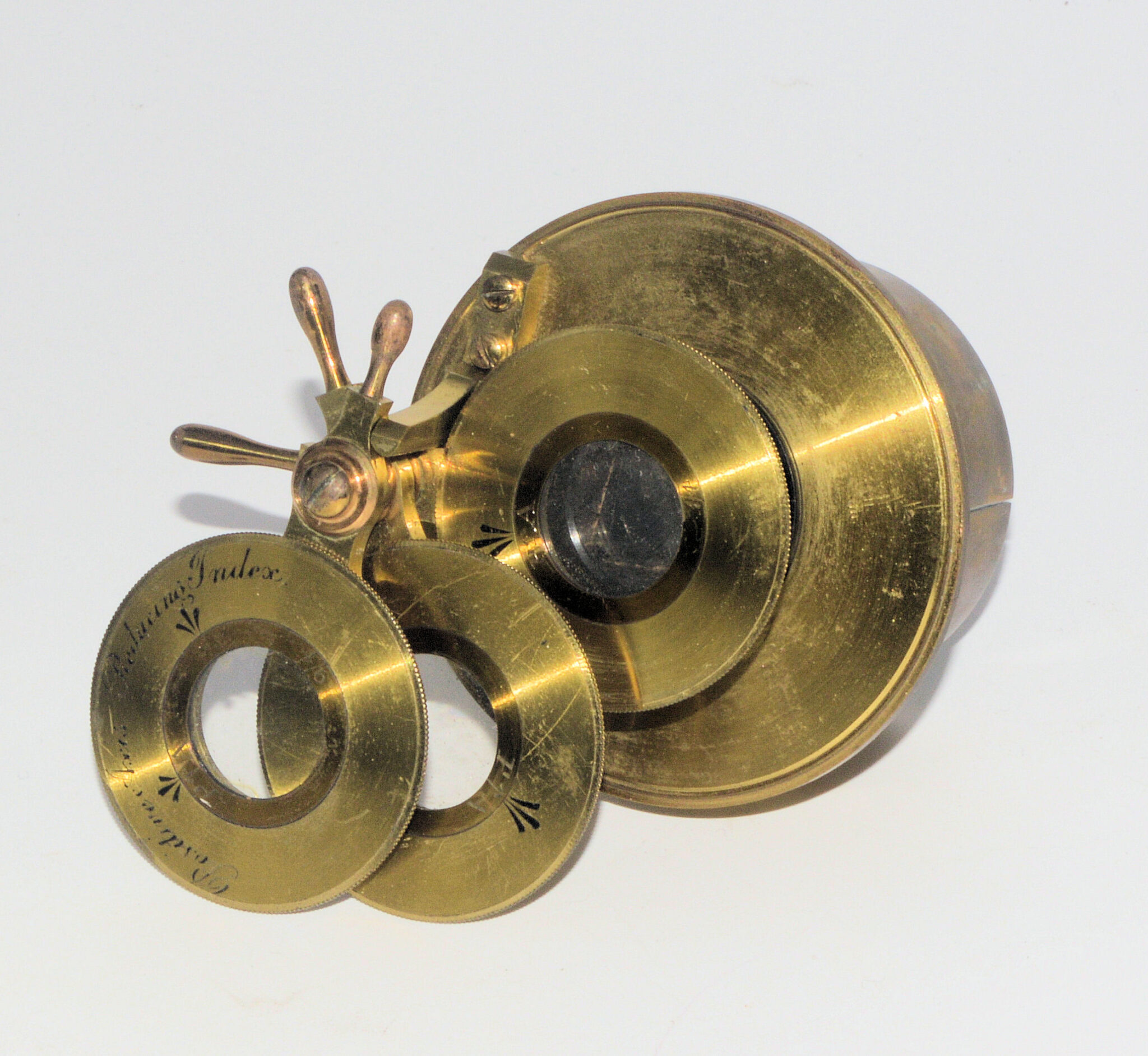
Gillette Condenser.
Spot lens condenser
Wheel of stops.
Large live box.
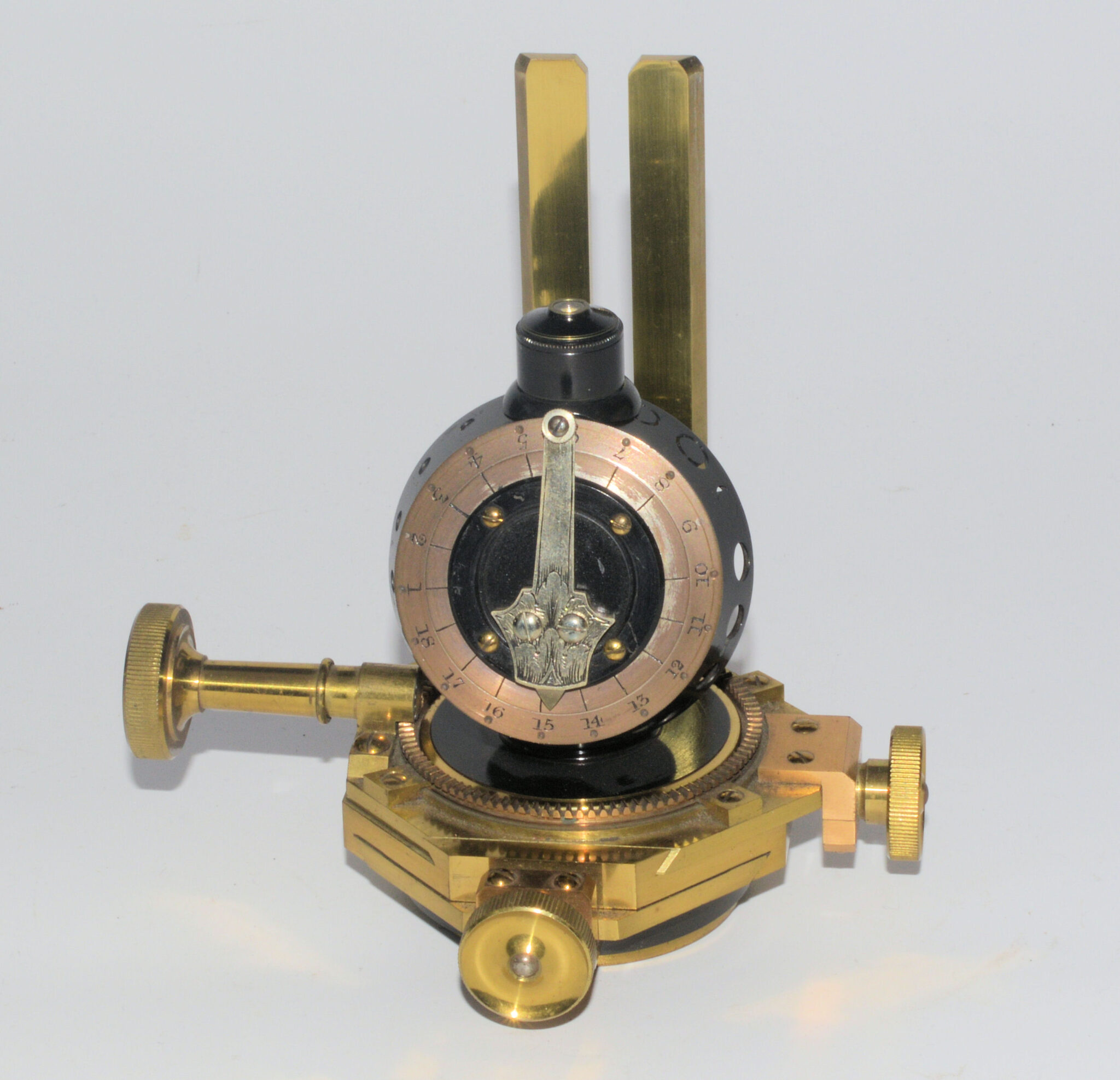
Large substage polariser with Nicol prism and selenite disks.
Objective analyser
Stage side reflector.
Large table condenser.
Contained within a substantial French polished wooden case, plinth base, with drop handles, panelled door with lock and key, with fitted drawer of accessories behind a lift off glass lid, microscope height (working height) 58cm, cabinet 81 x 47 x 46 cms.
The microscope is accompanied by a small archive of documents detailing research into its potential provenance. As three of the objectives are engraved ‘J.B. Rapkin’ the documentation explains a search at Companies House and the Post Office London Directories for such a person without result. There is no record of a J.B. Rapkin being involved in the making or selling of scientific instruments. The later firm of Pastorelli & A.T. Rapkin were specialised in the production of barometers and barographs and there is no proof that J.B. Rapkin was a related to A.T. Rapkin.
There is the possibility that the engraved initials may be that of Joseph Bancroft Reade, founder member of the Microscopical Society and President of the Society in his last two years (1869 – 70). That a later owner (J.B. Rapkin) purchased the microscope and had his name engraved on the objectives ………. seeing that ‘his’ initials were already engraved on the microscope foot and canister lids.
It would not be the first time that I have seen instruments with the owners or makers name / initials engraved on them, purchased later by someone with the same initials, with added engravings.
_____________________________________
A very clean and handsome instrument. Post to U.S.A. would be in the region of £500. U.K. post £35 or ideally I could deliver / meet potential buyers.