

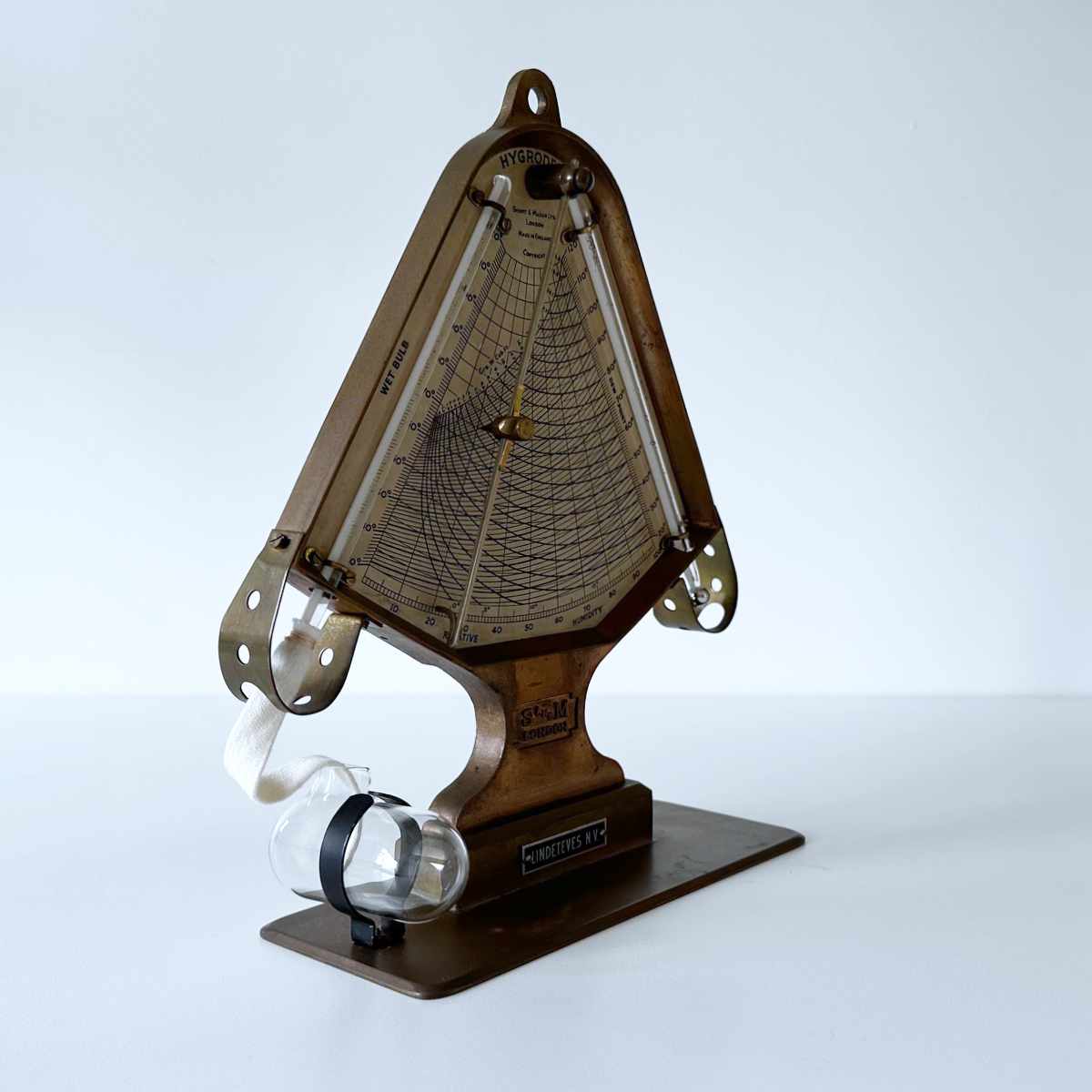
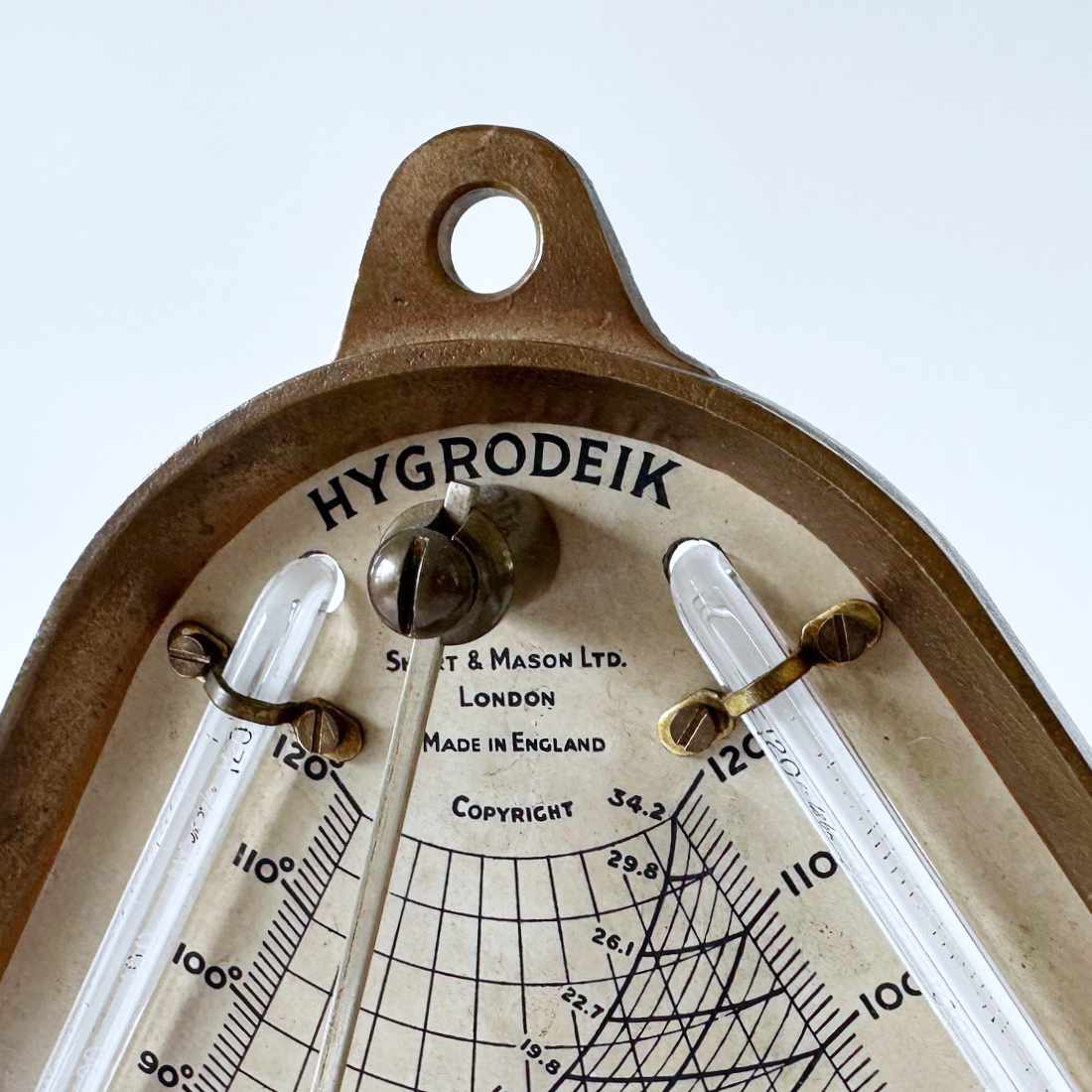
Hygrodeik or Wet & Dry Bulb Hygrometer by Short & Mason London
£795
Hygrodeik or Wet & Dry Bulb Hygrometer by Short & Mason London
Dimensions
H: 28 x W: 24 x D: 8cms
Circa
1910
Maker
Short & Mason
Country of manufacture
UK and Ireland
Description
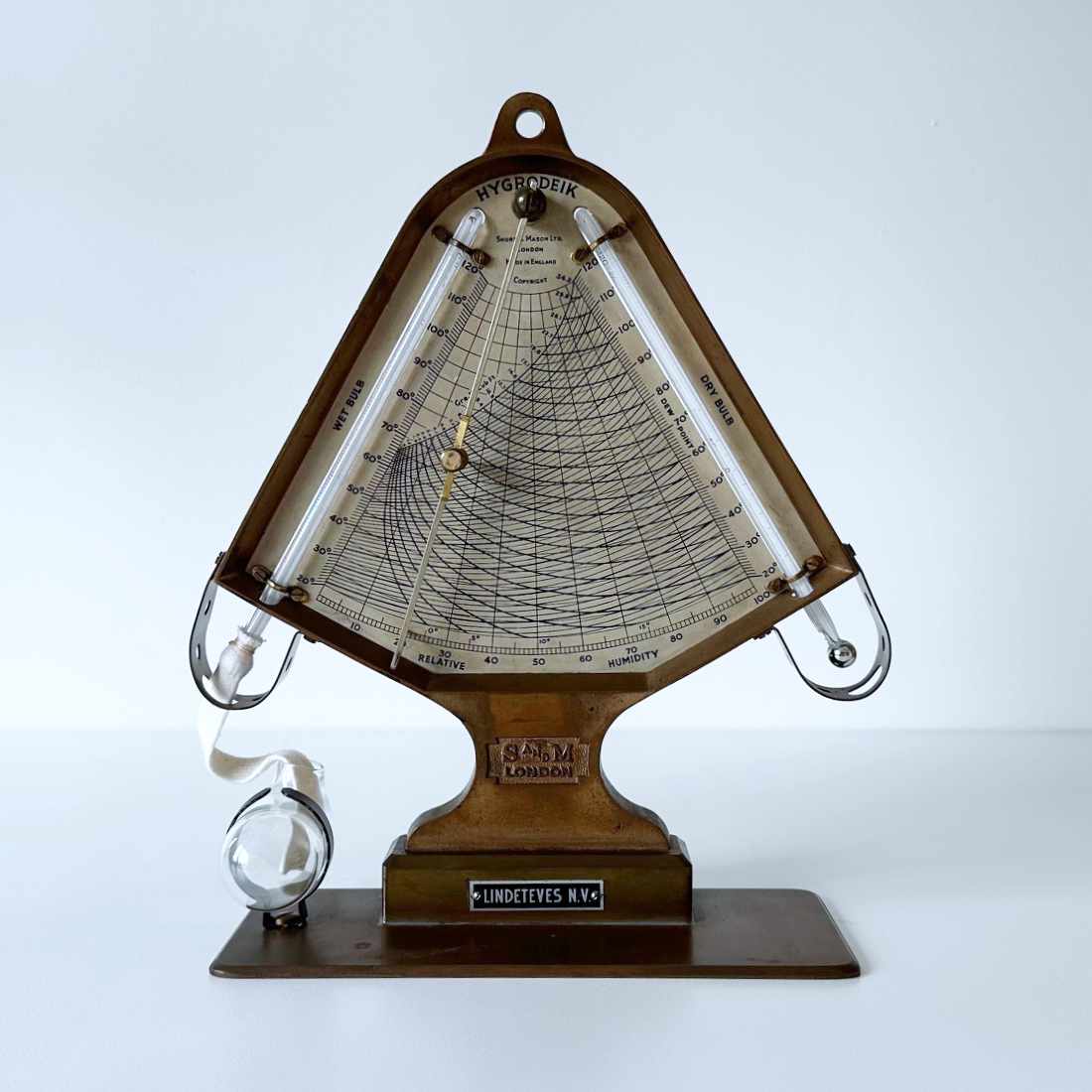
For sale, an Early Twentieth Century Hygrodeik or hygrometer by Short & Mason, London.
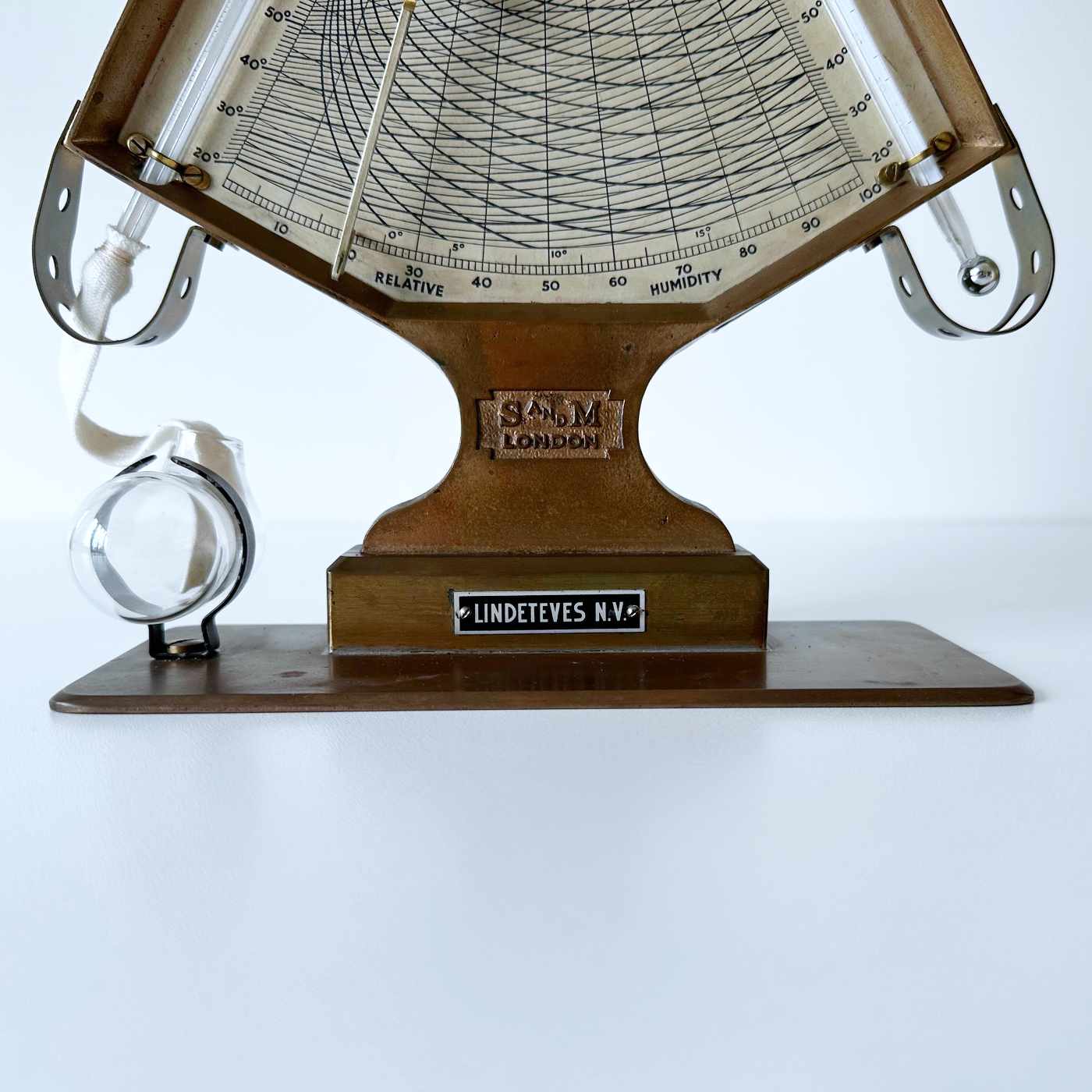
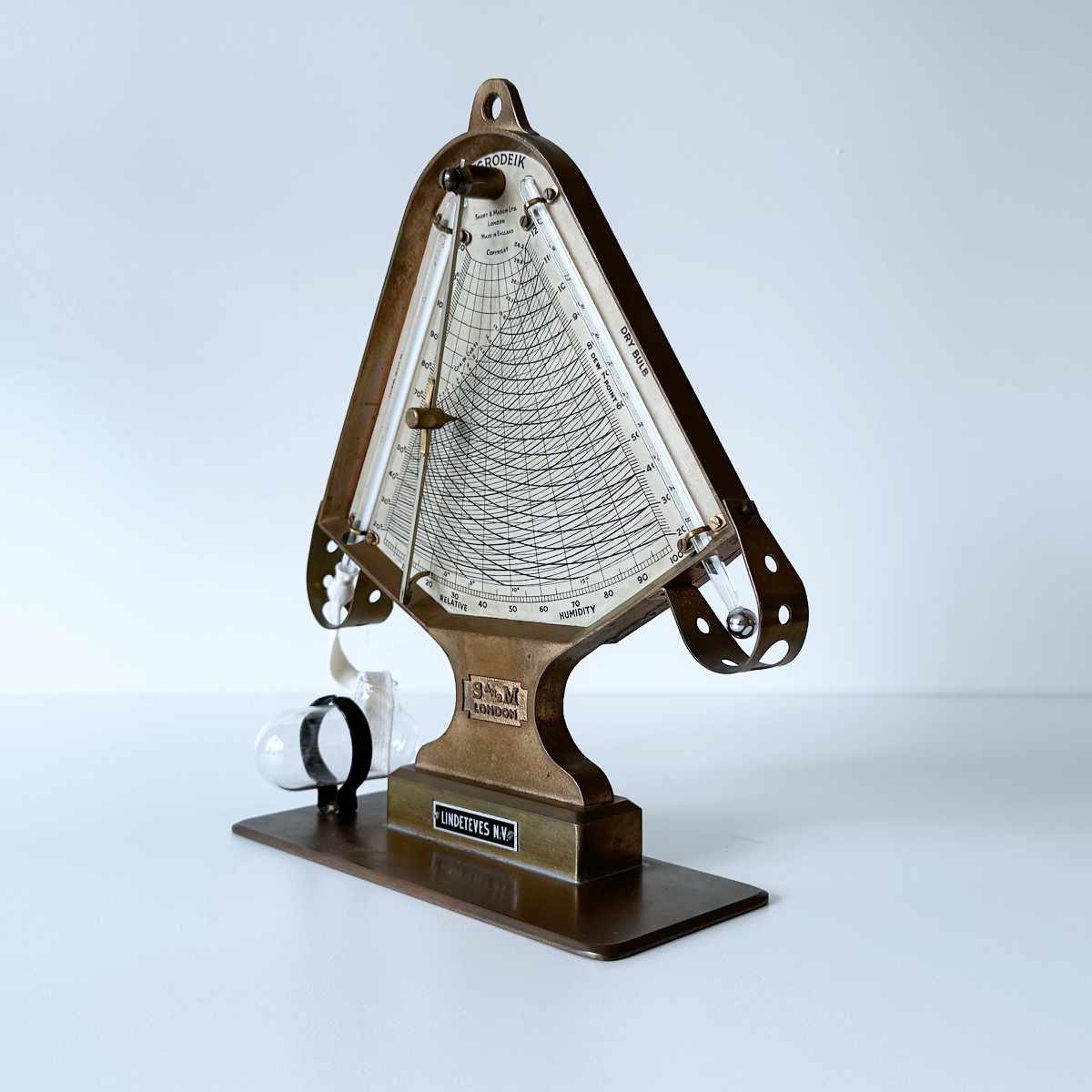
Manufactured from solid brass, this ingenious wet and dry bulb hygrometer is structured with both thermometers angled on either side of a triangular scale. The white glass backed thermometers have their bulbs protected at the protruding ends by means of solid brass loops with holes cut into them to aid the free flow of air. The wet bulb is covered with cotton tubing to keep it continuously damp by means of a glass water trough affixed to the base.
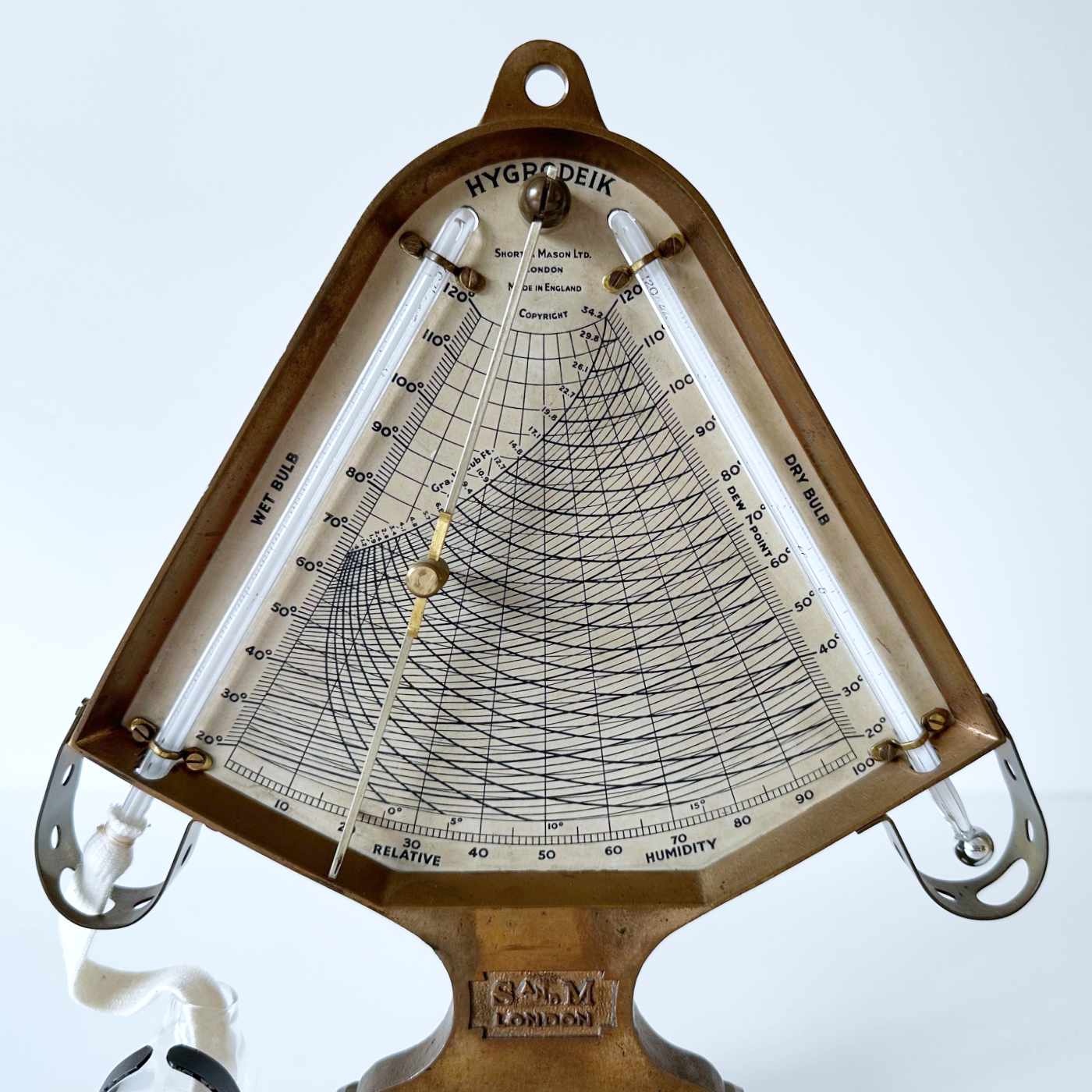
The central engraved and silvered dial reads from 10-100 degrees of humidity and has temperature scales running at the same angle as the thermometers. It has a central brass point hinged at the top of the scale with a secondary sliding pointer incorporated on the index arm. The brand name Hygrodeik appears at the top of the scale with the company name below, “Short & Mason Ltd, London and “Made in England”.
Its use is succinctly explained by means of the company’s 1911 catalogue.
“To find the relative humidity, swing the index hand to the scale at the left of the chart and set the sliding pointer at degree line on the chart which corresponds to the temperature shown upon the engraved stem of the wet bulb thermometer. Then swing the index hand to the right until the sliding pointer intersects the curved line which extends downwards to the left from the degree line on which the chart corresponding to the indicated temperature of the dry bulb thermometer. At this intersection the index hand will point to the relative humidity on the scale at the bottom of the chart.”
More detailed usage directions are provided to the reverse of the hygrodeik which are presented on a white early plastic background. The cast brass base is further impressed with the company logo for “S&M, London”. A further metallic plaque has been applied to the front of the instrument which denotes the name of the company who originally purchased it.
This example may be considered as the “hanging” example of the hygrodeik given the appearance of a hanging loop to the top of the instrument although it sits perfectly well on a desktop.
The makers Short & Mason were formed by Thomas Watling Short & William James Mason in 1864 and were based in Hatton Garden, London. They were makers of barometers and scientific instruments, but a significant part of their business was focused upon aneroid barometers and later barographs for which they had an unparalleled reputation by the end of the Nineteenth Century.
The partnership between the founders was dissolved at the turn of the century and the company was acquired by the US Company, Taylor Brothers who themselves had been in the business of scientific instrument making since 1851. Taylor Brothers benefited from the expertise that Short & Mason brought to the company and the instruments produced, were variously signed depending on which market the instrument was destined. In 1907, the US arm renamed itself The Taylor Instrument Company and began to use the brand name of, Tycos. This was eventually dropped in 1932 and the company reverted to the Taylor name.
From extant advertising, the Hygrodeik seems to have been developed during the company’s period of renaming its US arm under the brand name, Tycos since both US and UK catalogues use similar imagery. The UK catalogues also present images of instruments which are branded to Tycos indicating that the company thought it unnecessarily costly to reproduce the same with S&M branding.
Hygrodeiks in this condition are rare, they often have broken thermometer and missing parts. They are also more commonly presented under the US Tycos brand so to find a good working English made example with Short & Mason branding is a pleasure.
Circa 1910