

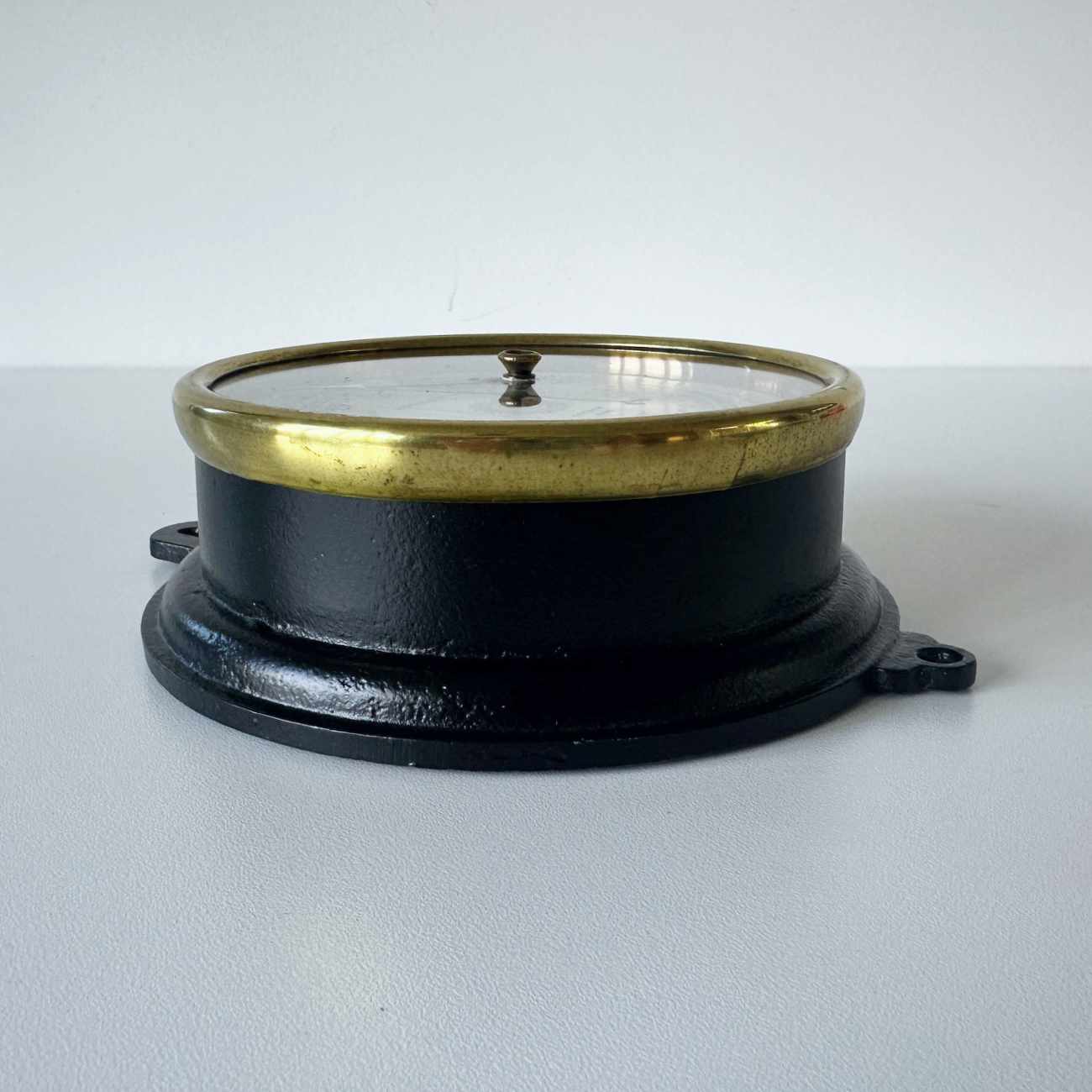
Mid Victorian Marine Aneroid Barometer by Norie & Wilson London
£395
Mid Victorian Marine Aneroid Barometer by Norie & Wilson London
Dimensions
H: 20 x W: 16 x D: 5.5 cms
Circa
1870
Maker
Norie & Wilson
Country of manufacture
UK and Ireland
Description
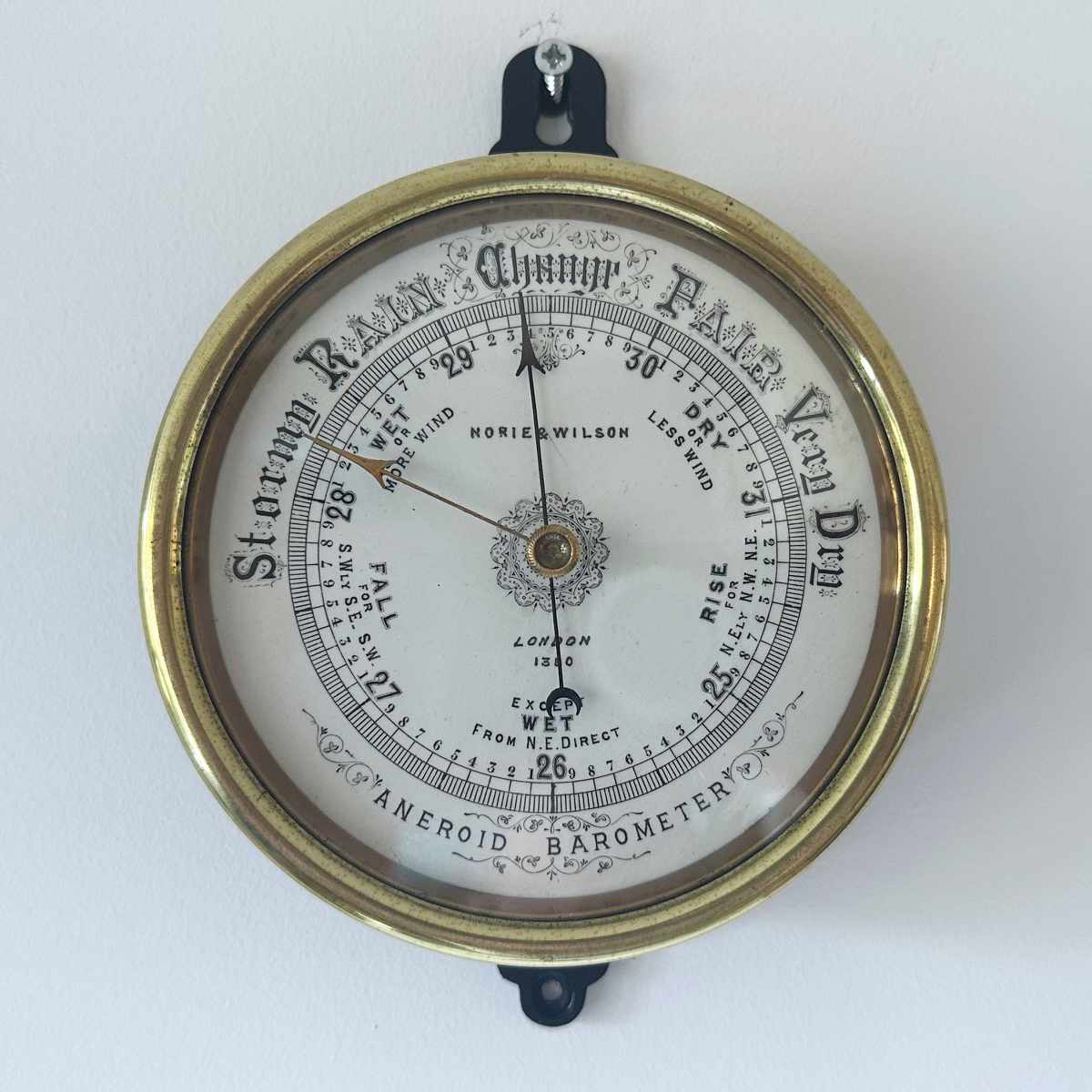
For sale, a mid-Victorian marine aneroid barometer by Norie & Wilson, London.
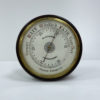
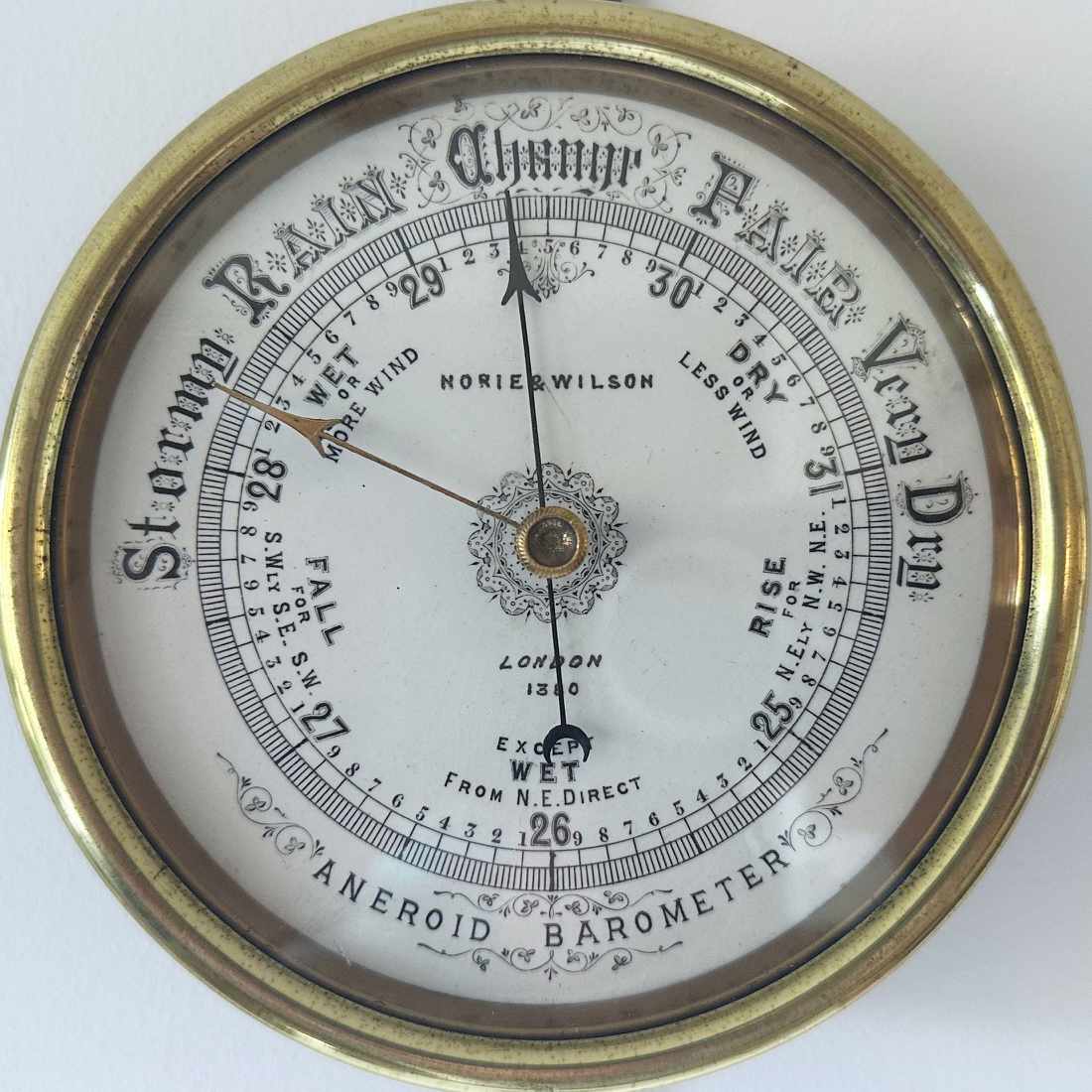
Comprised of a five-inch painted ceramic dial with a 360 degree scale divided from 25 to 31 inches of barometric pressure. The space on the outside of the scale is dedicated to standard Fitzroy type weather indications in beautifully decorated Gothic typeface to the upper half and the words aneroid barometer to the lower half.
The inner dial is provided with more complex weather indications akin to those which are found on the RNLI Fisherman aneroid barometers produced by Negretti & Zambra and Dollond during the same period. These indications align the barometer reading, its direction of movement together with the prevailing wind direction.
The centre of the dial is reserved for the makers name, Norie & Wilson, London and with a decorative rosette surrounding the centre. The barometer is complete with a blue steel pointer with half moon design and a brass set hand which is operated by a brass knurled adjuster above the glass.
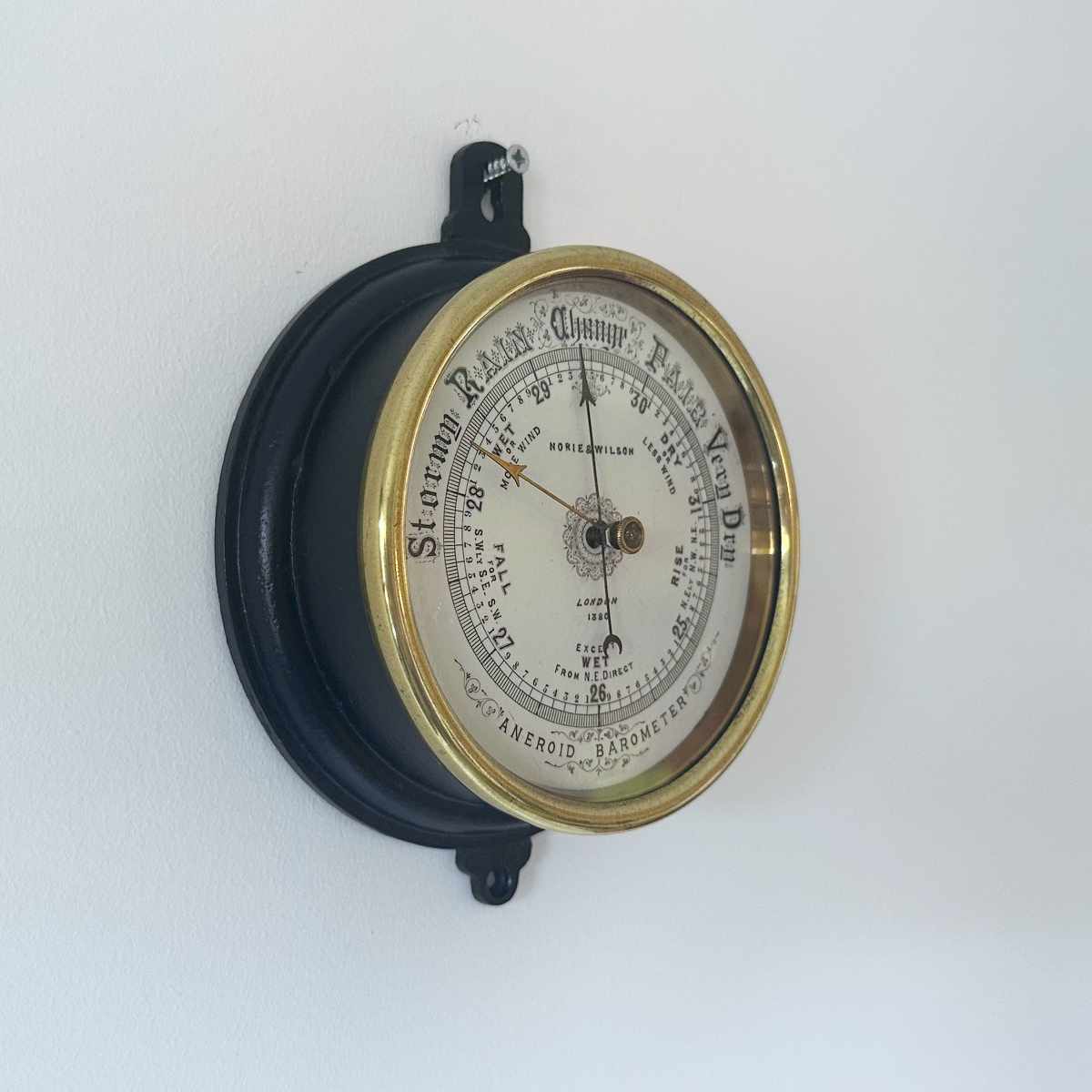
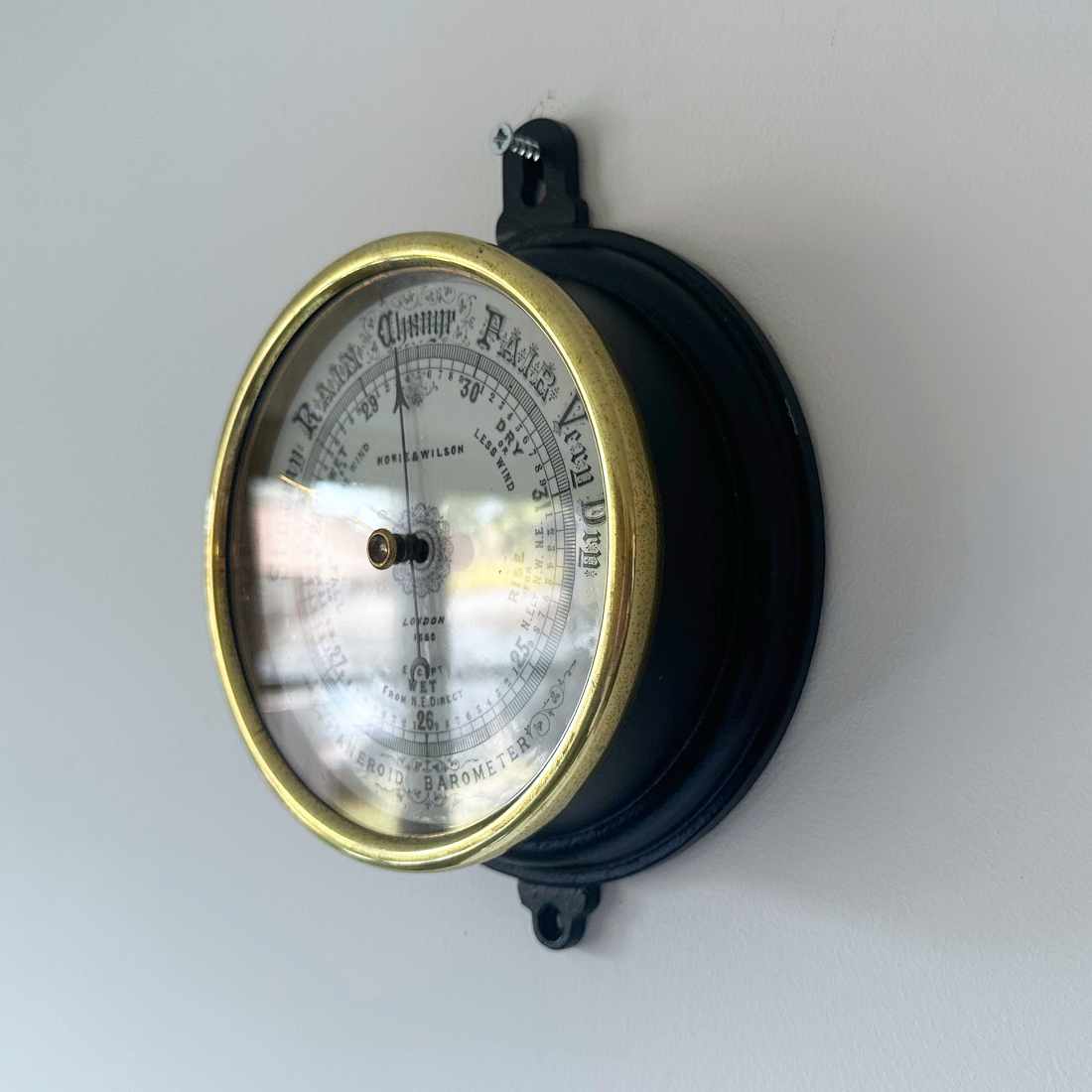
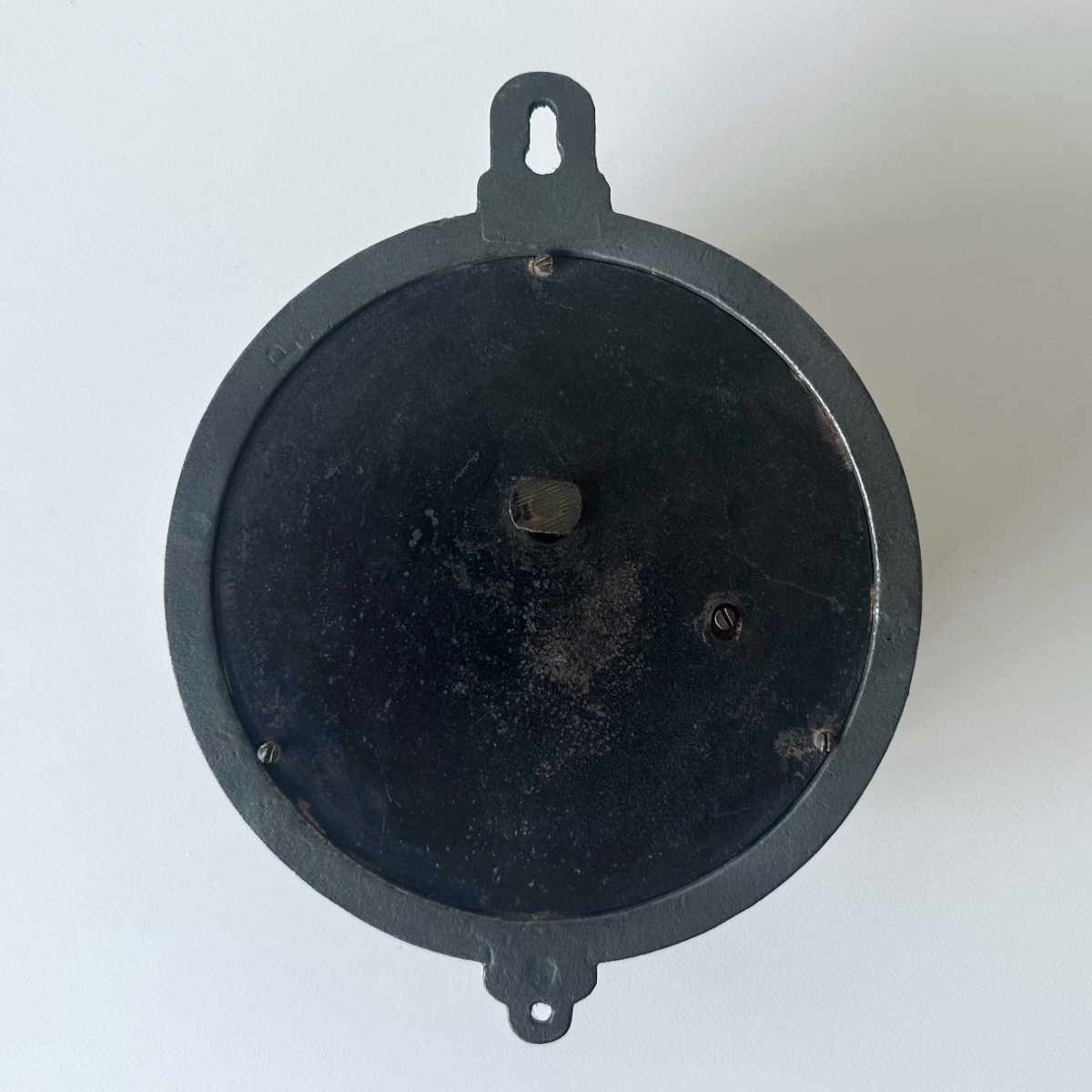
The dial and glass face sit behind a thick brass bezel which sits over a cast iron case with integrated hanging points to the top and bottom.
An interesting example of this style of maritime barometer which became prevalent around the 1870’s and from a company who served the maritime industry for many generations.
The origins of the company of Norie & Wilson stem back to the marine map maker, William Heather whose trading dates span a short period from 1793 to 1812. He was apprenticed to the engraver and stationer, George Mitchell in 1780 but accounting for a seven-year training period, his activities are not well documented until his arrival at 157 Leadenhall Street, a premises from which he traded throughout his entire remaining career.
In 1795 Heather opened The Navigation Warehouse and Naval Academy at this address, which saw huge trade from its proximity to The East India Company’s Headquarters. Later, it was also the premises for John Gilbert the Younger and the partnerships of Gilbert & Wright and later Gilbert & Gilkerson. Heather’s arrival at the address was prompted by his takeover of the chart publishers Mount & Page. His trade card of the period states that he sells “sea books, charts, sextants & all kinds of nautical instruments.”.
Heather employed John Norie at Leadenhall Street and there is some suggestion that Norie was initially a teacher at the Naval Academy also being run from the Heather’s premises. The relationship was seemingly a cordial one as Norie is known to have published his own book on seamanship in 1805, “A Complete Epitome of Practical Navigation” which went through numerous reprints, and Norie even named one of his sons after his employer (William Heather Norie). Upon Heather’s retirement or death in 1812, he became the obvious candidate to take over the business renaming it to JW Norie & Company. It is suggested that this move was secured with the financial assistance of George Wilson, an investor with little experience in the Maritime industry.
In 1838, George Wilson’s nephew Charles joined the company. Charles was born in Lucknow, the son of an Indian Princess Hoosainee Begum of Ashrafabad and Lieutenant-Colonel William Wilson, initially involved in the wine trade, he joined his uncle’s chart-making business just two years prior to Norie’s retirement in 1840 and after succeeding to ownership renamed it to Norie & Wilson.
Wilson continued to manage the business through the rest of his career until his death in 1882 where the business was passed to his sons George and William Wilson. Twenty years later, the firm was merged with the historic chart-making firms of James Imray & Sons and that of RH Laurie & Co to become Imray, Laurie, Norie & Wilson. It still exists today in St Ives Cambridgeshire as Imray, providing sea charts for “leisure sailors”. To have endured for this period of time is an astonishing achievement.
Although the original premises of the Navigation Warehouse are sadly lost to development, a model of the mid-shipman carving that used to adorn the premises still exists in The Charles Dickens Museum, an appropriate place since The Navigation Warehouse was used by Dickens as inspiration for Sol Gill’s shop in the novel Dombey & Son.
Circa 1870