

Victorian Cased Aneroid Barometer to TS & JD Negus of New York
£451
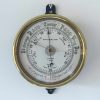
Victorian Cased Aneroid Barometer to TS & JD Negus of New York
Dimensions
Case = H: 15 x W: 14 x D: 7cms
Circa
1880
Maker
PNHB
Country of manufacture
France
Description
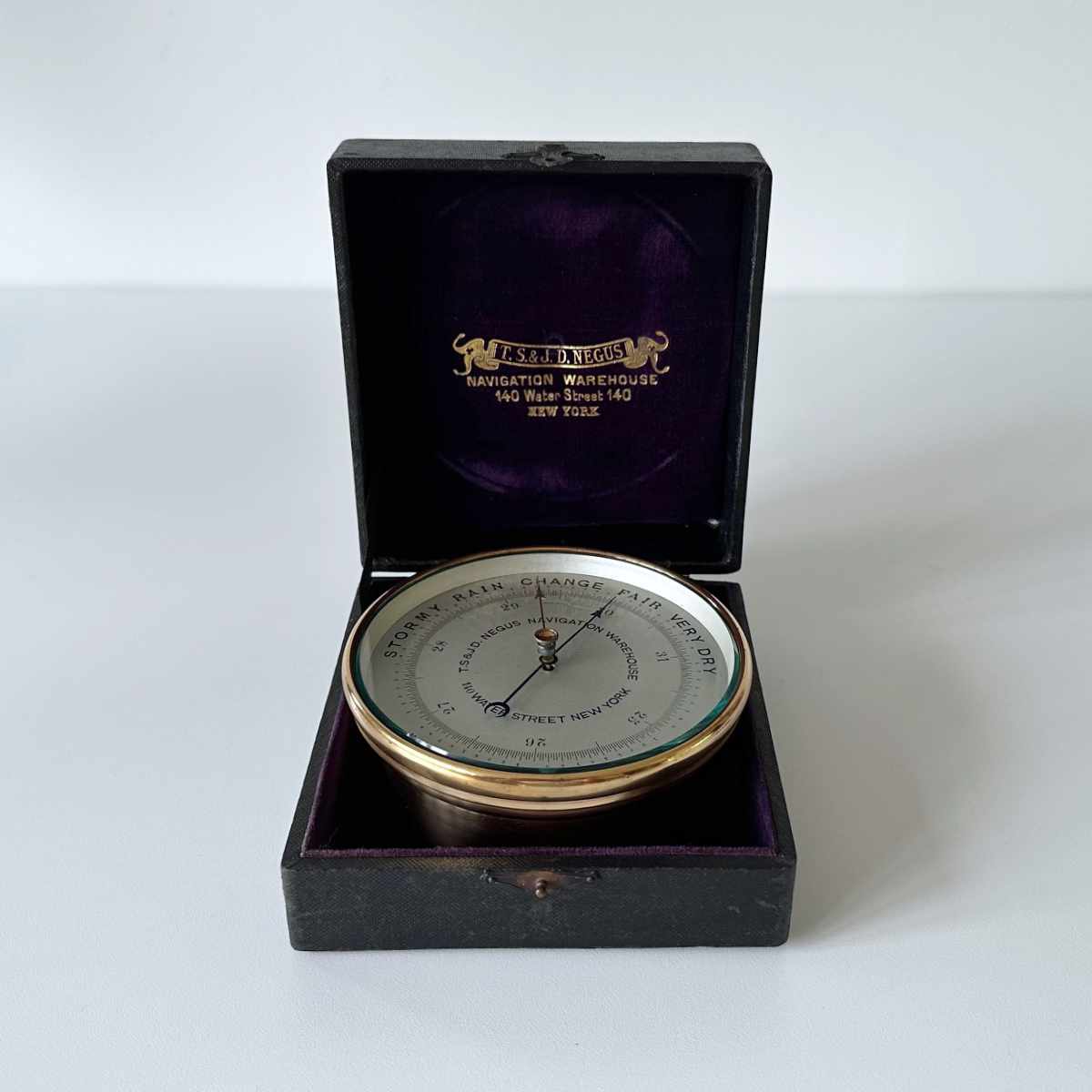
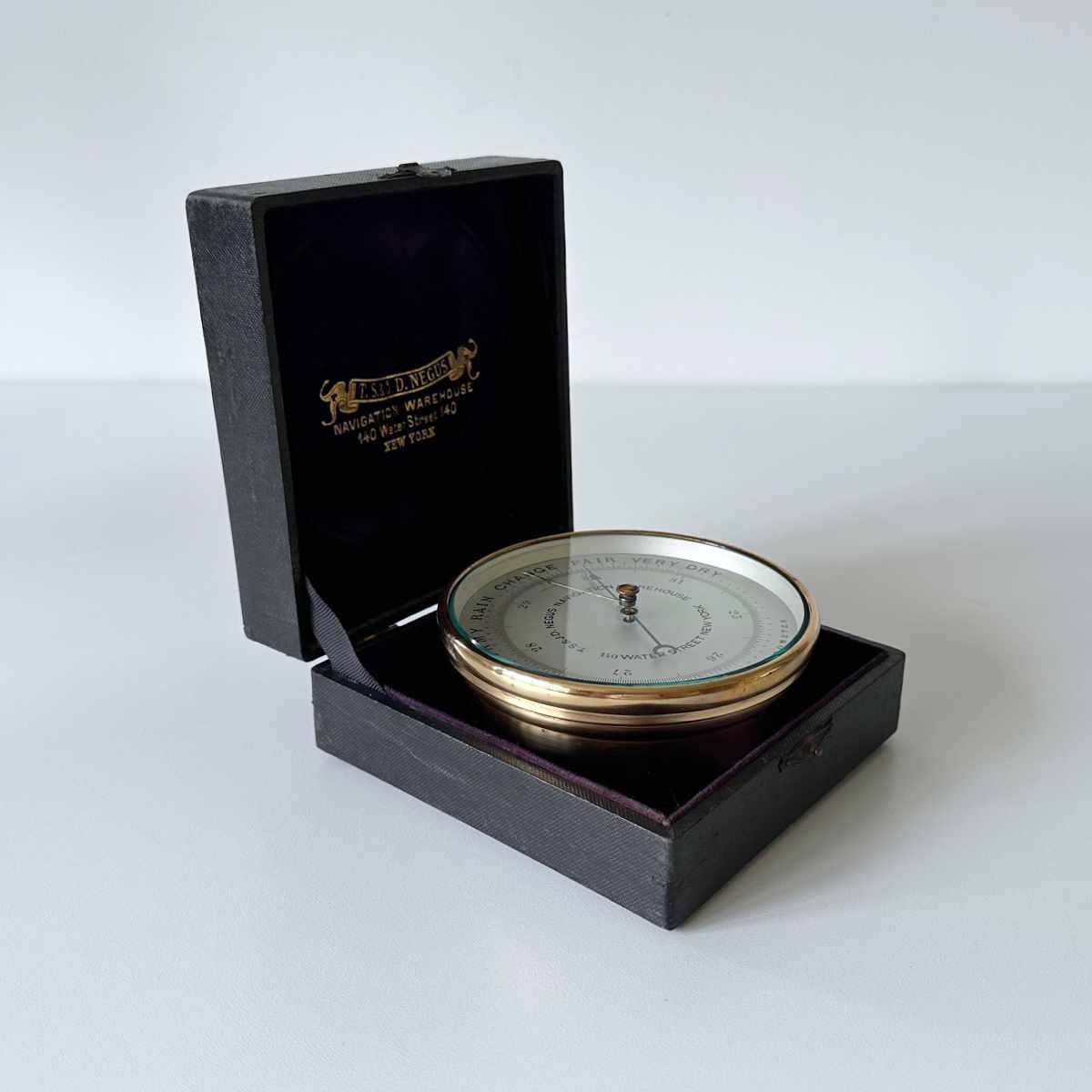
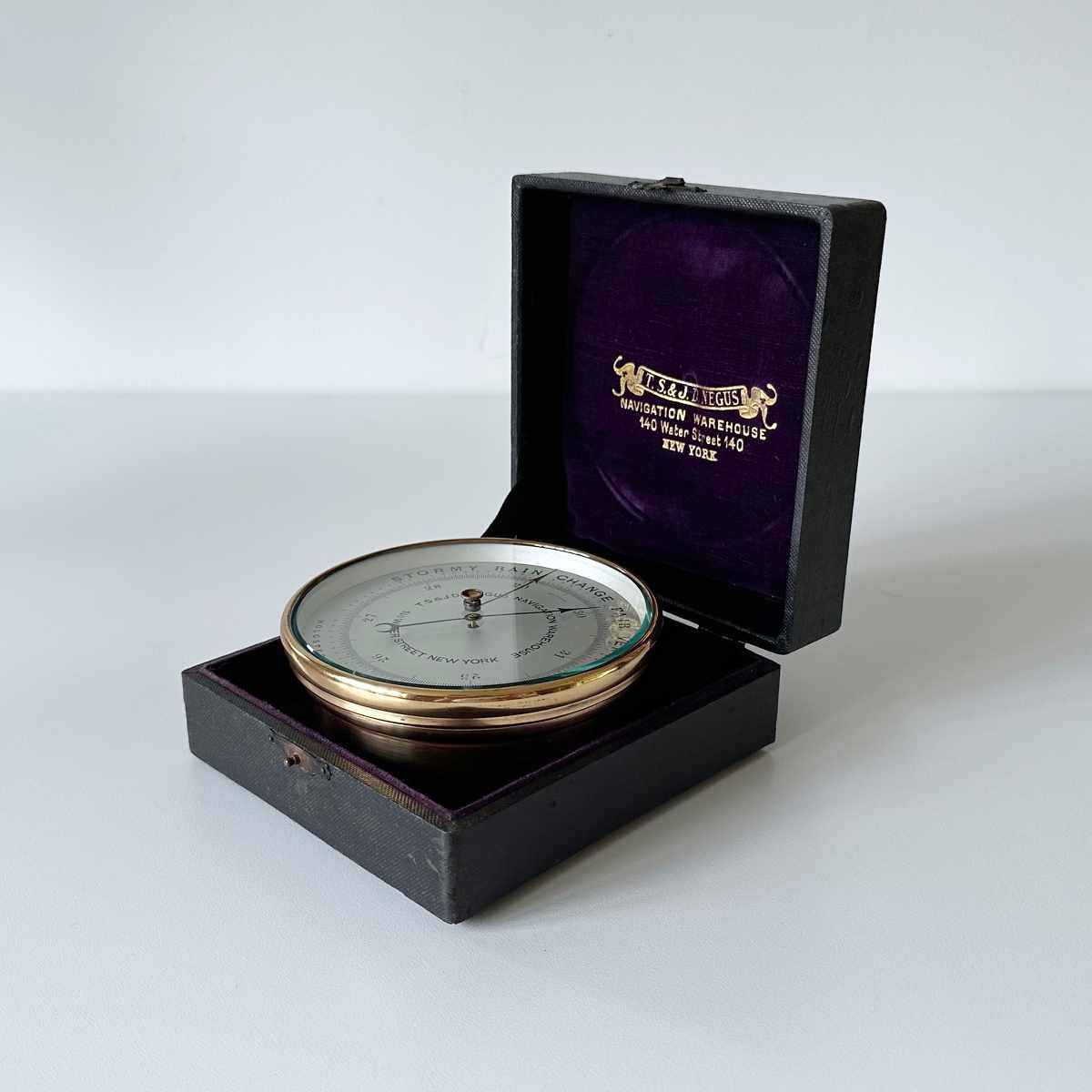
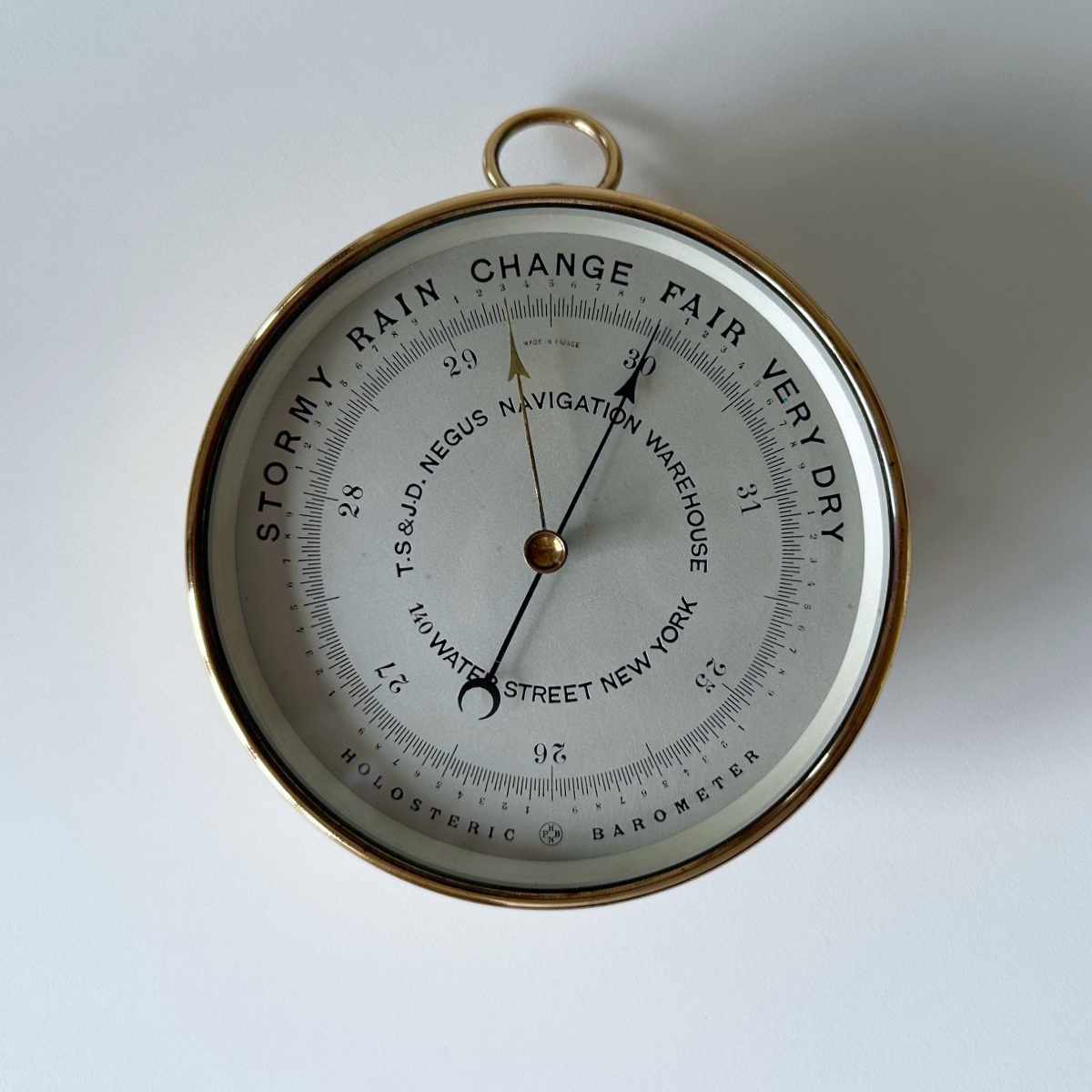
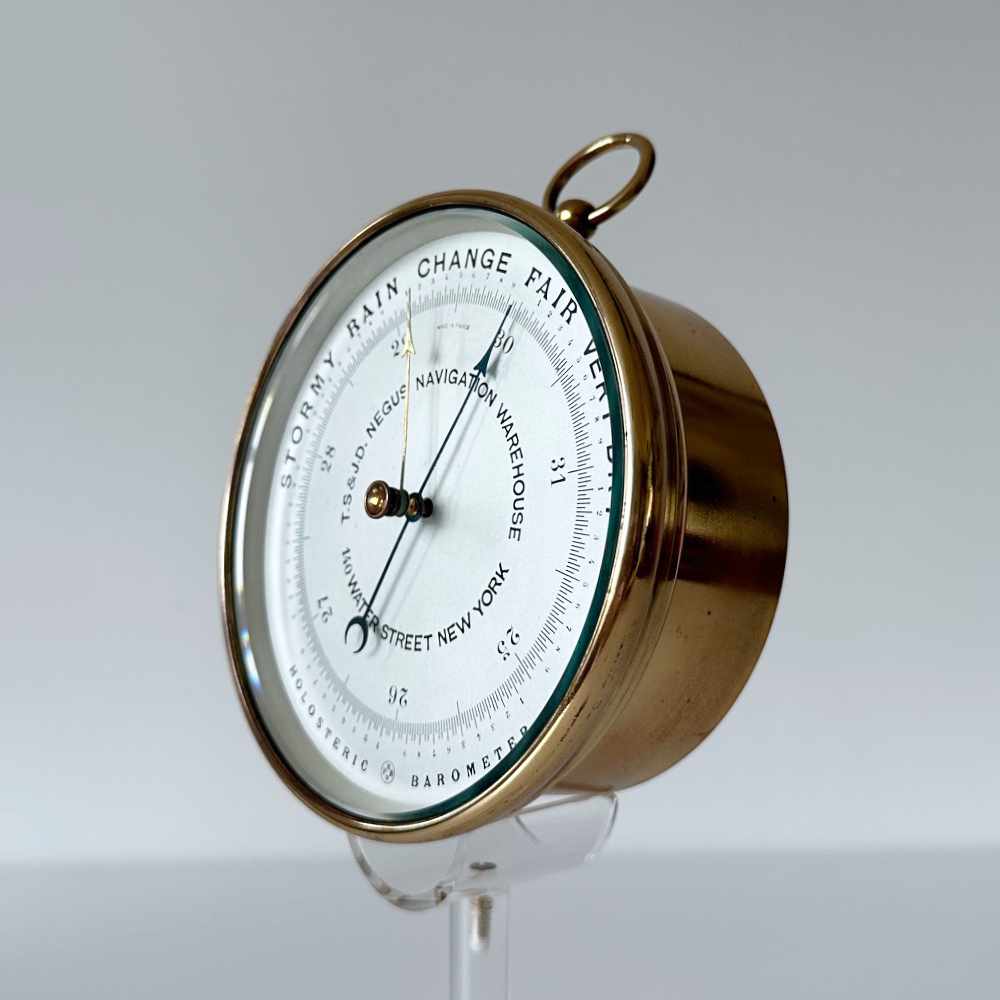
For sale a mid-Victorian Aneroid barometer engraved to TS & JD Negus, Navigation Warehouse, 140 Water Street, New York and manufactured by PNHB in its original case.
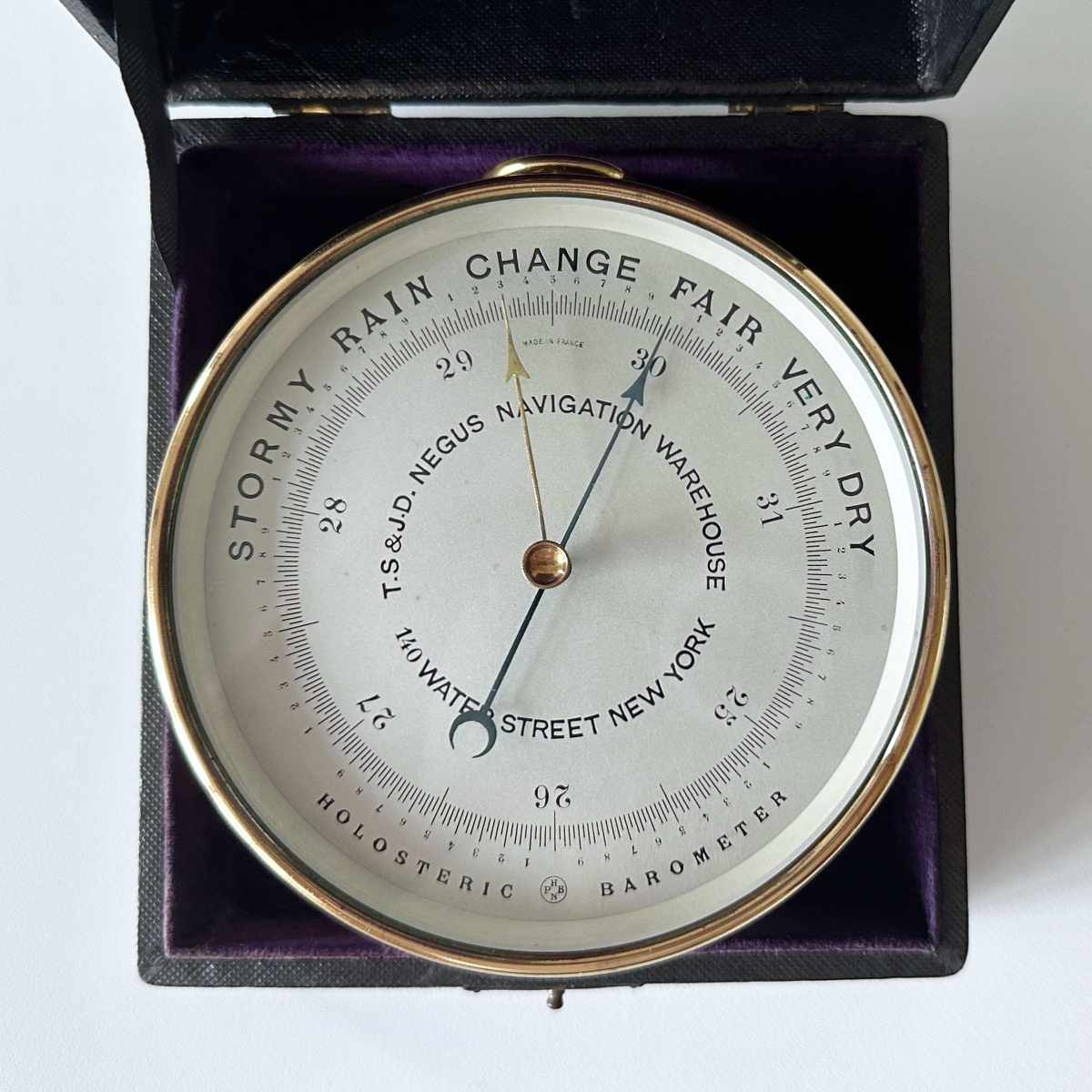
Comprised of a five-inch silvered dial divided with a 360-degree scale measuring 25 to 31 inches of barometric pressure and with weather indications engraved to the upper half. The lower half is engraved with the words Holosteric Barometer with manufacturer’s logo for the prolific French barometer making firm of Pertuis, Naudet, Hulot & Bourgeois (PNHB).
The retailer’s name is engraved in a circular design to match the scale stating the famous US marine instrument making firm of, TS & JD Negus, Navigation Warehouse, 140 Water Street, New York. It is completed with blue steel pointer and brass set hand operated through the glass by means of a brass knurled adjusting knob.
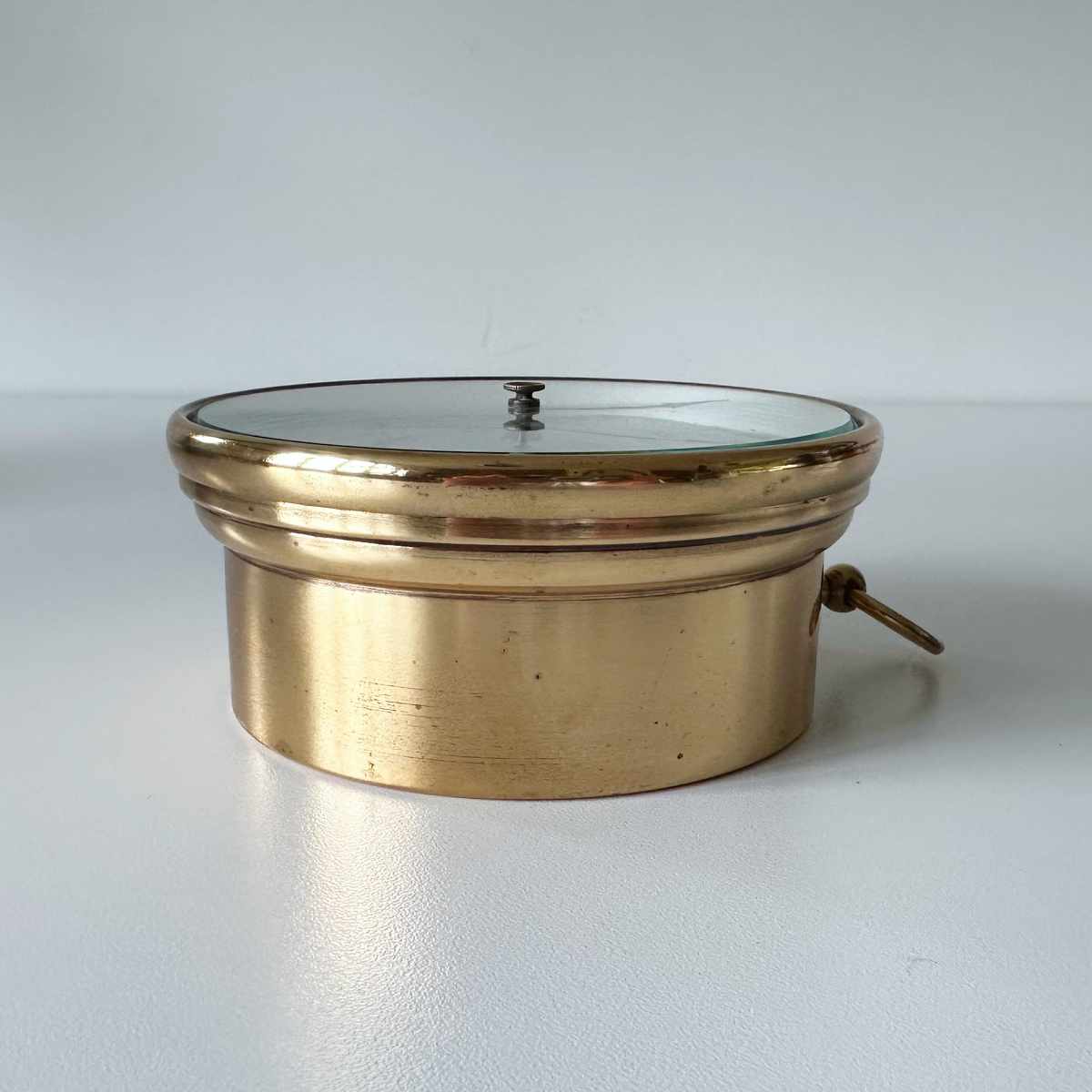
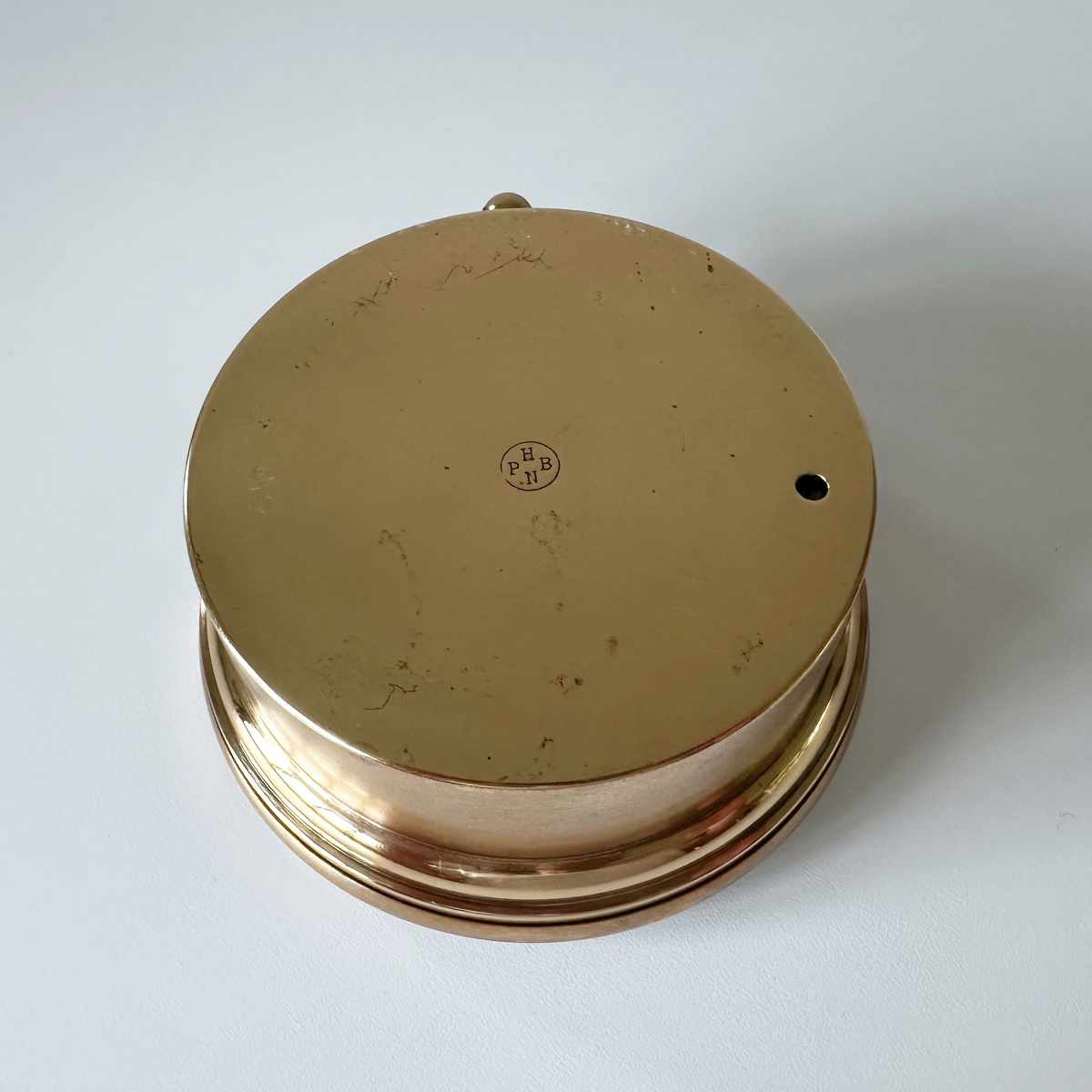
The dial and movement are contained behind a brass spun bezel with graduated brass case stamped to PHNB to the reverse and with integrated hanging ring to the top.
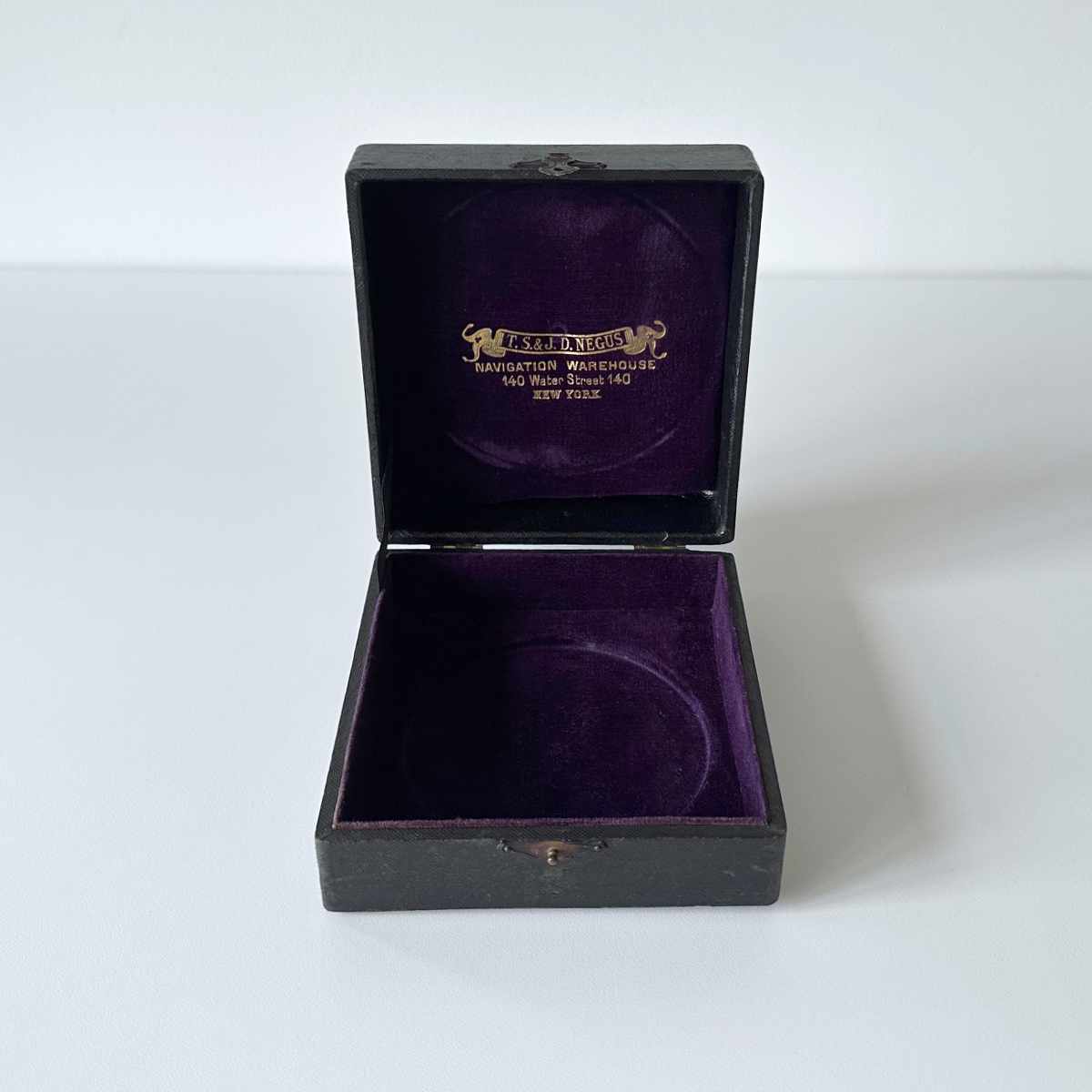
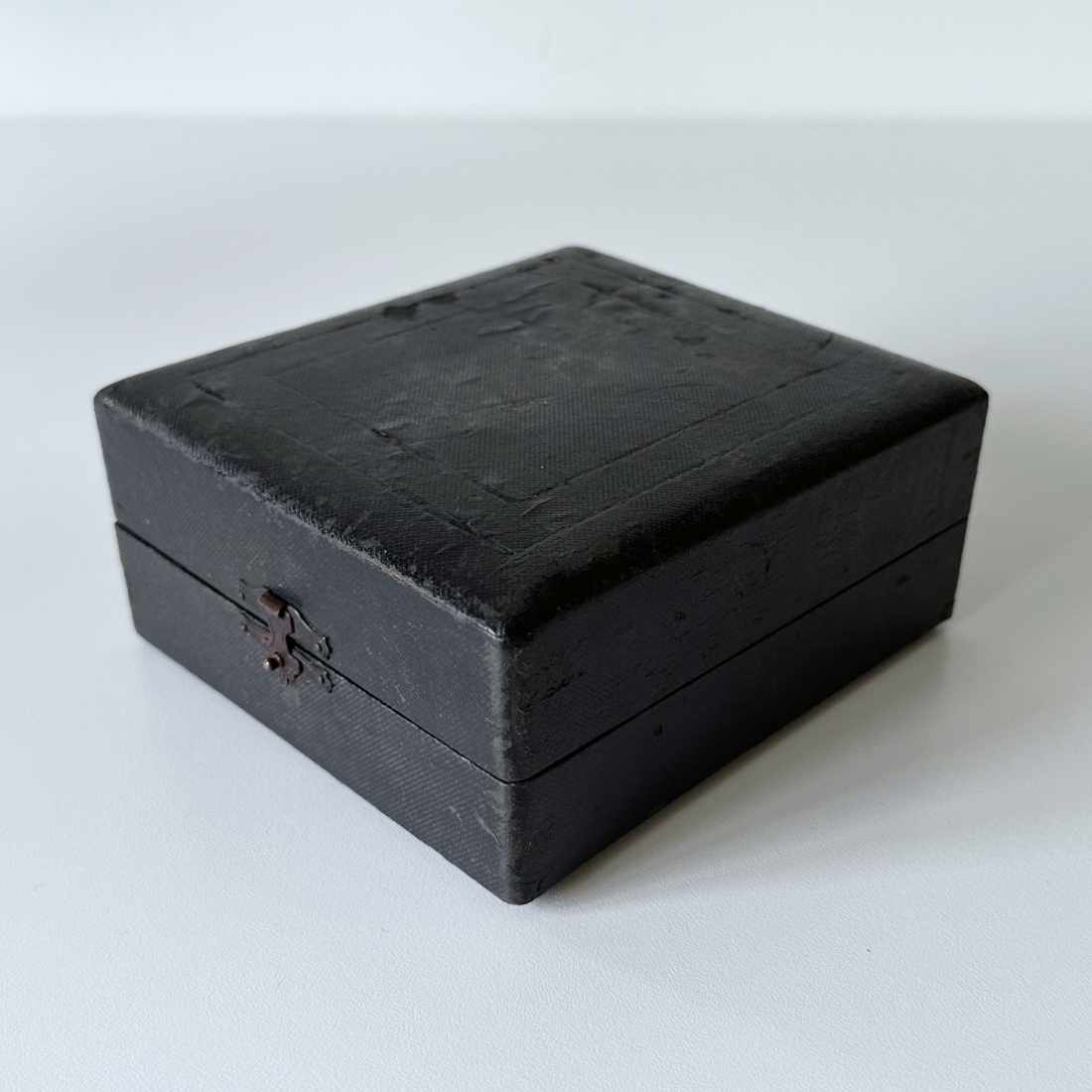
The outer case is covered in leather throughout, with a lovely fitted purple velvet interior which retains the gilt embossed lettering to the inner lid stating the retailers name and address. It is extraordinarily rare to find these barometers with their original cases and even rarer to find a PNHB barometer dedicated to a US firm.
A very interesting example which represents how closely European and US trade links had developed during the Nineteenth Century largely I suspect through the various groundbreaking Trade Exhibitions which began in 1850.
The brothers Thomas Stanford & John Davidson Negus were born in the early 1830’s to British immigrant parents. Their Father Thomas was obviously a man of means since both brothers were educated in England with the elder brother Thomas returning to New York ahead of John in 1848.
Little is known of the boys’ educations, but it is likely that they undertook London apprenticeships since Thomas immediately opened a workshop in Wall Street, where he manufactured and sold marine chronometers. It is suggested that Negus initially used European chronometer movements within his instruments suggesting that business contacts were already established prior to his return.
John Davidson Negus also returned from England in 1853 and joined his brother in partnership. The company was renamed, TS & JD Negus and moved to 140 Water Street which was named, “the Navigation Warehouse”. The title is an interesting one since a Navigation Warehouse and Naval Academy also existed in Leadenhall Street in London at the time and was home to makers such as the Gilberts and to Norie & Wilson. I have been unable to prove a definitive link, but it is likely that the brothers would have been familiar with this establishment during their time in the UK.
The company became the most renowned US maker of chronometers during its long history, at one point becoming the sole supplier to the US Navy. Their instruments are also noted to have been used for various Polar expeditions however their catalogues of the period bear testament to the wide range of other instruments that could be purchased at The Navigation Warehouse.
Both Negus brothers died in the early 1890’s with John Stewart Negus (son of John Davidson) taking over the running of the organisation. His son, John Clement Negus joined the company in 1931 and it moved premises to 69 Pearl Street. Both Father and Son had died by 1961, and John Stewart Negus II took over the company until his untimely death in 1963 ending over one hundred years of continuous family trade.
In their heyday, the original brother partnership obviously maintained healthy trade links with European instrument makers since this barometer is marked to the manufacturer Pertuis, Naudet, Hulot & Bourgeois (PNHB) who were prolific makers of these Vidi style barometers during the latter half of the Nineteenth Century. Many English instrument makers are also known to have branded and resold PNHB barometers as part of their stock offerings.
Surprisingly little has been written about the Parisian manufacturer, Pertuis, Naudet, Hulot & Bourgeois (PNHB). The company was formed in 1860 by the above-named partners, and they quickly rose to become one of the largest manufacturers and exporters of aneroid barometers in the world. Their early export success may be related to their exhibiting at the 1862 London Exhibition where they are listed under Volume 3 – The Colonial & Foreign Division and it is likely that the company garnered numerous business relationships as a result.
Interestingly, the company was listed at the exhibition as Naudet & Co (Cie in French), so it is also likely that the initial partnership was broken up in some way within two years, leading to the convenient (for Naudet at least) belief that the PNHB makers stamp really stood for “Paul Naudet Holosteric Barometre”. However, there are several confusing factors that suggest that not all partners left the concern. In 1867, “Naudet, Hulot & Cie” are referenced in the “Bulletin de la Societe D’Engouragement pour L’Industrie Nationale” after receiving a medal for their enhancements to Monsieur Vidi’s design (whose barometer patent had fallen into the public domain in 1859) through their “Holosteric Barometers”.
The company’s 1891 catalogue continued to reference this award, printing the Society’s report in full but at this stage, the catalogue states the business name as, “Naudet & Cie” but with the line below stating “Pertuis & Fils” in larger text proving that Pertuis also continued to have a stake in this highly successful enterprise.
We can only surmise at this stage, but it would suggest that Hulot and Pertuis maintained some kind of relationship with Naudet until the end of the Nineteenth Century and Bourgeois was the only partner to have left the company in its the early period. It is certain however that further research is required to untangle this complicated partnership arrangement.
Survival of the company through the Franco Prussian war and the First World War is evidenced through the existence of their catalogues but in 1928 it seems that the company had moved out of the original owner’s hands and had been bought out by a company named Dourde. Like many English scientific instrument makers, the new owners had sought to maintain the goodwill and customer base built up by Naudet and their catalogue’s front page is dual named to “Maison Naudet” and “Dourde successeur”.
Unlike many of its kind, Naudet (or Naudet Dourde) still exists and continues to make new barometers today even winning the “Enterprise du Patrimoine Vivant” award in 2016. They primarily trade under the Naudet name, so much so that the Dourde name is not incorporated into their branding on their website or on their instruments. A testament to the strength of reputation that this company created in the Nineteenth Century.
Circa 1880